The password was fourteen years old. The panic was fresh.
A data breach from 2012 is still working in 2026. The first theft took the account. The second theft is sold as the rescue.
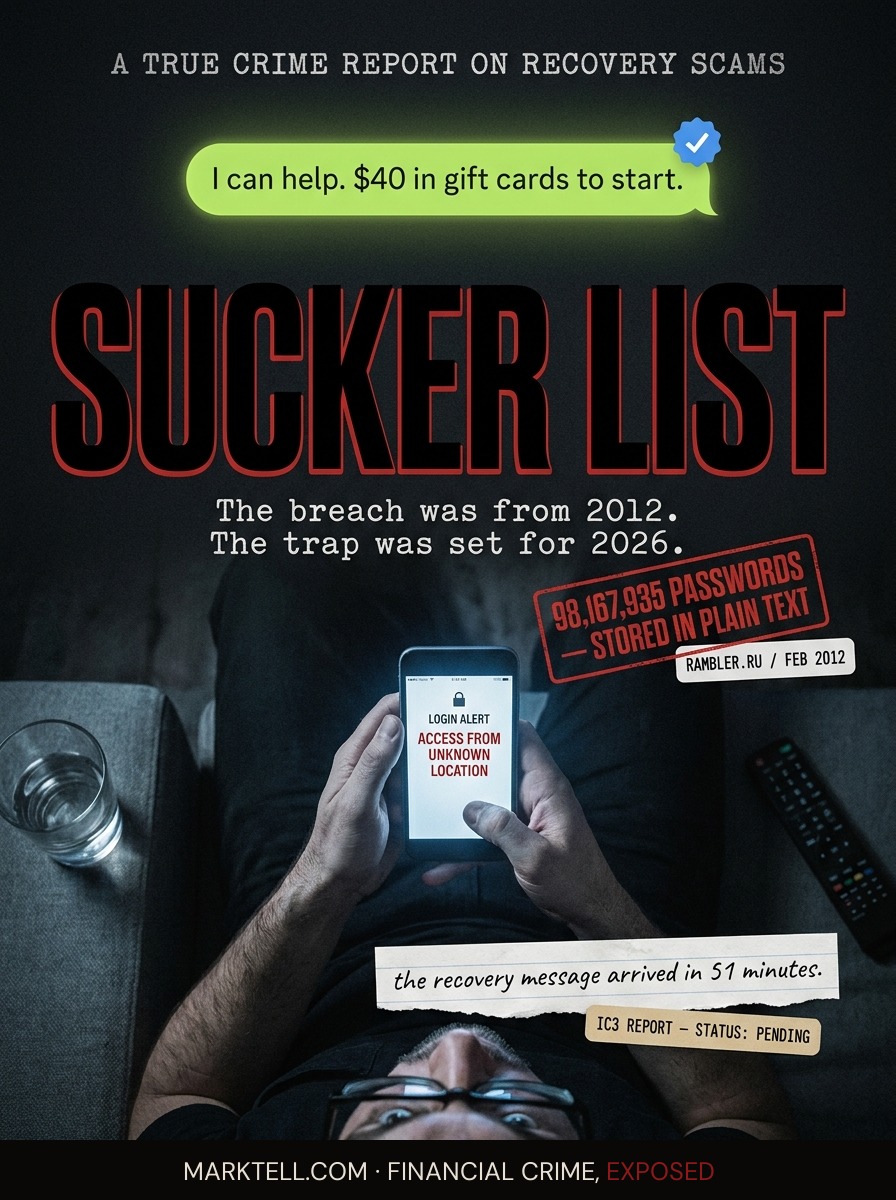
Marcus was forty minutes into a movie when his phone buzzed twice on the arm of the couch. The first buzz was a login alert from Steam. The second was the same alert again, from a different city.
He sat up. He opened the app. His library was empty.
Eleven years of saved games. Skins he had paid real money for. A profile he had built since he was a sophomore at USF. Gone in the time it took him to refill a glass of water.
He was thirty-eight years old. He worked IT contracts for hospital systems in Tampa. He knew, professionally, what a credential stuffing attack looked like. He knew, professionally, that you change your passwords and you set up two-factor authentication and you do not click links in panic.
He was still in panic forty minutes later when the Discord message came in.
The sender had a clean profile. A blue checkmark icon that was not actually a Discord verification but looked enough like one in a small thumbnail. A username that included the word "recovery." A bio that said he worked with Steam support contractors and could help with account takeovers if you got to him fast.
He had gotten to Marcus fast. That was the part Marcus did not stop to think about. The message came in fifty-one minutes after the takeover. Before Marcus had even told anyone.
He typed back. He explained what happened. The stranger asked for his email address to "check the breach status."
Marcus gave it.
The email was a Rambler.ru address. He had set it up in 2011 when a Russian friend in his dorm had recommended it as a backup. He had used it to register a handful of old gaming accounts. He had not logged into the email itself in years.
The stranger came back within a minute. "You're in the dump. 2012. Your password is still active on three platforms. I can lock it down for you. Forty dollars in Steam gift cards to start. I have to buy the recovery token."
Marcus bought the gift cards.
This is the room. Build it carefully because the room is the point.
I.
In February of 2012, Rambler.ru was breached. The Russian web portal, one of the largest in the country, had stored its user passwords in plain text. Not hashed. Not salted. Typed out like notes on a refrigerator.
The breach exposed 98,167,935 accounts. Usernames. Email addresses. Passwords. ICQ numbers attached to the older ones. The company acknowledged a smaller leak in March of 2014, around four million records, and forced password resets. The full scope of the 2012 dump did not become public until September of 2016.
By then the data had been moving through criminal markets for four years.
A password from 2012 should not still work in 2026. But people reuse passwords. People build their digital lives on top of an email they set up in college and then forget about. The accounts attached to that email accumulate. The gaming logins. The forum accounts. The cloud storage. The crypto exchange they signed up for in 2019 and never closed.
The 2012 dump is not a relic. It is a key ring. Every name on it opens something somewhere, fourteen years later, because the lock was never changed.
That is the first hit.
II.
The second hit is the one Bitdefender's threat researchers have been documenting through the spring of 2026. It is the part that turns a credential theft into a sustained business.
The pattern works like this.
The attacker uses the old credentials to compromise an account. Usually a gaming account, because gaming accounts have transferable value and panicked owners. Steam. Riot. Old MMOs with markets for skins and gear.
The owner notices within hours.
Within those same hours, a stranger arrives. On Discord. On Telegram. Sometimes through a comment on a Reddit post the victim made looking for help. The stranger presents as a recovery specialist. He has the badges. He has the language. He has, critically, the specific details about the breach the victim is still trying to understand.
He asks for a small fee to start. Forty dollars. Eighty. Paid in gift cards or a small crypto transfer. The amount is calibrated to be smaller than the value of what the victim just lost.
The victim pays.
Then there is a verification fee. Then a transfer fee. Then a "platform release" fee. The asks escalate in proportion to how much the victim has already committed. This is the sunk-cost trap, run as a script.
At some point in the sequence, the recovery specialist asks for the victim's login credentials. To "complete the handoff." The victim, who has already paid hundreds, gives them.
The account is briefly returned. The victim sees their library, their items, their saved data. They thank the specialist. They leave a positive note in the Discord server.
Six months later, the account is taken again. A recovery email the victim does not remember setting was buried in the account settings during the handoff. The operator simply uses it.
The same account, monetized twice.
III.
Bitdefender's researchers describe this as a recovery scam, which is the polite term. FINRA, in guidance issued in May of 2024, called it what the financial fraud world has called it for decades: a sucker list operation.
The phrase is old. It comes from the analog era of telephone fraud. A sucker list is a list of people who have already been defrauded once. They are worth more than ordinary leads, because they have proven they will engage. The list is sold between criminal operations. The second operation calls offering help.
The Rambler.ru dump is a sucker list at industrial scale. Ninety-eight million names of people whose credentials were taken without their consent. Some of those names belong to people who reused passwords. Some belong to people who used the email as a backup for accounts they care about now. Some belong to people who are dead, and whose accounts are being hijacked anyway because the email still receives recovery messages.
The first wave compromises the account. The second wave sells the recovery. The same data set powers both.
That is the machine. It runs on a fourteen-year-old breach because the breach was never closed. Plain text passwords do not stop being plain text. They sit in someone's drive. They get traded. They get sold. They get used.
IV.
Marcus got his account back the night of the takeover. The recovery specialist sent him a screenshot of his Steam library, restored. Marcus thanked him. He paid the final fee. He went to bed at 3:40 AM with the relief of a man who had just survived something.
What he did not see, because the operator had cleared it from the visible settings, was a recovery email address attached to his Steam account that he had not added.
He noticed in November.
A new login alert. A new empty library. The same Discord account that had helped him in May was gone. Deleted. The username re-registered by someone else, with a different avatar.
He filed a report with Steam. They told him they could see the unauthorized access. They could not tell him who.
He filed a report with the FBI's IC3 portal. He received a confirmation number. He has not heard back.
He stopped using the Rambler.ru email. He changed his passwords everywhere. He set up a hardware key. He did all the things he tells the hospital staff to do, in the trainings he gives for a living.
The forty dollars in gift cards is not the loss. The Steam library is not really the loss either, though he misses it. The loss is the hour on a Tuesday night in May when a stranger arrived inside his panic and Marcus believed, for a few minutes, that someone was on his side.
V.
If you have been compromised, the recovery offer that arrives within hours is not a coincidence. It is the second half of the same transaction.
The actor who took the account knows the account was taken. The actor who offers to recover the account knows the same thing, at the same time, with the same level of detail. In a meaningful number of cases documented by Bitdefender and others, those two actors are coordinated. Sometimes they are the same person.
Real recovery does not arrive in your DMs. It does not ask for gift cards. It does not have a Discord badge that looks almost like the real one. It does not need your password to give you back your account.
The platforms you actually have accounts with have support channels. Those channels are slow. They are frustrating. They will not solve your problem in an hour. That is the feature. The speed of the recovery scammer is the tell.
The 2012 breach is still working in 2026 because the people who hold the data have figured out how to monetize it twice. The takeover is the first sale. The recovery is the second. Both are paid by the same person.
Marcus's Steam account is gone again. The Rambler.ru email is closed. The forty dollars is gone. The thing the operator actually took from him, the thing Marcus is still working on getting back, is the reflex to trust the next person who messages him during a crisis.
He was the customer twice. He did not know it the first time.
- Bitdefender | 2026 | "'I found your hacked account': inside the Rambler.ru recovery scam"
- Bitdefender | March 17, 2026 | Explainer on recovery scams (fund recovery, refund scams, asset recovery scams)
- Bitdefender | March 6, 2026 | Scam alert on fake subscription renewal messages
- LeakedSource / public disclosure | September 2016 | Rambler.ru 2012 breach disclosure, 98,167,935 accounts, plaintext passwords
- Rambler.ru company statement | March 2014 | Acknowledgment of approximately 4 million account leak, forced password resets
- FINRA | May 20, 2024 | Investor guidance on fraudulent recovery offers and sucker lists
- American Riviera Bank | February 5, 2024 | Consumer guide on recovery scam recognition
- Visa Spring 2026 Biannual Threats Report | May 22, 2026 | Scam activity, AI-enabled impersonation and social engineering
- FTC | 2022 data | Consumer internet fraud losses of $8.8 billion
- FBI IC3 | 2019-2021 | Business email compromise loss increase of 65 percent
Editorial Notice
MarkTell is a true crime publication about financial fraud. Some scenes, dialogue, and sequential details are reconstructed from court filings, enforcement actions, news reports, and public records. Where the public record does not provide exact details, editorial reconstruction is used to convey the documented pattern of events. Names of private individuals may be changed to protect identity. All factual claims are sourced to public documents cited in the Evidence Trail above. MarkTell does not provide investment, legal, or financial advice. Nothing published here constitutes a recommendation to buy, sell, or avoid any investment. Allegations described in active cases have not been adjudicated and defendants are presumed innocent until proven guilty. Readers should conduct their own due diligence before making financial decisions.