The package weighed four pounds. Inside was everything she had left.
Eleven defendants have pleaded guilty in a $65 million elder fraud and money laundering operation that used call centers in India, money mules in Flushing, and a nationwide grid of short-term rentals to launder cash mailed by more than 2,000 elderly Americans. This is what the machine looked like from the kitchen table.
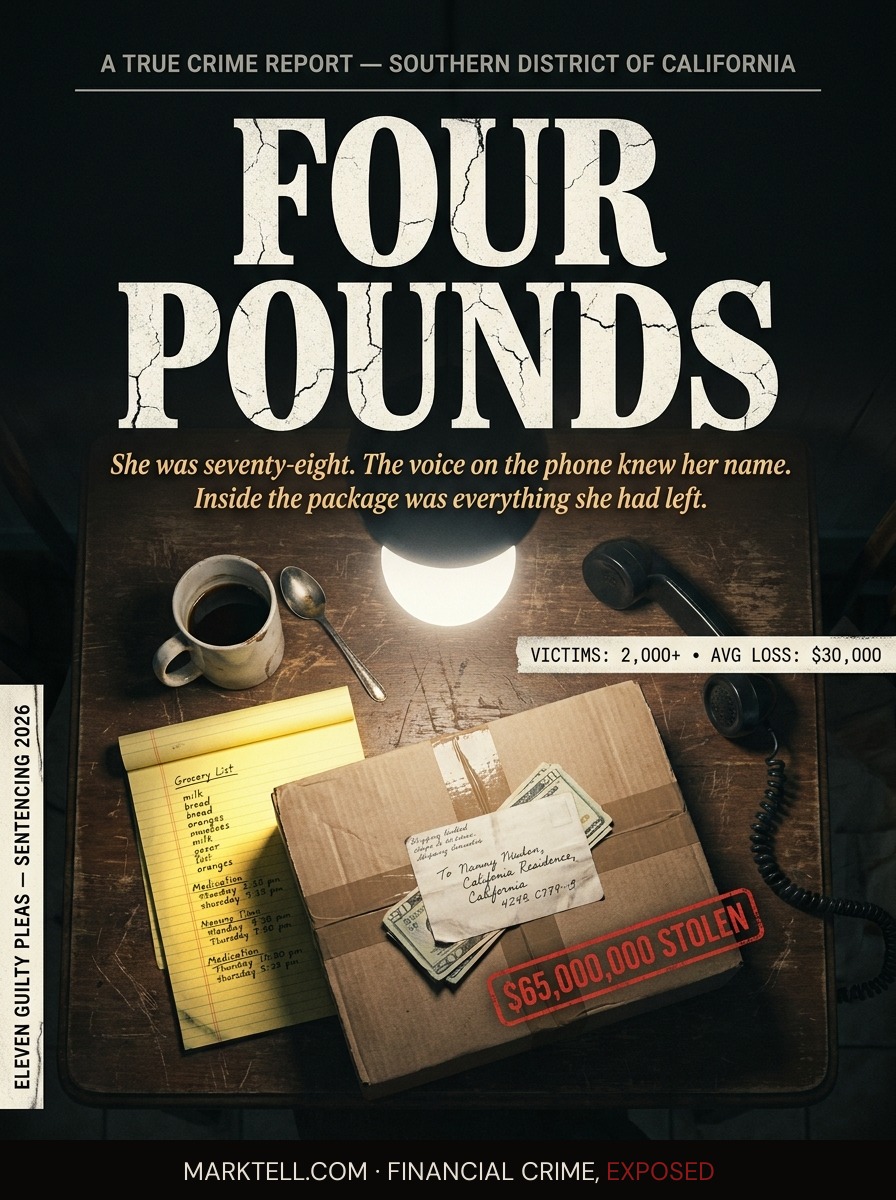
Ruth was seventy-eight the day the phone rang. She was at her kitchen table with a mug of coffee that had gone lukewarm and a legal pad she used for grocery lists and the medication schedule and the birthdays of her grandchildren. She still wrote checks by hand. She still balanced her checkbook against the paper statement the bank mailed her every month, because that was how her husband had done it and he had not been wrong about much.
The man on the phone said he was from the fraud department at her bank. He knew the last four digits of her account. He said someone in another state had tried to withdraw money that morning and the bank had frozen the account to protect her. He was very calm. He called her ma'am. He said he was going to walk her through the steps to keep her savings safe.
That is where the machine started.
Picture it. A woman at a kitchen table, a phone against her ear, a legal pad in front of her. She is not stupid. She raised three children on a librarian's salary. She has read more books than most people will see in a lifetime. What she has not done, in seventy-eight years, is receive a phone call from a stranger who was lying to her with the confidence of a man who had done this five hundred times before.
I. THE CALL
According to the U.S. Attorney's Office for the Southern District of California, a criminal network operating from at least 2019 through 2023 defrauded elderly Americans of approximately $65 million. The calls came from scam centers based in India. The men on the phone read from scripts. They said they were from the Federal Reserve. They said they were from the IRS. They said they were from Social Security or from the fraud department at the victim's bank. They asked to install a small program on the victim's computer so they could show them what was happening. The program was a remote access tool. Once it was on the machine, they could see everything.
They did not ask for the money right away. That was the discipline of the script. They built the fear first. They showed the victim, on her own screen, evidence that her account was being drained by criminals in another country. They said the only way to save the money was to convert it to cash and move it to a secure federal location. They said the bank could not be trusted. They said her family could not be trusted. They said if she told anyone, the criminals would get her.
Ruth withdrew the money in three trips. She told the teller she was helping her son buy a car. The teller asked if she was sure. She said she was sure. The man on the phone had told her exactly what to say.
II. THE PACKAGE
The DOJ record describes the next step in almost clinical terms. Victims were coerced into withdrawing bulk cash, concealing it in packages, and sending it via express mail to addresses supplied by the fraudsters. The packages went to short-term rentals. The rentals were booked with fake IDs on a rotating basis. When one address was used, the network moved to the next.
Ruth wrapped her cash in a stack of old National Geographics. She taped the box shut with the brown packing tape from the drawer where she kept the birthday candles. She wrote the address the man had dictated. She drove to a shipping store. She paid for overnight delivery. The clerk asked her what was in the box. She said books.
The package weighed four pounds. Inside was thirty thousand dollars in twenties and fifties.
The average loss per victim in this scheme, according to prosecutors, was nearly thirty thousand dollars. Read that number slowly. It is not the number that makes the case famous. It is the number that made the case possible. Thirty thousand dollars is the amount an elderly widow can be talked into withdrawing without triggering the branch manager's second look. Thirty thousand dollars is what the machine ate, over and over, more than two thousand times.
III. THE HUB
The packages arrived at rental houses in Southern California, Texas, Michigan, and New York. No one lived there. Couriers arrived with fake IDs, signed for the boxes, and drove them to consolidation points. From there the cash moved to Flushing, New York, where the U.S. Attorney's Office says Hua Wang, forty-eight, coordinated the flow.
Wang pleaded guilty in the Southern District of California to conspiracy to commit wire and mail fraud and to money laundering. He admitted responsibility for more than 2,000 cash packages sent by elderly victims. He admitted the total losses came to sixty-four million dollars. He was arrested in April 2025, shortly after co-defendant Weining Su, who also went by "Ning Ma," was caught trying to flee to China.
Ten other defendants have pleaded guilty alongside him. Xiao Lei Xu. Wen Chang Wang, who used the name "Cookies." Jiawen Cai, who used the name "Johnny Cai." Zhuhan Yin. Wenzhi Chen. Yuhui Sun. Jiaxin Jiang. Bing Shen. Chongchong Li. Many are Chinese nationals. A nationwide takedown in August 2025 brought further arrests. More than thirty defendants have been charged in related indictments. Sentencing hearings for the pleaded defendants are scheduled through July and September 2026.
This is the hub. The spokes were the rentals. The fuel was Ruth's cash.
IV. THE ROOM RUTH WAS IN
The men on the phone kept calling. That was part of the design. Once a victim was in, they stayed in. New reasons emerged. The federal safe deposit account required a processing fee. The tax on the recovered funds had to be prepaid. The Treasury Department needed one more package to complete the transfer.
Ruth sent three packages before her daughter came for Sunday dinner and noticed the checkbook.
The daughter asked what the withdrawals were for. Ruth started to answer. Then she stopped. Then she went into the bathroom and did not come out for a long time.
That part may be the hardest to write. Not the withdrawal. Not the package. The bathroom.
Elderly Americans lost approximately $4.9 billion to fraud in 2024, according to the FBI. A FinCEN analysis found more than $27 billion in suspicious activity linked to elder exploitation between June 2022 and June 2023. Most victims never report. Shame is the second theft. The machine counts on it.
V. HOW IT BECAME VISIBLE
The investigation began, prosecutors say, in December 2020, when one elderly victim reported that she had been defrauded into mailing cash. One report. One woman who told someone. From that seed the case grew for four and a half years before the first major arrests.
Along the way, an unusual set of contributors helped. YouTubers who ran channels called Scammer Payback and Trilogy Media documented interactions with scam call centers, followed money mules, and confronted couriers on camera. The U.S. Attorney's Office and the FBI acknowledged their work. In a case where the perpetrators were on one continent and the victims on another, the people who filmed the middle mattered.
But the case did not turn on YouTube. It turned on the boring work of federal enforcement. Bank records. Rental bookings. Package tracking numbers. The paper trail that the machine created every time it swallowed a box.
VI. THE THING RUTH LOST
Ruth got the money back only in the way that cases like this ever return money, which is to say partially, and slowly, and after paperwork that no seventy-eight-year-old should have to complete. Restitution in elder fraud cases rarely makes the victim whole. The cash has been moved through too many hands, across too many borders, into accounts that empty faster than they can be frozen.
What Ruth actually lost was not on the ledger. She lost the phone. She does not answer it anymore. Her daughter changed the ringer to a sound Ruth would recognize, and even that does not always work. She lost the confidence that had let her balance a checkbook for fifty-one years. She lost the belief that the person on the other end of a call was, at minimum, a person with no reason to hurt her.
That is what the ninety-seven-year-old widow of a Holocaust survivor lost, too, when she sent her life savings to a rental house in Southern California. Prosecutors have named her among the victims of this specific network. She survived what her husband survived. She did not survive the phone.
VII. WHAT THE MACHINE WILL BE CALLED NEXT
Eleven guilty pleas do not end this. The call centers in India are still on their scripts. The rentals are still being booked with fake IDs. The packages are still moving. When one network is broken, the operators who ran it or trained under it start another one under a new name, with a new set of addresses, and the same script, because the script works.
The machine is not Hua Wang. Hua Wang was a valve. The machine is the pipeline from a scripted call in one country to a kitchen table in another to a rental house in a third state to a hub in a fourth. That pipeline is still running. It will run tomorrow. It will run next week.
Ruth is not sure she will pick up if her daughter calls. She has told her daughter to text first. The phone sits on the kitchen table where the checkbook used to be. The coffee cup is in the sink. The legal pad is in a drawer.
The man on the phone said he was calling to keep her money safe.
He just was not using the word the way Ruth understood it.
- U.S. Attorney's Office, Southern District of California | June 30, 2026 | Press release: 11 plead guilty in $65 million elder fraud and money laundering scheme
- Courthouse News Service | June 30, 2026 | Reporting on guilty pleas
- U.S. Department of Justice | April 2025 and August 2025 | Announcements of arrests and nationwide takedown
- FBI Internet Crime Complaint Center | 2024 Elder Fraud Report | Losses to Americans 60+ totaling approximately $4.9 billion
- FinCEN | Financial Trend Analysis on Elder Financial Exploitation | June 2022 to June 2023, $27 billion in suspicious activity
- Nasdaq Global Financial Crime Report | 2024 | Elder financial abuse and $77.7 billion figure
- Public reporting on Scammer Payback (Pierogi) and Trilogy Media contributions to investigation
Editorial Notice
MarkTell is a true crime publication about financial fraud. Some scenes, dialogue, and sequential details are reconstructed from court filings, enforcement actions, news reports, and public records. Where the public record does not provide exact details, editorial reconstruction is used to convey the documented pattern of events. Names of private individuals may be changed to protect identity. All factual claims are sourced to public documents cited in the Evidence Trail above. MarkTell does not provide investment, legal, or financial advice. Nothing published here constitutes a recommendation to buy, sell, or avoid any investment. Allegations described in active cases have not been adjudicated and defendants are presumed innocent until proven guilty. Readers should conduct their own due diligence before making financial decisions.