The only person with the key took $1.78 million from the people she was hired to feed
Star Rana Jackson ran the American Indian Center of Arkansas for over a decade before she became its executive director. She also became, by design or by drift, the only person who could touch the federal money. Then the money started moving.
Marlene checked her bank app on a Friday in the spring of 2025 because the direct deposit had not come through by lunch.
She was fifty-eight. She had been a caseworker at the American Indian Center of Arkansas for nine years. She ran substance abuse intake out of a small room with a clipboard and a laptop the office shared between two people. She had a son in Tulsa and a granddaughter who liked to FaceTime her from the back of a school bus.
The deposit was not late. It was not coming.
She refreshed the app. She called the front desk. The front desk said they were looking into it. The front desk had been looking into a lot of things that week. The phones in the back office had a different sound now. Quieter. The kind of quiet that means people are on the phone with lawyers instead of clients.
By Monday, Marlene's health insurance card would not work at the pharmacy. By the end of the month, she would not have a job. By summer, the substance abuse counseling program she ran would not exist.
She did not know yet that one person had the only key.
II. The single-key safe.
The American Indian Center of Arkansas is a nonprofit that serves indigenous people and others in need across the state. It runs on federal grants. Department of Labor. Department of Education. Health and Human Services. The money does not arrive in a bag. It arrives through a system called the federal payment management system, which is exactly what it sounds like. A login. A password. A withdrawal screen.
At AICA, according to the federal prosecutors who eventually charged her, exactly one person had access to that system.
Her name was Star Rana Jackson. She was fifty years old, lived in Austin, Arkansas, and had worked at AICA for more than a decade before she was appointed Executive Director in October 2022. The people who knew her knew her as the person who had been there forever. The institutional memory. The one who knew how the grants worked.
That last part turned out to be exactly correct.
For the next two and a half years, Jackson was the only person who could pull federal money out of the AICA accounts. There was no second signature. There was no co-signer on the wire. There was no auditor sitting next to her at the screen. The grant came in. She moved it. Nobody else watched.
A nonprofit with one set of keys is not a nonprofit. It is a single-key safe with a logo on it.
III. What the keys opened.
The court record lays the withdrawals out cleanly.
On June 24, 2024, $30,000 came out of a Department of Education grant. Three days later, on June 27, $40,000 came out of a Health and Human Services grant. Around July 1, another $15,000 from the Department of Education. Those are the numbers the U.S. Attorney's Office for the Eastern District of Arkansas chose to highlight. They are not the whole story. The investigation found roughly 180 unauthorized deposits from AICA accounts, including transfers into a dormant AICA account that Jackson, the prosecutors said, still had access to. A dead account she could still log into. A heartbeat she controlled.
The money did not go to a Cayman trust. It did not go to a shell company in Belize. It went to a truck. Fifty-five thousand dollars down on a truck. Forty-four thousand dollars for a boat. A year of rent paid up front. Shopping. Food. The mundane geometry of a person who has decided the safe is hers.
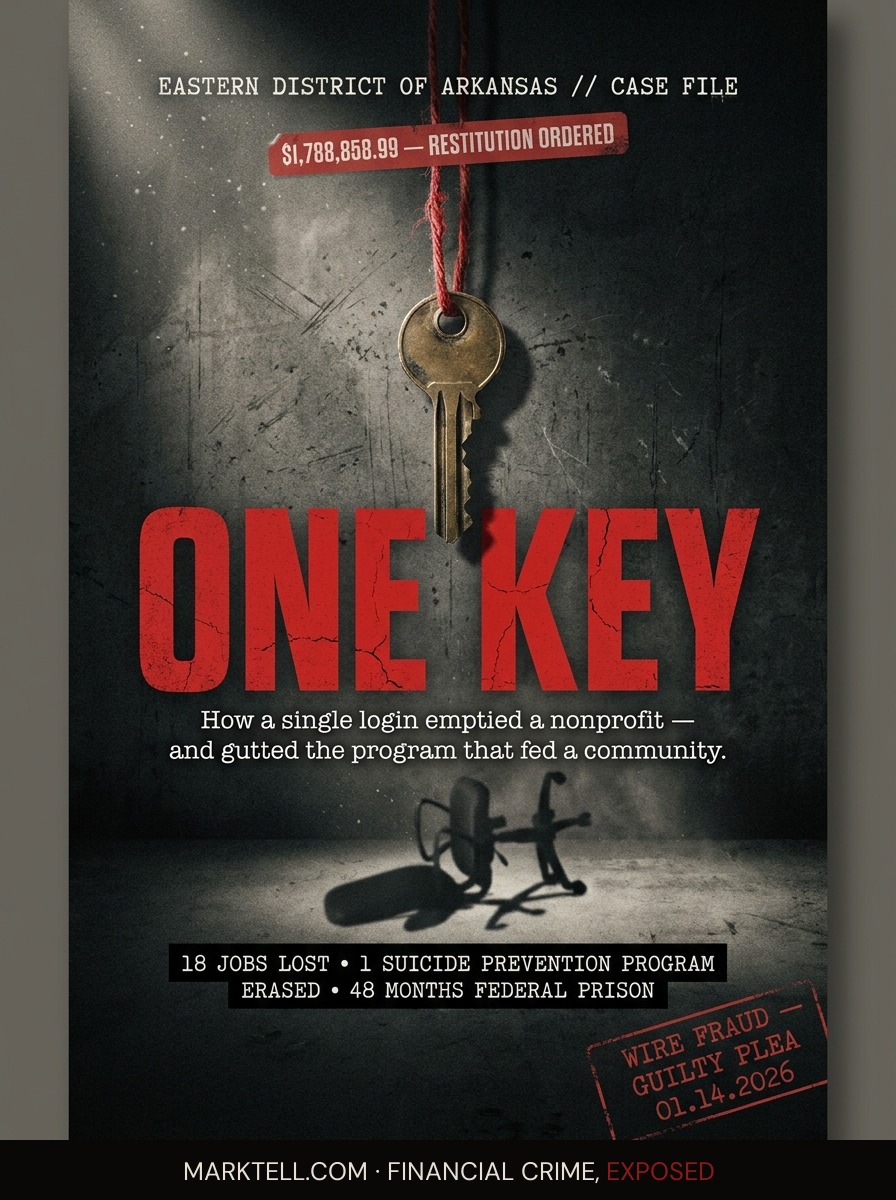
Total taken, as ordered in restitution by U.S. District Judge D.P. Marshall Jr.: $1,788,858.99.
Read that number slowly. Almost one million eight hundred thousand dollars. From a nonprofit that served low-income Native Americans in Arkansas. The math of it is the kind of thing you have to sit with.
That is what was in the safe. That is what the single key opened.
IV. What the safe was supposed to feed.
The grants were not abstract. They paid people. They paid Marlene. They paid the seventeen others who lost their jobs when the money ran out. They funded a substance abuse counseling program. They funded a suicide prevention program for low-income Native Americans, a population that the federal government's own data has been warning about for years.
The current executive director, Corinna Ortiz, told the court at sentencing that recovery would take years. She had hoped for more prison time. She said it plainly. She had watched eighteen people lose their jobs. She had watched 401(k) contributions disappear. She had watched paychecks come up short. She had watched federal funders pull back after the theft became public, which is the second wound. The theft takes the money. The publicity of the theft takes the future money.
That is the part the restitution order does not cover. The grants that will never come now. The clients who walked into an empty intake room and walked back out.
V. The Friday before the Friday.
Marlene's missed paycheck had a date. She would remember it later. She would think about all the Fridays before it when the deposit came in and she did not think about where it came from.
The federal payment management system has a login screen. Somewhere in Austin, Arkansas, in early 2023, a person sat down at a computer and typed in a username and a password that nobody else had. She did it again the next month. And the next. For more than two years.
The FBI investigated. The U.S. Attorney's Office for the Eastern District of Arkansas prosecuted. Jackson pleaded guilty to one count of wire fraud on January 14, 2026. On June 3, 2026, Judge Marshall sentenced her to forty-eight months in federal prison, three years of supervised release, and restitution of $1,788,858.99.
Four years. Almost one million eight hundred thousand dollars. Eighteen jobs. A suicide prevention program in a state that needs every one of them.
The numbers will be on a court docket forever now.
VI. The machine, and what it looked like.
Strip the names off this and you have a machine. A small, common, devastating machine. It runs in church finance offices. It runs in school PTAs. It runs in volunteer fire departments. It runs in nonprofits that serve the populations least able to absorb the loss.
The machine has one moving part.
One person with sole access to the money.
That is the entire machine. There is no sophisticated scheme. There is no offshore lawyer. There is no crypto wallet. There is just a login screen with one set of credentials and a board that did not ask the question.
The question is not exciting. It is not the television question. It is the ugly question.
Who else has the password.
If the answer is nobody, the answer is the machine.
VII. After.
Marlene, the composite, is back at work somewhere else now. A school district. A clinic. The granddaughter still FaceTimes from the school bus. The substance abuse intake room at AICA is being rebuilt by a new team with a new director and a new set of grants and, this time, presumably, more than one set of keys.
Star Rana Jackson reports to federal prison.
The eighteen people who lost their jobs will not get the two years back. The clients who needed counseling in 2024 and 2025 will not get the counseling back. The trust the federal funders had in AICA will not come back quickly. Restitution will be paid down over years, in amounts that will look small next to the amounts that were taken.
Marlene did not know there was a single-key safe.
She thought there was a nonprofit.
- THV11 | June 4-5, 2026 | "Arkansas woman sentenced in connection to theft of more than $1.7M from non-profit organization"
- U.S. Attorney's Office, Eastern District of Arkansas | June 3, 2026 | Sentencing announcement, U.S. v. Star Rana Jackson
- U.S. District Court, Eastern District of Arkansas | January 14, 2026 | Guilty plea, one count wire fraud
- U.S. District Court, Eastern District of Arkansas | June 3, 2026 | Sentencing order, Judge D.P. Marshall Jr., restitution $1,788,858.99
- FBI | Investigation of record
- American Indian Center of Arkansas | Public statements of current Executive Director Corinna Ortiz at sentencing
Editorial Notice
MarkTell is a true crime publication about financial fraud. Some scenes, dialogue, and sequential details are reconstructed from court filings, enforcement actions, news reports, and public records. Where the public record does not provide exact details, editorial reconstruction is used to convey the documented pattern of events. Names of private individuals may be changed to protect identity. All factual claims are sourced to public documents cited in the Evidence Trail above. MarkTell does not provide investment, legal, or financial advice. Nothing published here constitutes a recommendation to buy, sell, or avoid any investment. Allegations described in active cases have not been adjudicated and defendants are presumed innocent until proven guilty. Readers should conduct their own due diligence before making financial decisions.