The offering plate had a bank account behind it, and the account was his
A federal indictment unsealed this month alleges Richard Reinaldo Garcia turned faith into a wire-transfer instruction, routing more than $3.2 million from over fifty believers into accounts named for a ministry that mostly existed on paperwork.
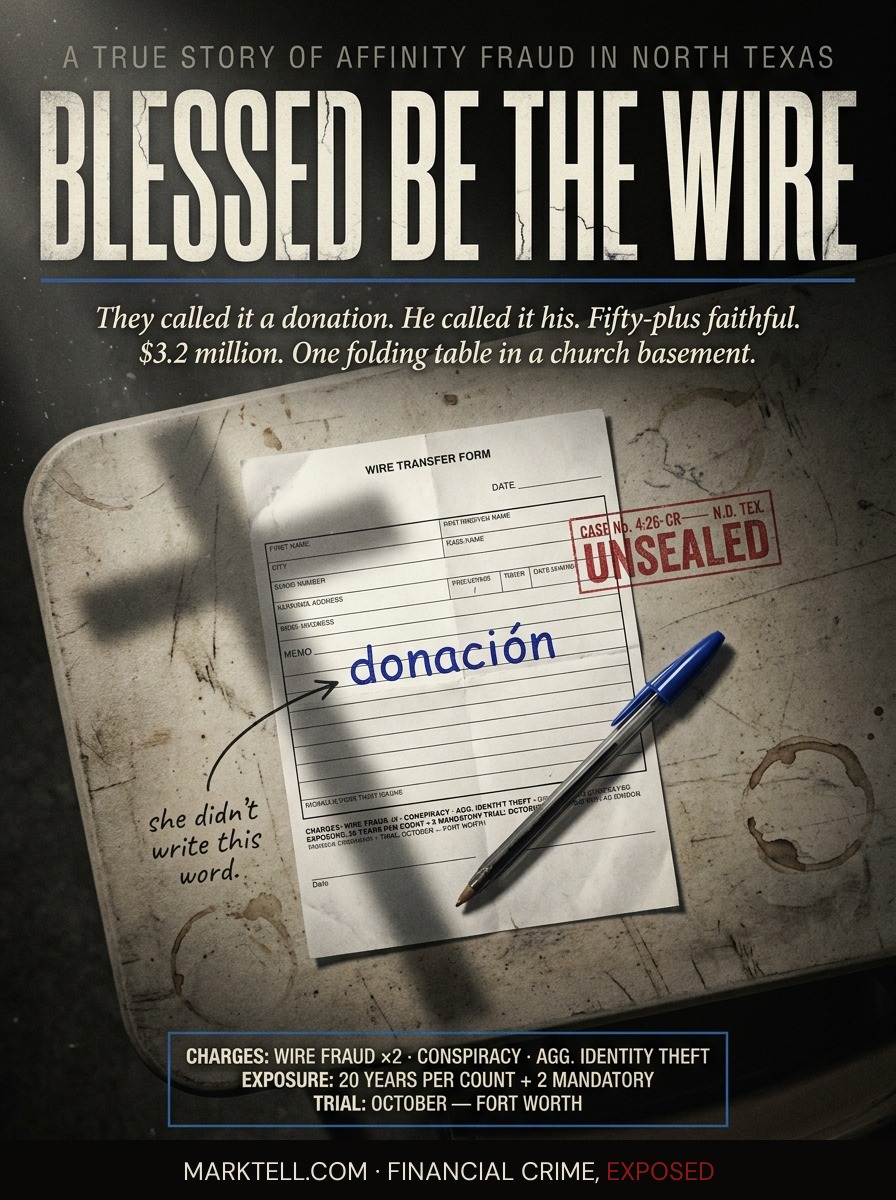
Marisol sat at her kitchen table in Grand Prairie on a Sunday afternoon in the spring of 2022 with a printed wire transfer form in front of her and a ballpoint pen she had borrowed from the drawer under the microwave. She was sixty-one. She worked as a home health aide, mostly nights, mostly with an elderly woman in Arlington whose family paid in checks that took three days to clear. She had six thousand dollars saved. She had told her sister that morning that God had put an opportunity in front of her and it would be a sin to look away.
The memo line on the form was already filled in.
It said donación.
She had not written that word. The man who handed her the form had written it in advance, in blue ink, in careful block letters, before he passed the paper across the folding table in the church basement. He told her the label was important. He told her the ministry was tax-exempt. He told her that when the church-flipping project sold, the return would come back to her the same way it went out, as a blessing that had passed through a bank.
She signed. She wired. She went home and made rice.
That is where this story starts, in a room that looked correct.
I.
According to a federal indictment unsealed this month in the Northern District of Texas, Richard Reinaldo Garcia, 53, of Arlington, ran a scheme from August 2021 through April 2025 that pulled more than $3.2 million from over fifty people. Some were his neighbors. Some were on other continents. What they shared was a church, or an idea of a church, and the belief that money sent toward that church would do what he said it would do.
Prosecutors allege it did not.
The indictment charges Garcia with one count of conspiracy to commit wire fraud, two counts of wire fraud, and one count of aggravated identity theft. If convicted on the wire fraud counts, he faces up to twenty years on each. The identity theft count carries a mandatory two-year sentence stacked on top. His trial is scheduled for October in Fort Worth federal court.
U.S. Attorney Ryan Raybould, announcing the case, said Garcia "allegedly took advantage of his victims' faith to enrich himself" and added that "religious trust is not a free pass in federal court."
Read that last line slowly. It is the sentence a prosecutor uses when the paperwork is the sermon.
II.
The pitch, as the government describes it, had three products.
The first was church flipping. Investors were told their money would buy small church buildings, renovate them, and resell them at a profit to congregations looking to expand. It sounded like house flipping with a steeple. It sounded like something a person could picture.
The second was Christian music concerts. Ministry-branded events, ticketed, sponsored, with a return to the underwriters after production costs.
The third was ministry programs. A catch-all. Youth outreach. Missions. The kind of line item that does not have a receipt because grace is not itemized.
The money moved through accounts held in names that sounded like a congregation you might already belong to. Ministerio Gracia. Iglesia Gracia de Texas. Gracia Church of Texas. Pesar de Todo LLC.
Read them again.
A ministry. A church. A church of Texas. And an LLC named after a Spanish phrase that means, roughly, "in spite of everything."
Investors were instructed, according to prosecutors, to label their transfers as donations. That is the sentence in the indictment that will do the most work at trial. Because a donation, in the eyes of a bank, is not an investment. A donation does not require a subscription agreement. A donation does not carry a promise of return. A donation is the label you put on money when you do not want anyone downstream to ask what it was buying.
The government alleges the money was not renovating churches or booking concerts. It was paying for Garcia's personal and business expenses.
That is the machine. An offering plate with a bank account behind it. The plate gets the light. The account gets the wire.
III.
Affinity fraud is the industry term. It is not a diagnosis. It is a design.
Here is what it means in plain English. When a person shares your language, your church, your accent, your saints, your holidays, and your understanding of what a good man looks like, your brain does something automatic. It moves that person from the stranger column to the family column. You stop asking the questions you would ask a stranger. You ask the questions you would ask a cousin. Those are softer questions. They are meant to preserve the relationship, not to test it.
Fraudsters know this. The good ones do not stumble into a religious community by accident. They arrive on purpose, because the community's trust is the raw material the machine runs on.
The North American Securities Administrators Association has flagged affinity fraud as one of the most persistent forms of investor abuse for two decades. The SEC keeps a standing warning on its website about it. Regulators know. The problem is that the person in the folding chair next to you does not read SEC warnings on a Sunday afternoon. She reads the bulletin.
Marisol did not think she was investing in a security. She thought she was helping a ministry that had promised, quietly, to help her back. The word donation on the memo line was not a red flag to her. It was a comfort. It matched the room she was in.
That is what the label was for.
IV.
The dates in this indictment matter.
August 2021 to April 2025. Nearly four years. Fifty-plus victims. More than $3.2 million.
Do the math slowly. That is an average of roughly sixty-four thousand dollars per victim, though real cases like this never average cleanly. Some people wrote a single check for a few hundred dollars. Others, prosecutors will likely show, wired retirement savings in chunks that grew as their trust grew. The first check is small because you are testing. The tenth check is large because you have stopped testing.
That is how a four-year scheme works. It does not depend on one big lie. It depends on many small confirmations that the first lie was true. A return payment here. A photograph of a renovated sanctuary there. A concert flyer. A Facebook post with the pastor smiling next to a keyboard.
The concealment mechanism is the community itself. When one investor asks a hard question, other investors, who have not yet been paid back, will discourage the question, because their own belief is holding up their own decision. The room polices itself. The operator does not have to.
Until he does.
V.
The moment the machine became visible was not a moment Marisol saw. It happened in a federal grand jury room she will never enter, in a building she has never been to, when prosecutors from the U.S. Attorney's Office and agents from the FBI Dallas Field Office laid the bank records next to the promises and asked twelve people to look at both.
The indictment was unsealed. Reporters wrote it up on July 11, 2026. The names of the accounts appeared in print, in English, next to a dollar figure that used to be, in Marisol's mind, a series of separate blessings.
She read the article on her phone, standing at the counter, still in the scrubs she wore to work. She did not cry. She scrolled back to the top and read it again to make sure she had the name right.
Richard Reinaldo Garcia. Fifty-three. Arlington.
She thought about the folding table. She thought about the pen from the microwave drawer. She thought about the word donación in blue block letters that were not her handwriting.
That part may be the saddest. That the label was not even hers. Someone else wrote what her money was for, and she copied it forward, in good faith, because good faith was what she had been raised to bring into a room like that.
VI.
Garcia is presumed innocent. The trial is set for October. The government will have to prove every element of every count to a jury, and the defense will argue, as defenses in these cases always argue, that the money was donated freely, that no promise of investment return was ever formalized, that the labels on the accounts were sincere expressions of religious mission, and that whatever losses occurred were the ordinary risks of a ministry that did not thrive. Those arguments have worked before. They may not work here. Allegation is not adjudication.
But the pattern in this indictment is not new, and that is the reason to tell it now, before the verdict.
Greater Ministries International took in nearly $580 million from Christian investors in the 1990s. The Baptist Foundation of Arizona raised over $590 million from members of its own faith community before it collapsed. Whitney Foster, a Dallas pastor, was sentenced in 2024 to thirty-five years for a deed fraud scheme that stole three church properties. The Jesus Survives Ministries pastors near Houston pleaded guilty last year to conspiracy involving COVID relief and auto loans.
The names change. The accounts change. The denomination changes. The machine does not.
It is an offering plate with a bank account behind it. The plate gets the light. The account gets the wire. The label on the wire says donation because the label on the wire is the door the machine walks through.
VII.
Marisol still goes to church. Not the one in the basement. A different one now, smaller, with a pastor who is her cousin's husband and who has never asked her for money for anything other than the electric bill.
She keeps the wire receipt in a folder in her kitchen desk. She showed it to a lawyer at a free clinic last year. He told her she was one of the ones on the list. He told her the government would be in touch. He told her not to expect the money back.
She said she knew.
She said the money was not the thing.
She said the thing was that on a Sunday afternoon in the spring of 2022, she believed she was doing something holy, and someone had written the word for it on the paper before she even sat down.
- NBC 5 Dallas-Fort Worth | July 11, 2026 | "Arlington man indicted in alleged $3.2M church investment fraud scheme"
- U.S. Attorney's Office, Northern District of Texas | July 2026 | Press release and indictment announcement, U.S. v. Richard Reinaldo Garcia
- Federal Bureau of Investigation, Dallas Field Office | July 2026 | Public statement on indictment
- U.S. Securities and Exchange Commission | Investor.gov | Standing investor alert on affinity fraud
- North American Securities Administrators Association (NASAA) | Investor education materials on affinity fraud
- Historical context: Greater Ministries International prosecution records (DOJ, 1999-2001); Baptist Foundation of Arizona case (Arizona Attorney General, 1999-2006); Whitney Foster sentencing coverage (Dallas Morning News, June 2024); Jesus Survives Ministries plea coverage (DOJ Southern District of Texas, June 2025)
Editorial Notice
MarkTell is a true crime publication about financial fraud. Some scenes, dialogue, and sequential details are reconstructed from court filings, enforcement actions, news reports, and public records. Where the public record does not provide exact details, editorial reconstruction is used to convey the documented pattern of events. Names of private individuals may be changed to protect identity. All factual claims are sourced to public documents cited in the Evidence Trail above. MarkTell does not provide investment, legal, or financial advice. Nothing published here constitutes a recommendation to buy, sell, or avoid any investment. Allegations described in active cases have not been adjudicated and defendants are presumed innocent until proven guilty. Readers should conduct their own due diligence before making financial decisions.