The nurse marked the box. The state says that box was worth one hundred million dollars.
Massachusetts has sued UnitedHealthcare for allegedly inflating the health status of elderly Medicaid members to pull at least $100 million in extra payments from MassHealth over a decade. The state says the company found the problem in an internal review, then kept the money.
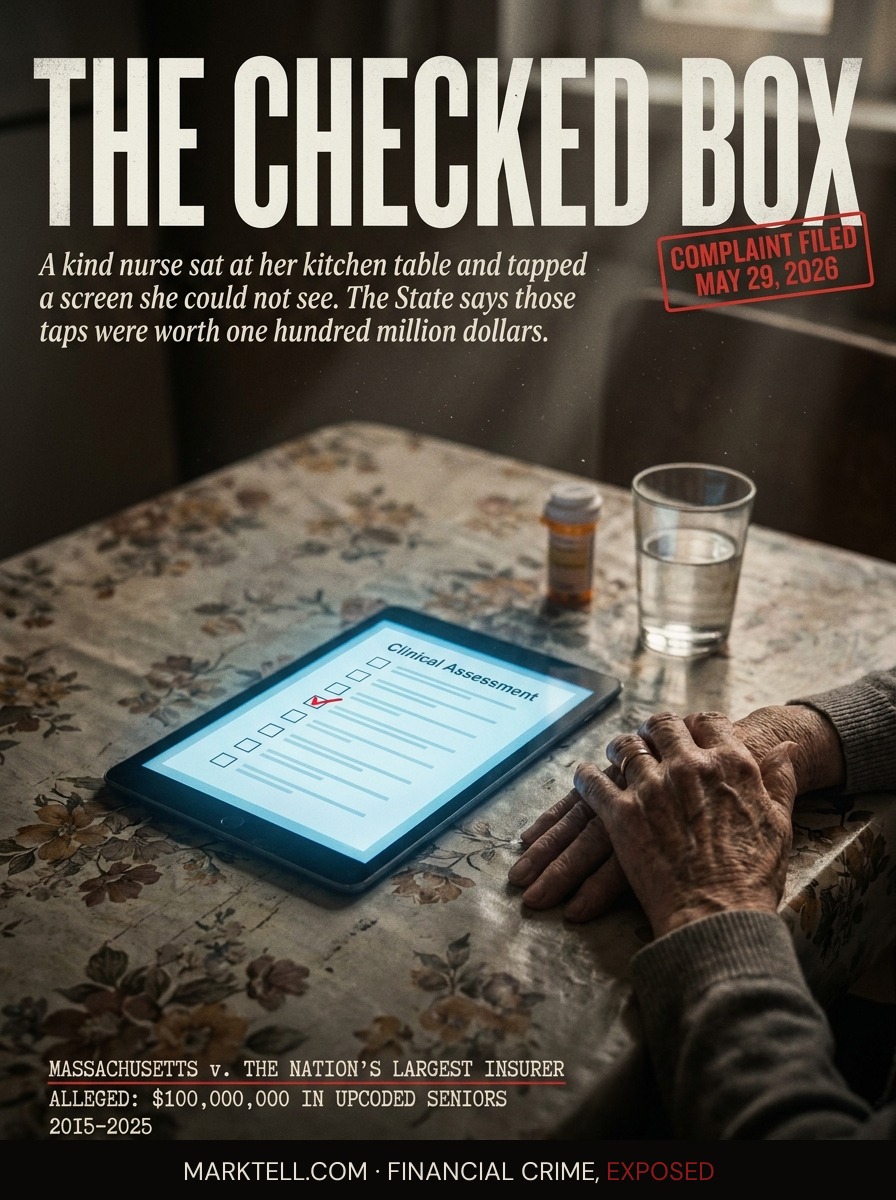
Eleanor is seventy-eight. She lives on the second floor of a three-decker in Worcester, the kind with a back porch that nobody uses anymore because the stairs are too much. Her husband died in 2017. Her son lives in Phoenix and calls on Sundays. She has Medicare because she is old and MassHealth because she is poor, and somewhere along the way a woman from an insurance company sat down with her and explained that she qualified for something called Senior Care Options. A plan for people like her. The woman was kind. Eleanor signed.
A few months later a nurse came to the apartment. The nurse was also kind. She sat at Eleanor's kitchen table, the one with the folded oilcloth, and she opened a tablet and started asking questions. Did Eleanor ever feel sad. Did she have trouble bathing. Did she take her medications. Eleanor answered honestly. She did not feel sad most days. She bathed fine. She took her pills.
The nurse tapped the screen. Eleanor could not see the screen.
This story is about the screen.
I.
On Friday, May 29, 2026, the Attorney General of Massachusetts, Andrea Joy Campbell, filed a civil complaint in state court against UnitedHealthcare Insurance Company, the unit of UnitedHealth Group that operates the largest Senior Care Options plan in the state. The complaint alleges that between 2015 and 2025, UnitedHealthcare defrauded MassHealth, the state Medicaid program, of at least $100 million.
The mechanism, according to the complaint, has a polite name. Upcoding. That is the industry word. The plain word is this: marking sick people sicker than they are so the government pays you more for taking care of them.
Senior Care Options is a managed-care plan for people who are dually eligible for Medicare and Medicaid. The members are old. Many are poor. Some have dementia. Some have nobody. The state pays the insurance company a fixed amount per member per month, and the amount depends on a level. Level 1 is the least sick. Level 2 is reserved, by the program's rules, for members with behavioral health or substance use disorders. Level 3 is the most serious. A Level 3 check is bigger than a Level 1 check. By a lot.
Between 2014 and 2025, MassHealth paid UnitedHealthcare more than $5 billion for SCO members. The complaint alleges that a meaningful slice of that, at least one hundred million dollars, was inflated.
The acuity machine. The higher you score the member, the higher the state pays you. That is the machine. Everything else is decoration.
II.
The complaint describes how it allegedly worked on the ground.
Field nurses went to apartments like Eleanor's. They sat at kitchen tables. They asked questions and tapped tablets. The complaint alleges that nurses were incentivized to code members as sicker or less capable than they actually were. It alleges that members without behavioral health or substance use conditions were placed at Level 2 anyway. It alleges that members who did not meet the criteria for the most serious classification were placed at Level 3 anyway.
It alleges something even more specific. That staff were trained, for the highest-acuity members, to always log seven days of visiting nursing services. Not as many days as the member needed. Seven. Every week. Because seven was the number that triggered the highest reimbursement category.
Read that again slowly. Not the care the member needed. The number that triggered the highest payment.
If the complaint's account is accurate, the assessment was not an assessment. It was a billing form wearing a stethoscope.
UnitedHealthcare disputes this. A spokesperson, Eric Hausman, called the complaint "meritless" and said it "doesn't accurately describe" the Senior Care Options program. He said the program helps seniors with complex needs get better support. That is the company's position. The case has not been tried. Allegation is not adjudication.
III.
Now go back to Eleanor's kitchen.
The nurse asks if she has felt down or hopeless in the past two weeks. Eleanor thinks about it. She says sometimes, in the evenings. She does not say she has depression because she does not believe she does. She had a sad week last month because it would have been her anniversary.
The nurse taps the screen.
The nurse asks if she needs help with bathing. Eleanor says she manages. She holds the rail. She is careful. The nurse asks if she has ever fallen. Eleanor says once, last winter, on the back porch ice, but she did not break anything.
The nurse taps the screen.
Eleanor does not know what level she has been assigned. She does not see a bill. The bill goes from UnitedHealthcare to MassHealth. MassHealth pays UnitedHealthcare a monthly check based on the level. Eleanor's role in this transaction is to be the unit of revenue.
That is the part that is hard to write without raising your voice. The mark in this case was not asked to wire money. The mark was asked to answer questions at her own kitchen table and trust that the woman with the tablet was writing down what she said.
IV.
The complaint contains an allegation that, if true, is the spine of the case.
It alleges that between 2018 and 2019, UnitedHealthcare conducted an internal review. The review allegedly identified that members had been miscoded. That the levels did not match the conditions. That the company had been collecting payments it should not have collected.
The complaint then alleges what the company did about it. It did not disclose the findings to MassHealth. It did not repay the money. It downgraded affected members, quietly, going forward. The state kept being billed at the old levels until the downgrades caught up. The money stayed in the company's accounts.
That is the move the complaint says proves intent. A mistake is a mistake. A mistake you find, document, and keep the proceeds from is something else.
Massachusetts is asking for triple damages. For civil penalties of up to $11,000 per violation. For interest. For costs. If the state proves what it has alleged and the court grants what the state has asked for, the bill will be considerably more than one hundred million dollars.
V.
UnitedHealth Group is one of the largest companies in the United States. Its market capitalization on the day the lawsuit was filed was roughly $343 billion. Its shares dropped 1.4 percent to $377.34. That is the market's reaction. A shrug with a small frown.
This is not the first time the company has been in this kind of room.
In January 2025, a Massachusetts court ordered three UnitedHealth-owned insurers to pay over $165 million for deceptive sales practices that misled more than fifteen thousand consumers into buying supplemental health insurance they did not need. The conduct was from 2012 to 2016, before UnitedHealth acquired the companies in 2019. But the check came from UnitedHealth's pocket.
In May 2025, the Justice Department was reported to be conducting a criminal investigation into possible Medicare fraud at UnitedHealth Group. By August, the probe had reportedly extended to its Optum Rx unit and to physician reimbursement practices.
In November 2023, the company was sued over allegations that it used an algorithm called nH Predict to deny rehabilitation care to Medicare Advantage beneficiaries, with full knowledge of the algorithm's error rate.
Pattern recognition is not proof. None of those matters are the same as this matter. But when you find yourself in the same kind of room over and over, the question is not whether you wandered in. The question is whether the room is where you live.
VI.
Eleanor will probably never know she was in this story. The downgrade, if one happened, would have arrived as a slight change in her care plan. Maybe fewer nurse visits. Maybe a different label on a form she never reads. She is not a plaintiff. She is not a witness. She is the data point.
Her son will read about the lawsuit on his phone in Phoenix, between Sunday phone calls, and he will not connect it to his mother. The article will mention UnitedHealthcare. He will think about his own deductible. He will scroll.
That part may be the saddest. The people who were used as the unit of revenue will mostly never know it was them. The check from MassHealth went to UnitedHealthcare. The triple damages, if they come, will go to the state treasury. Eleanor will get the same Sunday phone call. The kitchen table will still have the folded oilcloth. The tablet will be replaced by a newer tablet, and a nurse who is still kind will sit down and ask questions.
That is the machine. The complaint alleges what it did between 2015 and 2025. It does not allege that anyone has turned it off.
The nurse taps the screen.
Eleanor pours her a glass of water.
- Reuters | May 29, 2026 | "Massachusetts sues UnitedHealth unit for allegedly defrauding Medicaid program"
- Office of the Massachusetts Attorney General Andrea Joy Campbell | May 29, 2026 | Complaint and public statement re: UnitedHealthcare Community Plans of Massachusetts
- Massachusetts court order | January 2025 | $165M judgment against HealthMarkets, Chesapeake Life Insurance, HealthMarkets Insurance Agency
- Reuters / Wall Street Journal reporting | May 2025 and August 2025 | DOJ criminal probe of UnitedHealth Medicare billing and Optum Rx
- StatNews and class-action filings | November 2023 | nH Predict algorithm litigation against UnitedHealth / NaviHealth
- UnitedHealth Group Inc. (NYSE: UNH) | May 29, 2026 | Closing share price $377.34; market capitalization approx. $342.79B
- MassHealth | program documentation re: Senior Care Options (SCO) eligibility and Level 1/2/3 acuity classifications
Editorial Notice
MarkTell is a true crime publication about financial fraud. Some scenes, dialogue, and sequential details are reconstructed from court filings, enforcement actions, news reports, and public records. Where the public record does not provide exact details, editorial reconstruction is used to convey the documented pattern of events. Names of private individuals may be changed to protect identity. All factual claims are sourced to public documents cited in the Evidence Trail above. MarkTell does not provide investment, legal, or financial advice. Nothing published here constitutes a recommendation to buy, sell, or avoid any investment. Allegations described in active cases have not been adjudicated and defendants are presumed innocent until proven guilty. Readers should conduct their own due diligence before making financial decisions.