The nonprofit said one hundred percent. The wire transfers said otherwise.
Jason and Lacey Carney built a Springdale nonprofit on a promise that one hundred percent of donations went to malnourished infants. On June 12, both pleaded guilty in federal court. The money path tells a different story than the website did.
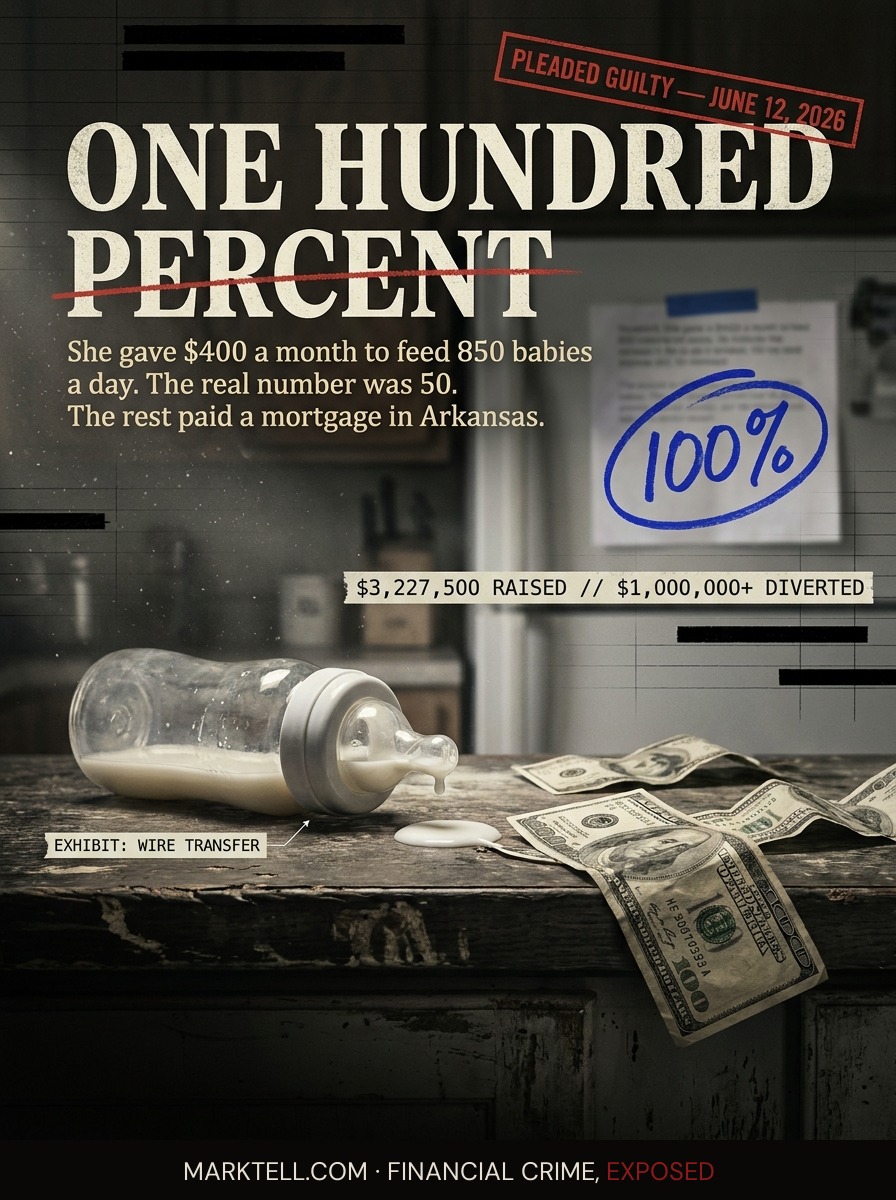
Diane is fifty-eight. She is a pediatric nurse outside Nashville. She has held babies whose mothers could not feed them and she has held babies whose mothers were already gone, and she made peace with the part of her job that does not have a fix by giving four hundred dollars a month to a nonprofit in Arkansas that said it had a fix.
The autopay confirmation arrived on the second Sunday of every month. She would see it on her phone while the coffee was still brewing. There was a printout taped to her refrigerator, faded now at the corners, that said one hundred percent of 2nd Milk sponsorships go directly to saving the lives of the most valuable babies. She had circled the words one hundred percent in blue pen, the way she circled lab values at work.
She watched the fundraising video the first time in 2018. There was a number in it. Eight hundred and fifty babies fed every day. There was music. There was a woman in a kitchen pouring formula into bottles, and there was a man with a clipboard counting cans, and the man on the clipboard was Jason Carney, who on Friday, June 12, 2026, pleaded guilty in federal court in Fayetteville to conspiracy to commit wire fraud, structuring transactions to evade bank reporting requirements, and two counts of filing false tax returns.
His wife Lacey Carney, the co-founder and chief financial officer, pleaded guilty the same day to one count of misprision. Misprision is the federal charge for knowing a felony is happening and concealing it. It is the charge for the person sitting next to the driver.
Both await sentencing. This is what the record says happened in between.
I. The pipe
2nd Milk was incorporated in Springdale, Arkansas, in 2015. The mission language was clean and it was repeated everywhere: save the lives of malnourished and orphaned infants in Africa and around the globe. Most of the named work was in Malawi. Formula. Food. Education. Resources. The kind of vocabulary that does not invite questions because the questions feel cruel.
A nonprofit is supposed to be a pipe. Money goes in one end from people like Diane. Help comes out the other end in a country most donors will never see. The donor's job is to trust the pipe. The IRS's job is to verify the pipe. The board's job is to inspect the pipe. The founder's job, in theory, is to keep the pipe clean.
The pipe at 2nd Milk reported total revenue of $3,227,500 between 2016 and 2022, according to the figures cited by federal prosecutors at trial. Of that, prosecutors alleged, more than $1 million did not reach the other end. It went sideways. It went into a house. It went into credit card statements. It went into a boat.
A nonprofit shaped like a pipe, with a valve pointed at a household. That is the machine in this case. The machine has a name in federal court. The name is a pass-through.
II. The line items
The indictment is not a summary. It is a list. Read it slowly.
A donor gave $20,000 for a chicken house project. The chicken house was a small income-generating program for the Malawi operation. Prosecutors say the money went to personal credit card balances and bank transfers.
A donor gave $15,000 for construction. Prosecutors say it went toward personal credit and the mortgage on the Carneys' home.
A donor gave $20,000 for baby formula and nutrition. Prosecutors say it was used for personal expenses and transfers to family members.
Read those three lines again. Notice what each of them was called when it came in. A chicken house. Construction. Formula. Notice what each became. A credit card payment. A mortgage. A transfer to a relative. The donor wrote the first label. The Carneys, prosecutors say, wrote the second one in the ledger nobody outside the household saw.
The website said one hundred percent. The wire transfers said something else.
III. The number that was not a number
The fundraising materials said 2nd Milk fed over 850 babies daily. That number sat on the homepage. It sat in the video Diane watched in 2018. It sat in donor decks.
According to trial testimony and internal records cited by federal prosecutors, the actual number in some periods was between 30 and 56.
Stop here. Do the math the way a nurse does math. 850 is not a rounding error away from 50. 850 is a different category of organization. 850 is a logistics operation with trucks and warehouses and staff. 50 is a small program a single family could run from a phone.
The gap between 850 and 50 is not exaggeration. It is the architecture of the pitch.
The Carneys also told donors they took little to no salary from the organization. The federal filings say donations were a primary source of their personal income. Not a supplement. Not a stipend. The income.
That part may be the hardest to sit with. The salary number was not just understated. The category was wrong. There was no salary because there did not need to be one. The household and the nonprofit were braided into the same set of accounts.
IV. The donor who flew
Diane never went to Malawi. Most donors never do. That is the design of the pipe. You trust because you cannot verify.
A Tennessee donor named Nellya Canfield did go. She was giving four hundred dollars a month, according to public reporting from the trial. She flew to the country where the babies in the video lived and she counted. She listened. She compared what she saw on the ground to what she had been reading in her email since she signed up.
The numbers did not match. The children did not match. The story she had been told from a Springdale headquarters did not match the room she was standing in.
Most frauds end the way this one did. Not because a regulator opened a file from a desk in Washington. Because one person who had been treated as a donor stopped behaving like one and started behaving like a witness.
V. The headquarters
The federal indictment listed, among the assets potentially subject to forfeiture, the 2nd Milk headquarters in Springdale. The headquarters had an address. The address was a residential home. The home was valued at approximately $778,300.
Picture it. A nonprofit dedicated to feeding babies in Malawi, headquartered in a house in northwest Arkansas, with the household's mortgage paid in part, prosecutors allege, by donations earmarked for construction.
The headquarters was not separate from the household. The headquarters was the household. That is what makes the pipe a pass-through. There was never a place where the nonprofit ended and the family began. The line items in the indictment are just the moments somebody wrote the transition down.
VI. Diane on Friday
The plea hearing was on a Friday. Diane heard about it from a coworker who had also been giving.
She walked to the kitchen. She looked at the printout on the fridge. One hundred percent. The corner was curling. She had taped it up there in 2019 because she liked the certainty of the number. A hundred is the highest a percentage goes. You cannot give more than everything.
She did not cry. She did not call anyone. She stood at the counter and did the small math she could do without a calculator. Four hundred dollars a month for almost eight years. She had been told her money was buying formula for fifty babies a day, or her fraction of it was. She had been told her money was the difference between a child eating and a child not eating.
Some of it was. Prosecutors have not said none of it was.
Some of it, the filings allege, paid down a credit card balance in Springdale.
She does not know which dollars were which. Neither does the government, not exactly. That is the part the pass-through is built to make impossible.
VII. The machine, named
Every fraud has a sentence at the bottom of it. This one's sentence is short.
A nonprofit is only a nonprofit if the pipe stays clean. If the valve points at a household, the nonprofit is the household with a tax exemption stapled to the front.
That is not a chicken house. That is not construction. That is not formula.
That is a salary the founders said they did not take.
Diane took the printout off the fridge on Saturday morning. She did not throw it away. She put it in the drawer with the tax returns. Evidence is hard to part with, even when it is your own.
The pipe is still a good idea. There are babies in Malawi. There are nurses outside Nashville who would still send the four hundred. The question that the 2nd Milk case leaves on the kitchen table is the ugly one. Not the one about generosity. The one about whose hand is on the valve.
- KNWA FOX24 | June 12-13, 2026 | "2nd Milk founder pleads guilty to wire fraud, falsifying bank returns in federal trial"
- U.S. Department of Justice / federal indictment of Jason and Lacey Carney | filings cited at trial, Western District of Arkansas
- Federal trial proceedings | jury selection June 5, 2026; testimony beginning June 9, 2026; guilty pleas entered June 12, 2026
- 2nd Milk public marketing materials | "100% of 2nd Milk sponsorships go directly" language; "over 850 babies daily" claim
- Trial testimony regarding donor Nellya Canfield's travel to Malawi and observation of operational scale
Editorial Notice
MarkTell is a true crime publication about financial fraud. Some scenes, dialogue, and sequential details are reconstructed from court filings, enforcement actions, news reports, and public records. Where the public record does not provide exact details, editorial reconstruction is used to convey the documented pattern of events. Names of private individuals may be changed to protect identity. All factual claims are sourced to public documents cited in the Evidence Trail above. MarkTell does not provide investment, legal, or financial advice. Nothing published here constitutes a recommendation to buy, sell, or avoid any investment. Allegations described in active cases have not been adjudicated and defendants are presumed innocent until proven guilty. Readers should conduct their own due diligence before making financial decisions.