The nephew died in a federal cell. The houses kept appreciating.
A retired haulage contractor from Clarendon stands charged with hiding a J$250M ($1.6M USD) property portfolio for a nephew who died serving 188 months in a US federal prison. The houses outlived him. The paperwork is what caught up.
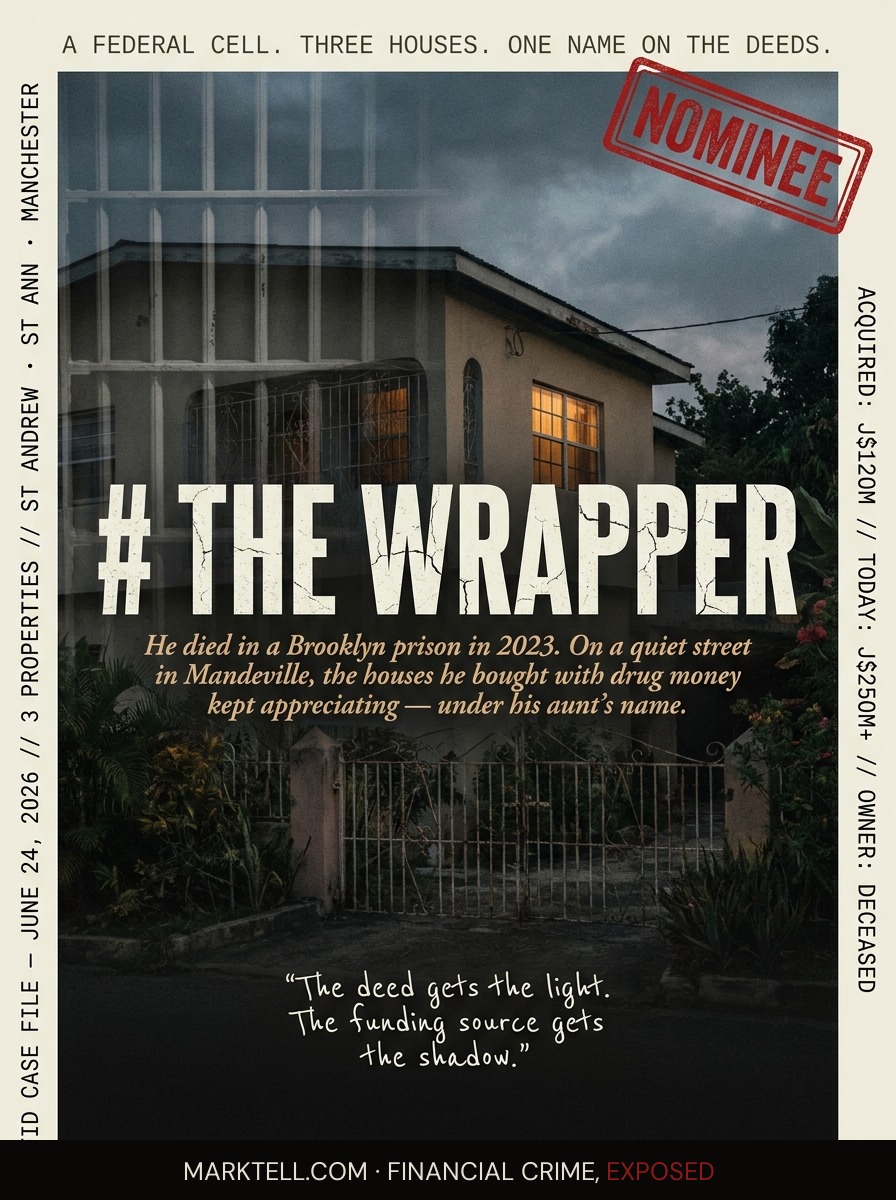
Marlene, sixty-one, a nurse at the regional hospital in Mandeville, has lived on her street for twenty-two years. She knows which houses have children and which have dogs and which have nobody at all. The house two doors down is one of the nobody houses. The grass gets cut. A light comes on at seven every evening. Once a year a truck arrives and men she does not recognize touch up the paint on the gate.
She has never seen the owner.
She has asked. Neighbors say a woman from Clarendon holds the deed. A retired trucker. Family money, they say. Which is the phrase Jamaicans use when nobody wants to ask the next question.
On Wednesday, June 24, 2026, the next question got asked.
The Financial Investigations Division, the agency Jamaica set up in 2002 to trace the money criminals do not want traced, arrested and charged Donna Marie Green-Mitchell, a retired haulage contractor from Clarendon. The charge sheet is long. Three counts of possession of criminal property. Three counts of dealing in criminal property. Three counts of engaging in a transaction involving criminal property. One count of entering into an arrangement to acquire criminal property on behalf of another. One count of acquisition. One count of conspiracy.
Underneath all of that lawyerly stacking is one simple accusation. The FID says the three houses were not really hers. It says they belonged, in the way that matters, to her nephew.
Her nephew is dead.
O'Neil McKenzie lived in Brooklyn. He was a Jamaican national who ran drugs in the United States and got caught doing it. A US federal court sentenced him to 188 months. He died in October 2023, still inside, still serving. He never came home.
The houses stayed.
That is the part worth sitting with.
A man goes to a federal prison in the United States. He dies there. And on an island seven hundred miles south, three houses that the government now says were bought with his money keep sitting on their lots, keep appreciating, keep having the grass cut and the paint touched up. The FID says they were worth about J$120M ($750K USD) at acquisition. They are worth more than J$250M ($1.6M USD) now.
That is the machine this piece is about. Not the trafficker. The wrapper.
Call it the nominee. That is the plain word for what the FID alleges Green-Mitchell was. A nominee is a person whose name goes on the paperwork when the person with the money does not want their name there. In a clean transaction, the name on the deed is the name of the person who paid. In a nominee arrangement, the name on the deed is a relative, an employee, a friend, a stranger paid a fee. The paperwork looks normal. The paperwork is the point.
Jamaica's real estate sector is soft tissue for this kind of work, and the government has now said so out loud. The Bank of Jamaica published the country's Third National Risk Assessment in June 2026, the same month Green-Mitchell was arrested. The assessment named real estate development one of the highest money laundering risks in the country. It noted something that should be read slowly.
Real estate developers in Jamaica are not legally required to verify where a client's funding comes from. Real estate dealers are. Developers are not.
The assessment looked at 385 development applications between 2021 and 2024, with a combined declared value of J$299.6B (about $1.9B USD). It found that high-risk funding sources, meaning self-financed and cash, accounted for roughly 7.8 percent of project costs. That is the visible piece. The invisible piece is what the government did not measure because nobody is required to report it.
This is the environment the FID says Green-Mitchell operated inside. Three properties. St Andrew. St Ann. Manchester. Held under her name. Allegedly funded by a nephew who was moving product on the streets of New York.
Picture Marlene at her kitchen window. She is not a mark in the way retirees in Ponzi cases are marks. She did not send anyone money. But she lived next to laundered value for years, if the FID is right, and nobody told her. Her neighborhood absorbed a house whose deed did not describe its owner. Her property values were shaped by a purchase whose funding source Jamaica was not legally allowed to ask about.
The neighbor is a kind of mark too. The neighbor is the person the machine hides behind.
Read the charge sheet again. Three counts of possession. Three of dealing. Three of transacting. The number three keeps repeating because there are three houses. The FID's structure of the case is that each property is its own crime and the whole portfolio is another one on top. That is the conspiracy count. The idea that Green-Mitchell did not just hold one house by accident. She held a portfolio, and the portfolio was a system.
The Jamaica Constabulary Force's financial units worked the case alongside the FID. The Fraud Squad. The Financial Crime Investigations Division. The Constabulary Financial Unit. Four agencies pulling on the same knot.
Green-Mitchell was offered bail at J$3M (about $19K USD). She is scheduled to appear at the Kingston and St Andrew Parish Court on July 9, 2026.
None of the allegations has been tried. Green-Mitchell has not been convicted of anything. That distinction matters. What is known, what is on the record and adjudicated, is that O'Neil McKenzie was a convicted drug trafficker who died in an American prison. What is alleged is that the money he made in Brooklyn was walked into Jamaica and set down inside three houses with his aunt's name on the deeds.
The FID has done this before, and it has done it bigger. In 2022, it recovered roughly J$500M ($3.2M USD) from Andrew Hamilton. It has pulled nearly J$200M ($1.3M USD) from Norris "Deedo" Nembhard. This is a machine the agency has taken apart before, in other configurations. Different wallpaper. Same skeleton.
Here is what does not change from case to case.
The deed gets the light. The funding source gets the shadow.
The relative gets the mortgage. The trafficker gets the equity.
The garden gets tended. The neighbors get told nothing.
The house appreciates. The nephew dies.
The police issued a public warning after the arrest, aimed at ordinary Jamaicans. Do not let your name be used to acquire or hold property for another person without verifying the source of funds. If you do, you can be charged. You can be fined. You can lose the property. The warning is not written for kingpins. It is written for aunts. For cousins. For old friends who owe someone a favor. That is who the machine actually recruits. Not accomplices. Family.
Marlene's house is not one of the three. Her deed has her name on it and her mortgage receipts in a drawer and her mother's photograph on the wall. She earned it on a nurse's salary over twenty-two years.
The house two doors down has a name on the deed too. According to the FID, that name is the wrapper. The money underneath the name was moving through Brooklyn and Kingston in ways the neighborhood was not built to see.
The nephew is dead. The houses are not.
That is the part the paperwork could not bury.
- Jamaica Observer | July 2026 | "Woman charged after FID alleges she hid drug trafficker's $250m property portfolio"
- Financial Investigations Division of Jamaica | June 24, 2026 | Charge announcement, Donna Marie Green-Mitchell
- Bank of Jamaica | June 2026 | Third National Risk Assessment (NRA), 2021-2025 review period
- US federal court records | 2023 | O'Neil McKenzie sentencing (188 months) and death in custody, October 2023
- Proceeds of Crime Act (POCA), Jamaica | 2007, amended January 2026
- FID historical asset recovery records | 2022 | Andrew Hamilton (J$500M) and Norris Nembhard (J$200M) forfeitures
Editorial Notice
MarkTell is a true crime publication about financial fraud. Some scenes, dialogue, and sequential details are reconstructed from court filings, enforcement actions, news reports, and public records. Where the public record does not provide exact details, editorial reconstruction is used to convey the documented pattern of events. Names of private individuals may be changed to protect identity. All factual claims are sourced to public documents cited in the Evidence Trail above. MarkTell does not provide investment, legal, or financial advice. Nothing published here constitutes a recommendation to buy, sell, or avoid any investment. Allegations described in active cases have not been adjudicated and defendants are presumed innocent until proven guilty. Readers should conduct their own due diligence before making financial decisions.