The neighbour who needed a short-term loan kept needing one for eighteen months
Timothy Paul Barnes asked friends, clients, and a charity he chaired for short-term loans. Eighteen months and nearly £2 million later, the money was in a crypto wallet that had already been drained by someone else.
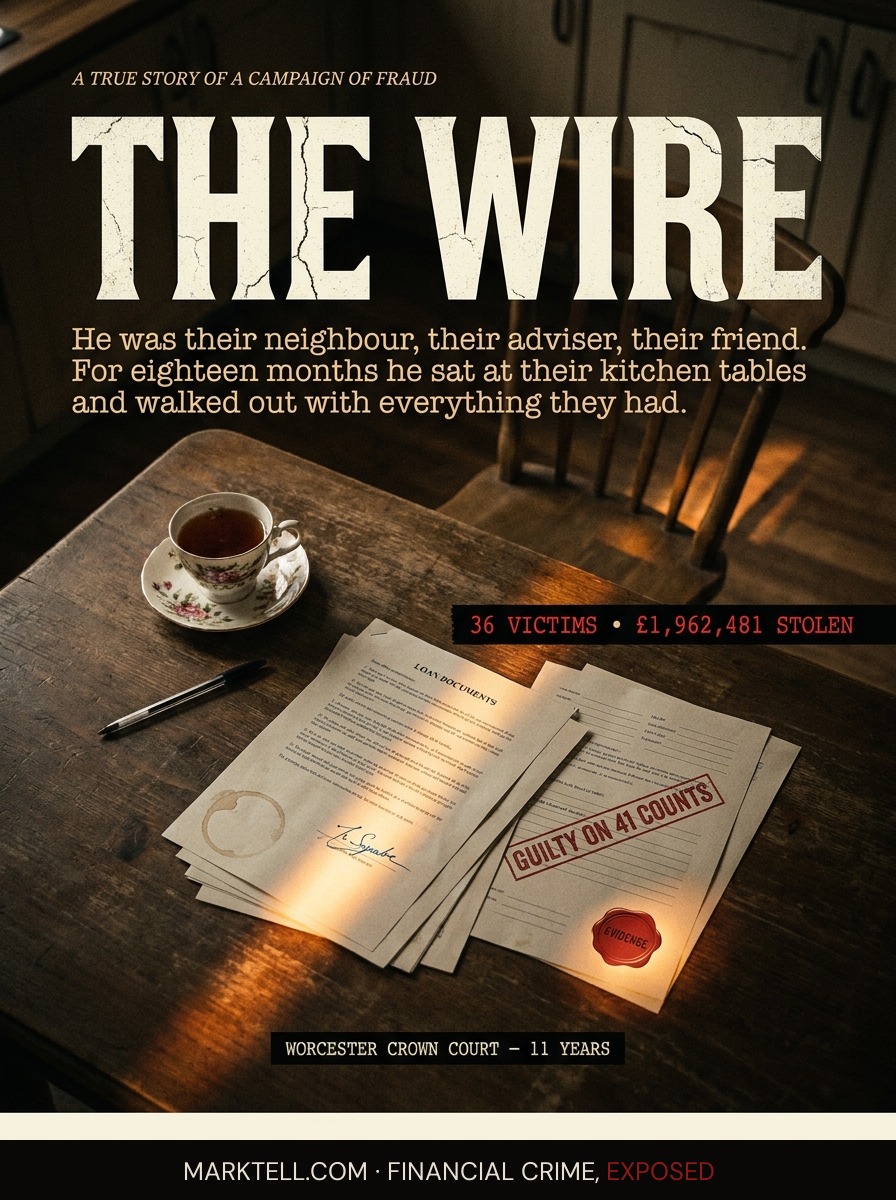
Margaret made the tea before Paul arrived because Paul always wanted tea. She was seventy-one. She had been his client for nine years. He had handled the rollover of her teaching pension and her late husband's small annuity, and she trusted him the way you trust a man who remembers your dog's name.
He sat at her kitchen table on a Tuesday in early 2023 and explained that his mother's estate was held up in probate. Ninety days, he said. Maybe sixty. He just needed to bridge a payment. He had the paperwork with him in a folder. The letterhead looked correct. The signatures looked correct. He had been a financial adviser for decades and he knew what a real document looked like, so the one he handed her did too.
Margaret signed. The transfer went out the next morning. £42,000.
She is not real. But thirty-six people are, and one of them lost £886,000, and the man who took it sat across a table that looked very much like hers.
I.
Timothy Paul Barnes lived at Charland Court in Droitwich, a quiet address in a quiet town in Worcestershire. He was sixty-eight. He had been a financial adviser for most of his working life. He was the chair of the British Motorcycle Charitable Trust. He was a neighbour on a residents' association. These are not incidental details. These are the three doors he used.
On Friday, June 19, 2026, Judge Jackson at Worcester Crown Court sentenced Barnes to eleven years in prison. He had pleaded guilty to 34 counts of fraud by false representation, three counts of making or supplying an article for use in fraud, two counts of fraud by abuse of position, and two counts of theft. The total taken was £1,962,481.68 (about $2.5M USD) from 36 victims. The campaign ran for roughly eighteen months, from late 2022 into the summer of 2023.
The court heard that Barnes had no prospect of repayment from the first loan onward. The judge used the phrase "campaign of fraud." That phrase matters. A campaign is planned. A campaign has stages.
II.
The first stage was the easy money. Barnes approached people he already knew. Friends. Neighbours. He told them his wife had left him. He told them he needed to settle his mother's estate. He told them about a divorce payment that had to clear by Friday. He asked for short-term loans. He promised quick repayment.
A short-term loan from a friend is the oldest soft pitch in fraud. It is not framed as an investment. There is no prospectus to read. There is no diligence to do. There is only a person you know asking for help, and the social cost of saying no.
Archie Johnson lent him £20,000 ($25K USD). Anthony Judd lent him £10,000 ($13K USD). Roger Cliffe lent him £18,000 ($23K USD). Those names are in the court record. The amounts are in the court record. Each loan was supposed to be temporary.
None of them were.
III.
The second stage was the client list.
A financial adviser knows things about you that even your children do not know. He knows what is in your pension. He knows what your annuity pays each month. He knows the maturity date on the bond you bought in 2017. He knows when the inheritance cleared.
Barnes used that knowledge. According to the prosecution, £1,754,736.68 (about $2.2M USD) was taken from 34 people in the form of loans. The largest single sum from one person was £886,000 (about $1.1M USD). That victim was not named in open court. You can picture them anyway. Someone who had worked their whole life. Someone who handed over the equivalent of a house because a man who knew exactly what they had said he needed it for sixty days.
To make the loans look real, Barnes created false documents. The prosecutor, Lauren Millichip, presented them. The judge noted them in sentencing. The articles for use in fraud were not theoretical. They were pieces of paper that looked like contracts and were not.
IV.
The third stage was the charity.
Barnes was the chair of the British Motorcycle Charitable Trust. From that position he took £206,500 (about $260K USD). From the Morton Wood Residents' Association, where he was a neighbour with access, he took £1,245 (about $1,600 USD).
The residents' association figure is small. It is also the most telling number in the file. A man taking close to two million pounds does not need £1,245. He took it because the door was open and taking things had become the thing he did.
V.
Picture the kitchen table again. Margaret is not real, but the table is real in thirty-six other houses, and what happened at those tables was the same.
The loan was for ninety days. Ninety days came. The repayment did not. Paul had a reason. Probate was slower than expected. The solicitor was on holiday. There was a complication with a sibling. He needed another two weeks. He was sorry. He was so sorry. Could she also lend him another four thousand to cover a payment that was tied to the first one, because if that payment did not clear the whole estate would be held up another six months and then nothing would come back?
That is how the recovery loop closes on the victim. The second loan is made to protect the first. The third is made to protect the second. The lender is not investing anymore. The lender is defending the money she has already lost. She does not know it is lost. She thinks she is helping it come home.
Read that slowly.
VI.
The money went somewhere. It always does. In this case, West Mercia Police's Economic Crime Unit, led by Detective Sergeant Bev Hamilton, followed it.
It went into a crypto wallet.
According to the investigation, Barnes had himself been the victim of a crypto scam earlier. He had lost his own money in it. The loans he took from his friends, clients, the charity he chaired, and the residents' association where he lived were not funding a yacht. They were funding an attempt to win back what he had already lost to someone else.
That is the machine. A man gets scammed. The man, instead of accepting the loss, becomes the scammer. He uses the trust he has spent a career building to fund a recovery attempt that has no statistical chance of working. The money does not stop at him. It moves through him to the wallet of whoever scammed him first.
There is a name for what victims do when they cannot accept the original loss. It is called the recovery scam. Usually the recovery scammer is a stranger. Here, the recovery scammer was the victim himself, paying with other people's money.
The wallet, by the time the police looked, was effectively empty.
VII.
Margaret learned in the way most of them learned. The calls stopped being returned. The texts went one direction only. A neighbour mentioned at a coffee morning that Paul had borrowed money from her too, and the words sat oddly in the air because Margaret had been told the loan from her was an unusual favour. Then another name came up. Then another.
Barnes was arrested on December 19, 2023, on suspicion of fraud and money laundering. The investigation took two and a half years to bring to sentencing. That is a long time to wait when you are seventy-one and the money in question was the money that was supposed to last you the rest of your life.
Detective Sergeant Bev Hamilton, after the sentencing, said the custodial sentence reflected the abuse of trust and the harm done to the 36 individuals and organisations. She used the word trust. The victims used the word trust. The judge used the word trust. It is the only word that fits.
VIII.
A man asked his friends for short-term loans. He used forged documents to make the loans look like real instruments. He used his position as their financial adviser to know exactly how much he could take. He used his position as charity chair to take from the charity. He used his position as neighbour to take from the residents' association. He sent the money into a crypto wallet to chase a loss he had already taken to someone else.
That is the file. Eleven years.
The number that should sit with you is not £1,962,481.68. It is £1,245. The residents' association money. The amount so small it makes no sense to take, taken anyway.
By then the door was just open. He was walking through every door that was open. He had stopped seeing them as doors.
He thought he was recovering his money. He was the wire.
- The Droitwich Standard | June 19-22, 2026 | "Droitwich financial adviser jailed for 11 years for conning his victims out of £2million"
- West Mercia Police | June 19, 2026 | Statement from Detective Sergeant Bev Hamilton, Economic Crime Unit
- Worcester Crown Court | June 19, 2026 | Sentencing remarks of Judge Jackson; prosecution by Lauren Millichip
- West Mercia Police | December 19, 2023 | Arrest of Timothy Paul Barnes on suspicion of fraud and money laundering
- Earlier reporting | June 9, 2025 | Initial court appearance, 39 charges related to £2M scam linked to cryptocurrency
Editorial Notice
MarkTell is a true crime publication about financial fraud. Some scenes, dialogue, and sequential details are reconstructed from court filings, enforcement actions, news reports, and public records. Where the public record does not provide exact details, editorial reconstruction is used to convey the documented pattern of events. Names of private individuals may be changed to protect identity. All factual claims are sourced to public documents cited in the Evidence Trail above. MarkTell does not provide investment, legal, or financial advice. Nothing published here constitutes a recommendation to buy, sell, or avoid any investment. Allegations described in active cases have not been adjudicated and defendants are presumed innocent until proven guilty. Readers should conduct their own due diligence before making financial decisions.