The money came back from Guernsey. The Cryptoqueen did not.
A bank account in the Channel Islands gave up £8.59 million tied to Ruja Ignatova. Eight years after Asha handed over her savings in a Mumbai hotel ballroom, a sliver of the money is moving toward Germany. The Cryptoqueen is not.
Asha keeps the certificate in a plastic sleeve in the second drawer down, the one with the gas bills and the warranty for the refrigerator. It is printed on heavy paper. It has a hologram in the corner. It says she owns a "Tycoon Trader" education package, and underneath that, in smaller letters, that the package includes tokens that will, in time, become coins.
She is fifty-eight. She runs the front office at a private school in Navi Mumbai. She has worked there for nineteen years. The drawer is in the kitchen because that is where her husband used to pay the bills before he died, and she has not moved the system.
The certificate is from 2016. She paid ₹2.7 lakh (about $4K USD at the time). Her sister had bought in six months earlier and was already drawing what looked like commissions. They went together to a seminar at a hotel near the airport. There were folding chairs. There was a man in a navy suit. There was a PowerPoint with a picture of Ruja Ignatova on stage at Wembley Arena, in a red gown, in front of a screen that said the next Bitcoin.
The man in the navy suit did not say it was the next Bitcoin. He said it was bigger.
This week, eight years later, a court in Guernsey signed off on the release of £8.59 million (about ₹100 crore, around $10.5M USD) toward German authorities, who will run a compensation process for OneCoin victims. The money came out of a single bank account in the Channel Islands. The account was connected to Ruja Ignatova personally. The Guernsey Financial Intelligence Unit had been building intelligence on it since 2017. Joint inquiries with German authorities began in 2021. According to Guernsey's Royal Court order earlier this year, the seizure was finalized in 2026.
That is one pipe in a larger plumbing system. There are others.
In April 2026, the U.S. Department of Justice opened a separate remission program. Over $40M in forfeited assets is available to OneCoin victims who bought between 2014 and 2019. The deadline to file a petition is June 30, 2026. If you put money into OneCoin and you are reading this, that is sixteen days from today.
Picture the pipe.
At the top is the pitch. The pitch was a cryptocurrency that was not a cryptocurrency. OneCoin claimed to run on a blockchain. It did not. A blockchain is a public ledger that anyone can audit. OneCoin's ledger was a SQL database on a private server, controlled by the company, which is to say controlled by the people selling the coins. Internal emails surfaced in U.S. court proceedings showed the founders discussing the absence of a real chain among themselves. The chain was always the proof. There was no chain. There was no proof. There was a database, and the database said whatever the company wanted it to say.
The middle of the pipe was the multi-level marketing structure. You did not buy OneCoin. You bought an "education package." Starter, Trader, Pro Trader, Premium Trader, Tycoon, Premium Tycoon. The packages contained training materials nobody read and tokens that could be "mined" into coins. The real product was the recruitment. You earned commissions by bringing in the next person, who earned commissions by bringing in the next person.
This is the part Asha understood and did not understand at the same time. Her sister was bringing in commissions. The commissions were real. The money in her sister's bank account was real. What Asha did not know, what almost nobody in the ballroom that day knew, was where the commissions came from. They came from her. They came from the ₹2.7 lakh she had just handed over. Her sister's earnings were Asha's principal, repackaged, moving up the chain.
At the bottom of the pipe, the money left the country.
In October 2017, the Economic Offences Wing of the Navi Mumbai Police arrested eighteen OneCoin promoters at a recruitment event. They froze approximately ₹24.57 crore (around $3.32M USD at the time) across nine bank accounts. Officers told reporters at the time that an additional ₹75 crore (around $10.12M USD) had been moved out of those accounts before the freeze could be executed. That money went somewhere. Some of it, traced through the corporate structure, ended up in the kind of accounts that hold £8.59 million in a Channel Islands bank.
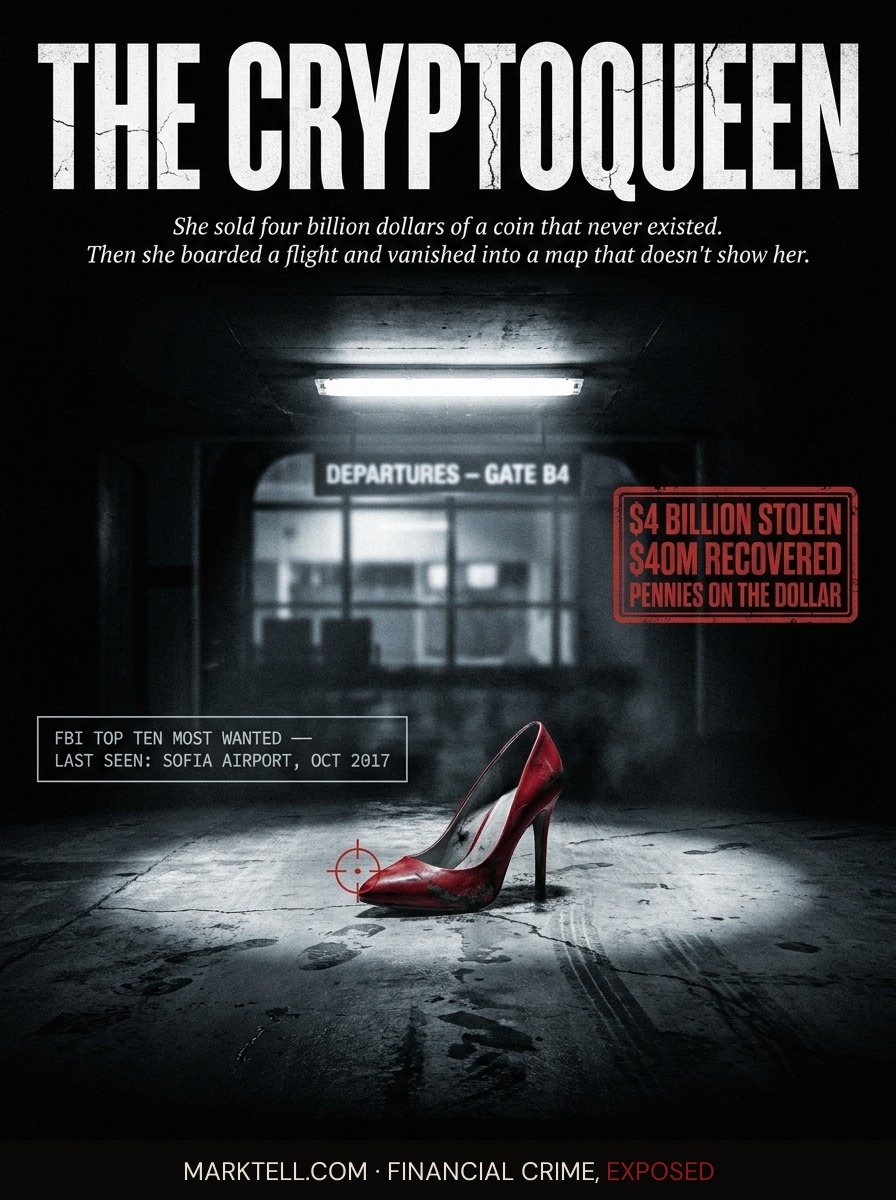
The same month the Mumbai arrests happened, Ruja Ignatova boarded a Ryanair flight from Sofia to Athens. She has not been seen in public since. The U.S. indicted her in 2017 on wire fraud, securities fraud, and money laundering counts. In June 2022 the FBI added her to its Top Ten Most Wanted Fugitives list with a $100,000 reward. The reward has not been collected.
Her co-founder did not run far enough. Karl Sebastian Greenwood was arrested in Thailand in 2018, extradited, and in September 2023 sentenced in the Southern District of New York to twenty years in federal prison. He was ordered to pay $300M in restitution. Her brother, Konstantin Ignatov, who stepped into the leadership vacuum when Ruja disappeared, pleaded guilty to fraud and money laundering charges in November 2019. He is cooperating.
The U.S. Department of Justice has estimated total OneCoin losses globally at over $4 billion between 2014 and 2019.
Hold that number against the recoveries. ₹100 crore from Guernsey. $40M from DOJ remission. ₹24.57 crore from Navi Mumbai. The arithmetic is the part nobody likes to write down. Pennies on the dollar. That is the math of every fraud of this scale. The money does not evaporate. It disperses. It buys property. It pays for citizenship-by-investment programs. It sits in accounts under nominee names. Some of it gets found. Most of it does not.
Asha did not learn the word "Ponzi" until 2018, when her nephew sent her a BBC podcast called The Missing Cryptoqueen. She listened to all of it on her commute over three days. She did not tell her sister she was listening. When she finished the last episode she sat in her car in the school parking lot for twenty minutes before going inside.
She did not call her sister for three years.
That part may be the cost the recovery numbers do not measure. The relationships. The Sunday dinners that stopped. The wedding the sister was not invited to. The grandchildren who grew up not knowing each other because the money had moved through the family the way the disease moves through a body, person to person, each one believing they were giving the next one something good.
There is a phrase law enforcement uses when a recovery action like this week's gets announced. They call it a "milestone." It is the right word. A milestone is a stone on the side of a road. It tells you how far you have come. It does not tell you how far is left.
Asha will not get her ₹2.7 lakh back. She might get some fraction. The German compensation process has not published a formula yet. If the U.S. DOJ program is a useful comparison, victims will need to file petitions, submit documentation, prove the purchase, prove the loss. The certificate in the plastic sleeve in the kitchen drawer may finally be useful. It was always going to be useful for something. She kept it because she did not know what else to do with it.
The pipe is still there.
It is operating right now, under different names, with different wrappers, in different ballrooms. The OneCoin playbook has been recycled into a dozen follow-on schemes that the same recruiters, the same upline structures, the same hotel events keep producing. The Cryptoqueen left a template. The template does not require her to be running it. That is the point of a template.
Read the seizure announcement slowly. The money came out of a single account. A single account, after nine years, after two countries' financial intelligence units working in coordination, after a Royal Court order, after a transfer mechanism set up specifically for this purpose. £8.59 million. Out of $4 billion.
The pipe ran in one direction for nine years. The valve at the top closed in October 2017. The woman who closed it walked through an airport in Sofia and into a place the maps do not show.
What came back this week is the part she did not have time to move.
- The420.in | June 12, 2026 | "OneCoin Victims Set to Receive Over ₹100 Crore in Seized Funds"
- States of Guernsey, Economic and Financial Crime Bureau | 2026 | Royal Court seizure order, £8.59M
- U.S. Department of Justice, SDNY | September 12, 2023 | Sentencing of Karl Sebastian Greenwood
- U.S. Department of Justice, SDNY | November 4, 2019 | Konstantin Ignatov guilty plea
- U.S. Department of Justice | April 2026 | OneCoin Remission Program announcement
- FBI | June 30, 2022 | Ruja Ignatova added to Top Ten Most Wanted Fugitives list
- Economic Offences Wing, Navi Mumbai Police | 2017 | Arrests and seizure reports
- BBC | 2019-2022 | "The Missing Cryptoqueen" investigative podcast, Jamie Bartlett
- U.S. v. Ignatova et al. | SDNY indictment, 2017
Editorial Notice
MarkTell is a true crime publication about financial fraud. Some scenes, dialogue, and sequential details are reconstructed from court filings, enforcement actions, news reports, and public records. Where the public record does not provide exact details, editorial reconstruction is used to convey the documented pattern of events. Names of private individuals may be changed to protect identity. All factual claims are sourced to public documents cited in the Evidence Trail above. MarkTell does not provide investment, legal, or financial advice. Nothing published here constitutes a recommendation to buy, sell, or avoid any investment. Allegations described in active cases have not been adjudicated and defendants are presumed innocent until proven guilty. Readers should conduct their own due diligence before making financial decisions.