The meals were never served. The money moved anyway.
Federal prosecutors say Fahad Mohamed Nur helped drain a pandemic child-nutrition program of millions before fleeing the country in January 2022. This week the FBI put a $150,000 price on finding him.
I.
The phone buzzed on the kitchen table at 7:14 a.m. and Marlene, who was sixty-one and had spent most of the pandemic packing shelf-stable breakfasts into paper sacks, picked it up because it was easier than not picking it up. A Star Tribune alert. A face on the FBI's most-wanted list. A Minneapolis address on the indictment that she recognized before she had finished the headline.
She knew the strip mall. She drove past it on her way to the church basement where her site had operated in the spring of 2021, the one with the folding tables and the cooler of milk cartons and the line of kids that got longer every Thursday. She had never seen a line at the strip mall. She had assumed, when she noticed it at all, that whatever business lived there was quiet.
The name on the poster was Fahad Mohamed Nur. The number under his photograph was $150,000. That was what the government was willing to pay someone to help find him.
Marlene set the phone down and looked at her coffee. It had gone cold while she read.
II. The invoice.
To understand what the government says Fahad Mohamed Nur did, you have to understand the invoice. Not the pitch. Not the sales deck. The invoice is the machine here. Everything in this case runs through it.
The federal child nutrition programs, the Child and Adult Care Food Program and the Summer Food Service Program, work like this. The U.S. Department of Agriculture reimburses meals served to low-income children. A state agency, in Minnesota the Department of Education, administers the money. Nonprofit sponsors like Feeding Our Future sign up meal sites, approve them, and submit the invoices. A site says it served a thousand meals on Tuesday. The sponsor forwards the number. The state pays. The sponsor takes an administrative cut, and the site takes the rest.
The whole system runs on the honesty of the count.
In March 2020, when schools closed, the USDA loosened the rules. For-profit restaurants could participate. Meals could be distributed off-site. Documentation requirements softened. The point was to feed children whose cafeterias had gone dark. The effect, prosecutors would later allege, was to hand a small group of operators a machine that printed money as long as they were willing to write down numbers that were not true.
Feeding Our Future was a Minnesota nonprofit founded in 2016 by a woman named Aimee Bock. In 2019 it drew about $3.4 million in federal funds. In 2021 it drew close to $200 million.
Read that again.
Not three times bigger. Nearly sixty times bigger, in two years, at an organization whose job was to watch other people's numbers.
III. The site that had no line.
The government's indictments describe a pattern. Someone would open a "site." Sometimes the site was a real restaurant. Sometimes it was a storefront that had been a barbershop the year before. The site would enroll under Feeding Our Future as a sponsor. It would submit claims for astonishing numbers of meals. A single suburban address invoicing for five thousand children a day. Storefronts claiming to have fed more kids than lived in the surrounding zip code.
The money would arrive. The site operator would keep a piece. Money would move to vendors who were supposed to be supplying the food. In some cases the vendors were real. In many, prosecutors say, the vendors were shell companies owned by the same people running the sites.
Fahad Mohamed Nur is charged with running one of those vendors. The company was called The Produce. According to the 2022 indictment, over $5 million in fraudulent federal funds passed through it. He is charged with wire fraud, conspiracy to commit money laundering, and money laundering. He has not been convicted. He has not been arraigned. In January 2022, the same month the FBI raided Feeding Our Future's offices, prosecutors say he left the country.
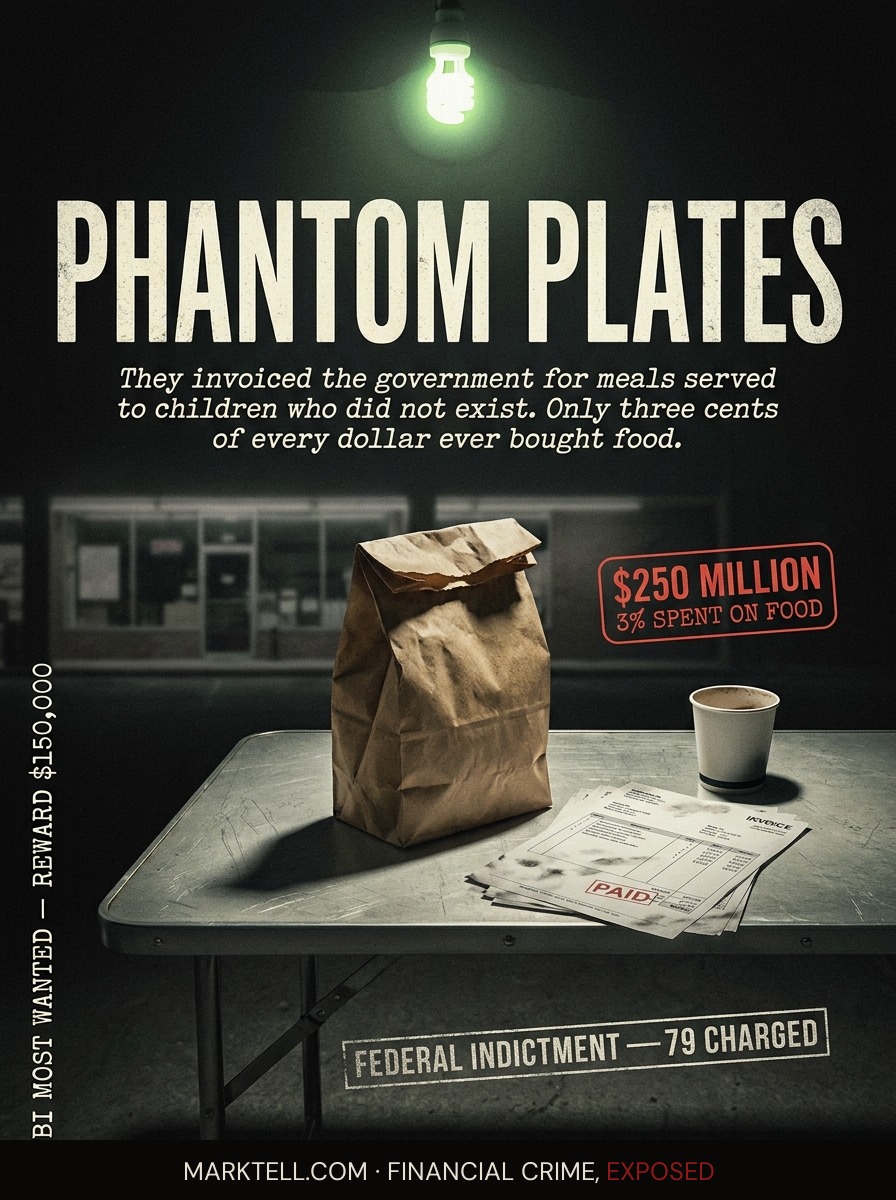
Federal prosecutors say only about three percent of the money the scheme collected was ever spent on food.
Do the math on that. If the whole scheme took in $250 million, and the government says the number may be closer to $300 million or $350 million, then somewhere between $242 million and $340 million was spent on things that were not meals. Court filings describe luxury cars. Real estate. International travel. A wedding.
The children whose names were on the invoices were not real children.
IV. The room where the state lost.
There is a moment in this story that deserves to sit still.
In the summer of 2020, the Minnesota Department of Education began to see the numbers coming out of Feeding Our Future and tried to slow the payments down. MDE had flagged the organization internally as far back as July 2019. In November 2020, Feeding Our Future sued the department. A Ramsey County judge ruled that MDE did not have the legal authority to halt the payments. The state kept paying.
The June 2024 report from Minnesota's Office of the Legislative Auditor used the word "inadequate" to describe MDE's oversight. That is the auditor's word. Not mine.
Between the court order and the FBI raid, roughly fourteen months passed. In those fourteen months, the machine ran at full speed.
Marlene remembers that stretch as the time she was told to keep meticulous records. Her site logged the sacks by hand. She had a clipboard. She had a co-worker who initialed the count. She remembers arguing with a kid one afternoon about whether he had already come through the line, because the rules said one sack per child and she did not want the audit to catch her giving out two.
She was afraid of the audit.
Somewhere across town, the government now alleges, a storefront was invoicing for children who did not exist, and no audit was coming.
V. The list.
The FBI's most-wanted fraudsters list is a small one. It is not the same as the fugitive list you may be picturing. It is a public tool the bureau uses when it wants the public's help finding people it has been unable to locate through ordinary channels. Adding someone to it is a signal. It says: we have exhausted the quiet options.
Fahad Mohamed Nur was added to the list on July 8, 2026. The reward is up to $150,000 for information leading to arrest and conviction.
He is the second Feeding Our Future defendant to appear on it in five weeks. Said Abdullahi Ereg was added on June 5, 2026, and surrendered at Minneapolis-Saint Paul International Airport five days later. Ereg is accused of taking $4.2 million. In late June, another defendant, Abdikerm Abdelahi Eidleh, was taken into custody in Mogadishu.
The pattern the FBI is running is a pressure campaign. Put the face on a poster. Put a price on the face. Wait.
VI. What the machine ate.
Aimee Bock, the founder, was convicted in March 2025. On May 22, 2026, a federal judge sentenced her to 500 months in prison. That is over forty-one years. As of April, sixty-five of the seventy-nine people charged in the scheme had been convicted.
Those are the adjudicated facts. The list is long, and it keeps growing.
The unadjudicated facts include Nur.
But the loss is not only the money. It is the program itself. Every legitimate site that ran during the pandemic, every church basement and community center that actually fed children, now operates under the shadow of what the invoices did. Every immigrant-run food business in Minnesota, and the scheme's defendants were overwhelmingly from the Somali community, now carries the political weight of a scandal the Trump administration cited in late 2025 to justify an immigration operation targeting that community.
Marlene knows two women who worked real sites and who stopped answering their phones when reporters started calling neighborhoods.
That part may be the saddest.
VII. The cold coffee.
She picked the phone back up around seven-thirty. She read the article to the end. She looked at Nur's photograph for a long time, the way you look at a face you are trying to decide whether you have seen before, and then she put the phone down again.
The strip mall she had driven past for two years had, according to the government, been part of a $250 million machine that was billing the United States for meals it did not serve to children who did not exist. The line of children she had actually fed had been real. She had counted them by hand.
The machine was not the pitch. The machine was the invoice. The invoice is what a food program looks like when nobody is checking, and the check is what the country ran out of somewhere between March 2020 and January 2022.
The reward on the poster is $150,000.
The meals were never served. The money moved anyway.
- CBS News | July 8, 2026 | "Man accused in Feeding Our Future scheme added to FBI's 'most wanted fraudsters'"
- U.S. Department of Justice, District of Minnesota | September 2022 | Indictments in Feeding Our Future prosecution
- FBI | July 8, 2026 | Most Wanted Fraudsters listing for Fahad Mohamed Nur
- Minnesota Office of the Legislative Auditor | June 2024 | Special Review of MDE oversight of Feeding Our Future
- U.S. District Court, District of Minnesota | March 2025 | United States v. Aimee Bock, verdict
- U.S. District Court, District of Minnesota | May 22, 2026 | United States v. Aimee Bock, sentencing
- Ramsey County District Court | November 2020 | Feeding Our Future v. Minnesota Department of Education
- FBI | June 5, 2026 | Most Wanted Fraudsters listing for Said Abdullahi Ereg
- Star Tribune, Sahan Journal, MPR News | 2022-2026 | Ongoing reporting on Feeding Our Future prosecutions
Editorial Notice
MarkTell is a true crime publication about financial fraud. Some scenes, dialogue, and sequential details are reconstructed from court filings, enforcement actions, news reports, and public records. Where the public record does not provide exact details, editorial reconstruction is used to convey the documented pattern of events. Names of private individuals may be changed to protect identity. All factual claims are sourced to public documents cited in the Evidence Trail above. MarkTell does not provide investment, legal, or financial advice. Nothing published here constitutes a recommendation to buy, sell, or avoid any investment. Allegations described in active cases have not been adjudicated and defendants are presumed innocent until proven guilty. Readers should conduct their own due diligence before making financial decisions.