The meals were imaginary. The restitution is five million dollars real.
A Rochester man joins the long line of defendants ordered to repay millions in the largest pandemic fraud in American history. The meals were on paper. The money was not.
The room where this kind of sentence gets read does not look like television. Fluorescent light. A wood lectern that has heard a thousand other voices. A prosecutor with a binder. A defense lawyer who has stopped trying to win and started trying to subtract months. The defendant stands. The judge reads the number into the record.
Five million dollars in restitution.
The Post Bulletin reported the sentence this week. A Rochester man, one more name added to a case file that now runs to seventy-nine indictments and sixty-three convictions, according to federal tallies as of early 2026. He will not be the last. The court calendar in the District of Minnesota has been booking these hearings for two years. There is one scheduled for May 21 that the country will pay attention to. There are dozens that no one outside the courtroom will notice at all.
This is what the back end of the largest pandemic fraud in American history looks like. Not a press conference. A docket.
Call the machine by its working name. The meal site.
A meal site, in the federal child nutrition program, is supposed to be a place where children get food. During the pandemic, the U.S. Department of Agriculture loosened the rules so that the food could move. For-profit restaurants could participate. Meals could be distributed off-site. Paperwork could be filed remotely. The loosening was a kindness. It was also a door.
The way the door worked is simple enough that a sixth grader can follow it, which is part of why so many people walked through. A nonprofit called Feeding Our Future, founded in Minnesota in 2016 by a woman named Aimee Bock, was authorized to act as a sponsor. A sponsor is a middleman. The state, in this case the Minnesota Department of Education, sends federal money to the sponsor. The sponsor passes the money to the meal sites. The sponsor takes an administrative fee for the trouble.
In 2019, Feeding Our Future moved about $3.4 million in federal funds. In 2021, it moved close to $200 million. The growth curve is the first place a regulator should have stopped reading and started looking.
What the meal sites were supposed to do was feed children. What many of them allegedly did, according to the federal indictments returned in January and September of 2022, was print numbers. Five thousand meals a day, seven days a week, from a single restaurant. Attendance rosters listing children who did not exist, repeated across sites, sometimes with the same names showing up at different addresses. Invoices that did not match any kitchen any health inspector had ever entered.
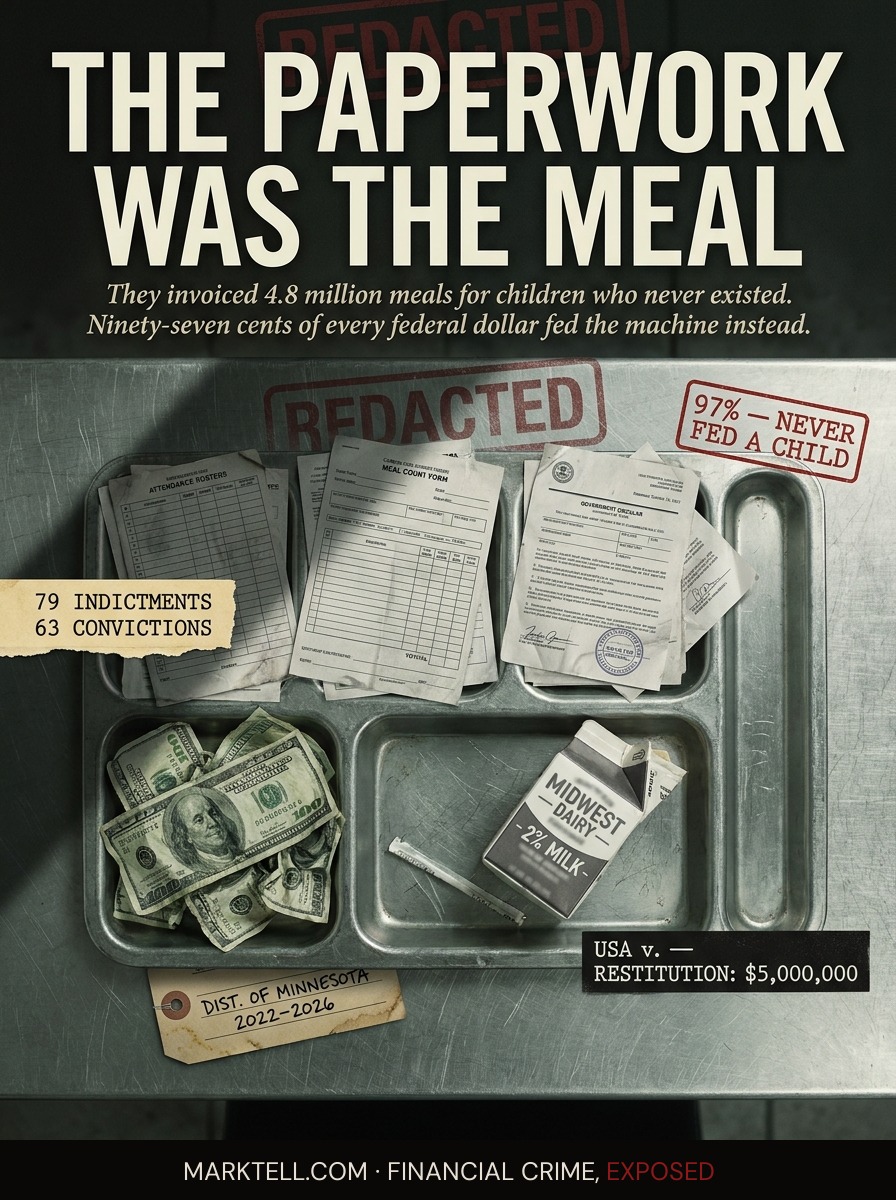
Federal prosecutors allege that of the money that ran through the program in this scheme, roughly three percent actually bought food.
Read that slowly.
Three percent.
Ninety-seven cents of every dollar that the United States Department of Agriculture sent into Minnesota under the banner of feeding hungry children during a pandemic, prosecutors allege, did not feed a child. It bought cars. It bought houses. It bought travel. It paid kickbacks. It paid bribes. It paid administrative fees to a sponsor that, the DOJ alleges, took more than $18 million it was not entitled to.
The children were not the customers. The children were the cover story.
That is the sentence that should sit in the chest a moment.
The Rochester man sentenced this week is one operator of one node. Five million dollars is, in the topology of this case, mid-sized. Mohamed Ismail, sentenced earlier in the docket, was ordered to pay over $47 million and given twelve years. Suleman Yusuf Mohamed pleaded guilty on April 2, 2026, and agreed to repay $8,662,287 for fraudulently claiming, per his plea, to have served more than 4.8 million meals. On April 9, Abdullahe Nur Jesow drew 43 months and an order to repay $866,458 for claims of more than 1.7 million meals.
Each of those numbers is a fiction priced in public money.
At the top of the structure, Aimee Bock and Salim Said, co-owner of Safari Restaurant, were found guilty on all counts on March 19, 2025. Said's restaurant alone, the indictment alleged, claimed to serve 5,000 meals a day every day, drawing more than $3.9 million between April 2020 and November 2021. Bock is scheduled to be sentenced on May 21, 2026. Prosecutors alleged on April 30 that she has been trying to manage the narrative from jail, directing her son to leak court documents to media and elected officials in an attempt to shrink her role before the judge fixes a number.
What the leak strategy concedes, by trying so hard, is that the role was not small.
The Minnesota Department of Education saw early signs in July of 2019 and referred concerns to the FBI in April of 2021. The raids came in January of 2022. The first wave of indictments followed that fall. Read the timeline once forward and once backward. Forward, it is a story about regulators eventually doing their job. Backward, it is a story about how long the door stayed open after the first person noticed it was unlocked.
The Rochester sentence will scroll past most readers because $5 million in this case file is not the headline. It is the routine. That is the part that should make the stomach tighten. A fraud becomes routine when the system that processes it has had to build a routine.
Picture the meal site one more time. Picture the storefront with nothing in the window. Picture the roster with the same handwriting on too many lines. Picture the invoice for thousands of meals that no kitchen ever cooked. Picture the wire transfer leaving the state agency on schedule, every cycle, because the paperwork was correct on its face and no one had walked through the door yet.
The paperwork was the meal.
That is what the machine is for. It converts paperwork into money and calls the paperwork a child.
The Rochester man stood in a courtroom this week and a federal judge attached his name to five million dollars he will likely never fully repay. He will go where the others have gone. The docket will move to the next defendant. The May 21 hearing will draw the cameras. The leadership will be sentenced. The press will write that the case is closing.
The case is closing. The door is not.
Three percent fed the children. The other ninety-seven percent fed the machine. The machine is what is left when the headlines stop. Somewhere, under a different statute, in a different program, with different paperwork, it is already being rebuilt.
- Post Bulletin | May 2026 | "Rochester man sentenced in Feeding Our Future fraud scheme; ordered to pay $5M restitution"
- U.S. Department of Justice, District of Minnesota | January 2022 and September 2022 | Feeding Our Future indictments
- U.S. District Court, District of Minnesota | March 19, 2025 | United States v. Aimee Bock and Salim Said, jury verdict
- U.S. District Court, District of Minnesota | April 2, 2026 | Plea agreement, Suleman Yusuf Mohamed
- U.S. District Court, District of Minnesota | April 9, 2026 | Sentencing, Abdullahe Nur Jesow
- Federal prosecutors' filing | April 30, 2026 | Allegation regarding Bock directing leaks from jail
- Minnesota House Fraud Prevention and State Agency Oversight Policy Committee | May 6, 2026 | Statement regarding Rep. Ilhan Omar records
- USDA Food and Nutrition Service | 2020-2021 | Pandemic-era waivers for Child Nutrition Programs
- Minnesota Department of Education | 2019-2021 | Internal flags and FBI referral chronology, per DOJ filings
Editorial Notice
MarkTell is a true crime publication about financial fraud. Some scenes, dialogue, and sequential details are reconstructed from court filings, enforcement actions, news reports, and public records. Where the public record does not provide exact details, editorial reconstruction is used to convey the documented pattern of events. Names of private individuals may be changed to protect identity. All factual claims are sourced to public documents cited in the Evidence Trail above. MarkTell does not provide investment, legal, or financial advice. Nothing published here constitutes a recommendation to buy, sell, or avoid any investment. Allegations described in active cases have not been adjudicated and defendants are presumed innocent until proven guilty. Readers should conduct their own due diligence before making financial decisions.