The mastermind lived in West Vancouver. The mailbox is in Washington.
For seven years, Fred Sharp allegedly ran the back office of a billion-dollar penny stock machine from a quiet B.C. address. This week, Canada's highest court closed the last door he had left.
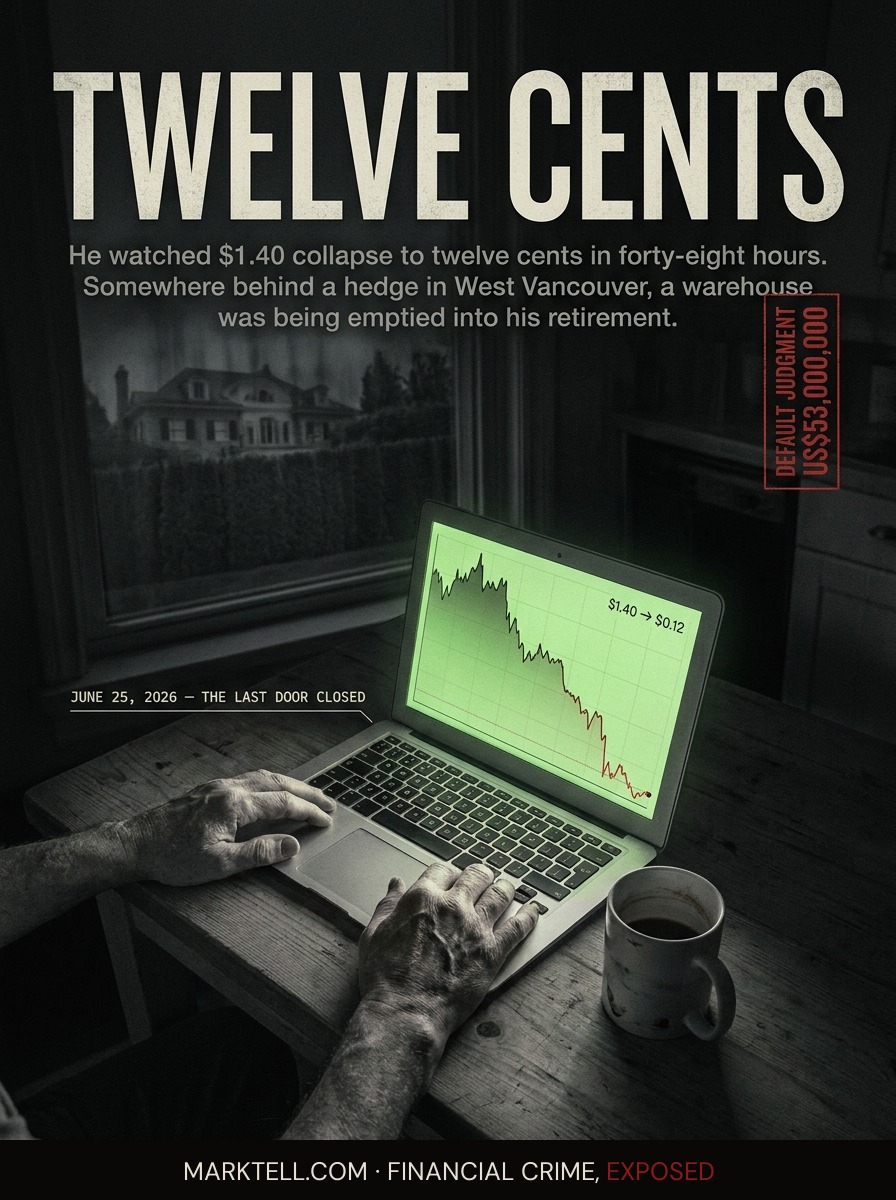
Glen was sixty-eight and he watched the screen the way some men watch the weather.
He had a routine. Coffee at six. Laptop open on the kitchen counter by six fifteen. Level-2 quotes on a small-cap stock somebody on a paid email list had called "the next runner." He had retired from the electrical trade in 2015 and he had decided, like a lot of men his age, that the part of him that used to read schematics could read tickers. He was not stupid. He had built houses you could still drive past in Spokane. He just did not know what he was looking at.
The bid was $1.40 on Monday. By Tuesday afternoon it was twelve cents.
He refreshed the screen. He refreshed it again. The ask kept getting hit. Somebody, somewhere, was selling into him and into every other guy on every other kitchen counter from Spokane to Tampa, and the volume on the tape was not retail volume. It was somebody emptying a warehouse.
Glen did not know it then, but the warehouse was in West Vancouver.
I.
The SEC says the man who ran the warehouse is named Fred Sharp. He is seventy-four. He is a former lawyer. He lives behind a hedge in a part of British Columbia where the houses do not look like they need to be advertised. On June 25, 2026, the Supreme Court of Canada declined to hear his last appeal. With that single line on a docket, the U.S. Securities and Exchange Commission won the right to walk up to his door and start collecting roughly US$30M in illicit profits, part of a total US$53M judgment that has been waiting since 2022.
He never filed an answer to the original U.S. complaint. The judgment is a default judgment. That is a court order entered against a defendant who did not show up to fight. In American federal court, if you do not respond, the allegations are taken as admitted. The number gets entered. The clock starts running.
The clock has been running for four years.
II.
The SEC complaint, filed in 2021, calls Sharp the architect of a stock fraud worth, in its full alleged scope, roughly US$1B. It says he ran the back office for at least seventeen other British Columbians who held control positions in U.S. penny stocks between 2011 and 2019. It says he built the concealment plumbing. It says the plumbing flowed through a network of offshore shell companies, some of them set up through Mossack Fonseca, the Panamanian law firm the world learned about in 2016 when its files spilled into the Panama Papers.
The mechanism, in plain English:
A small U.S. public company exists. Its share price is low. Its float is thin. The true owners of a large block of stock are people in B.C., but the shares on the register are held by shell companies in places where nobody asks who owns the shells. The owners hire promoters. The promoters write the emails. The emails go out to people like Glen.
The price moves up.
The shells sell.
The price falls.
The retail buyer holds the bag. The proceeds get wired back through the plumbing to the beneficial owners in Canada.
That is the machine. The SEC alleges Sharp built it and rented it out.
III.
There are two ways to think about the number US$30M.
The first way is to look at it as a recovery. A regulator, after years of work, has reached the moment where it can begin collecting against a defendant who has fought it from another country. That is not nothing. It is, in fact, remarkable. Cross-border collection in securities cases usually dies on the runway. The U.S. SEC, represented in Canada by Gowling WLG lawyers Malcolm Ruby and Will Chamberlain, walked the judgment through the B.C. Supreme Court (recognition granted June 14, 2024) and then through the B.C. Court of Appeal (dismissal June 25, 2025) and now past the Supreme Court of Canada (leave denied June 25, 2026). Three doors. All shut behind the defendant.
The second way to think about US$30M is to think about Glen.
The SEC's number is disgorgement. That is the legal word for the profit the defendant is alleged to have made. It is not the loss. The loss is bigger than the profit, because the loss includes every retiree who refreshed a screen and watched the bid drop while somebody, in some account, in some jurisdiction, sold into him. The loss is the gap between what Glen thought the stock was and what the stock actually was. The loss is the savings Glen had set aside to help his daughter with a down payment. The loss is the conversation he did not have with his wife about the conversation.
The number on the SEC's judgment is what the regulator can prove changed hands at Sharp's end of the pipe. The number on Glen's screen was what changed hands at his.
Those are different numbers.
IV.
The week the Supreme Court of Canada closed Sharp's last door was not a quiet week for the rest of the network. On June 24, 2026, an Ontario man named Julius Csurgo pleaded guilty to securities fraud in connection with what U.S. prosecutors describe as the same Vancouver-orchestrated machine. On June 19, the SEC filed a fresh civil claim in B.C. Supreme Court trying to recover more than US$50.9M from six other B.C. residents tied to the same US$1B scheme.
Read those three dates again.
June 19. June 24. June 25.
That is not three news items. That is the same machine being disassembled in public, one bolt at a time.
V.
Sharp's lawyer, Joven Narwal, has said his client intends to keep fighting where he can. Sharp was banned from B.C. markets in February 2023. Quebec's Financial Markets Administrative Tribunal fined him $2M (about US$1.5M USD) in March 2026 in a separate matter, which he is appealing. He faces criminal charges in the United States that remain unproven. Allegation is not adjudication. A default judgment is, on the other hand, a judgment.
The distinction will matter to lawyers. It will not matter to Glen.
VI.
Picture the kitchen counter again.
The laptop is still open. The quote is still twelve cents. Glen has done the math three times because the math keeps coming out the same. The number on the screen is not just a number. It is the trip he was going to take with his wife next spring. It is the room he was going to finish in the basement for the grandkids. It is the margin between a retirement that worked and a retirement that did not.
He never met Fred Sharp. He never heard the name. He could not have pointed to West Vancouver on a map without looking it up. The man on the other end of his trade was a paid newsletter writer whose name he no longer remembers, and behind that man was another man, and behind that man was a shell, and behind that shell was a lawyer in a house with a hedge.
That is the architecture. The retail buyer at one end. The lawyer at the other. Everything in the middle exists to make sure the lawyer never has to look at the buyer.
VII.
The SEC has won the right to look at the lawyer.
Whether the SEC actually collects US$30M is a different question. Canadian assets can be moved. Houses can be encumbered. Seventy-four-year-old men have time and lawyers and the patience of people who have already waited out four years of appeals. The judgment is enforceable now. Enforceable is not the same as paid.
But here is what is settled, and it is worth saying plainly.
A man who never showed up to defend himself in a U.S. federal courtroom no longer has a Canadian door to hide behind. The B.C. Supreme Court opened it. The Court of Appeal kept it open. The Supreme Court of Canada refused to close it. Whatever Sharp does next, he does in daylight.
Glen did not get a courtroom. He got a screen that went from $1.40 to twelve cents in two days and a quiet afternoon at a kitchen counter where the math kept coming out the same.
The mastermind lived in West Vancouver.
The mailbox is in Washington.
- Business in Vancouver | June 2026 | "SEC ready to collect US$30M from B.C. stock fraud 'mastermind' after appeal denied"
- SEC v. Fred L. Sharp et al. | filed August 2021 | U.S. District Court, District of Massachusetts
- SEC default judgment against Fred Sharp | 2022 | U.S. District Court
- B.C. Supreme Court recognition order | June 14, 2024 | enforcement under Foreign Money Claims Act
- B.C. Court of Appeal | June 25, 2025 | dismissal of Sharp appeal
- Supreme Court of Canada | June 25, 2026 | leave to appeal denied
- British Columbia Securities Commission | February 2023 | market ban order against Sharp
- Quebec Financial Markets Administrative Tribunal | March 2026 | $2M fine against Sharp
- U.S. v. Julius Csurgo | June 24, 2026 | guilty plea, securities fraud
- SEC civil claim filed in B.C. Supreme Court | June 19, 2026 | recovery action against six additional B.C. residents
Editorial Notice
MarkTell is a true crime publication about financial fraud. Some scenes, dialogue, and sequential details are reconstructed from court filings, enforcement actions, news reports, and public records. Where the public record does not provide exact details, editorial reconstruction is used to convey the documented pattern of events. Names of private individuals may be changed to protect identity. All factual claims are sourced to public documents cited in the Evidence Trail above. MarkTell does not provide investment, legal, or financial advice. Nothing published here constitutes a recommendation to buy, sell, or avoid any investment. Allegations described in active cases have not been adjudicated and defendants are presumed innocent until proven guilty. Readers should conduct their own due diligence before making financial decisions.