The Massachusetts default judgment crossed the border on a Monday in May.
Amar Bahadoorsingh did not appear in Boston in 2023. He did not appear in Toronto in 2026 either. The ban arrived anyway, and the machine he allegedly fed has three other B.C. names attached to it this spring.
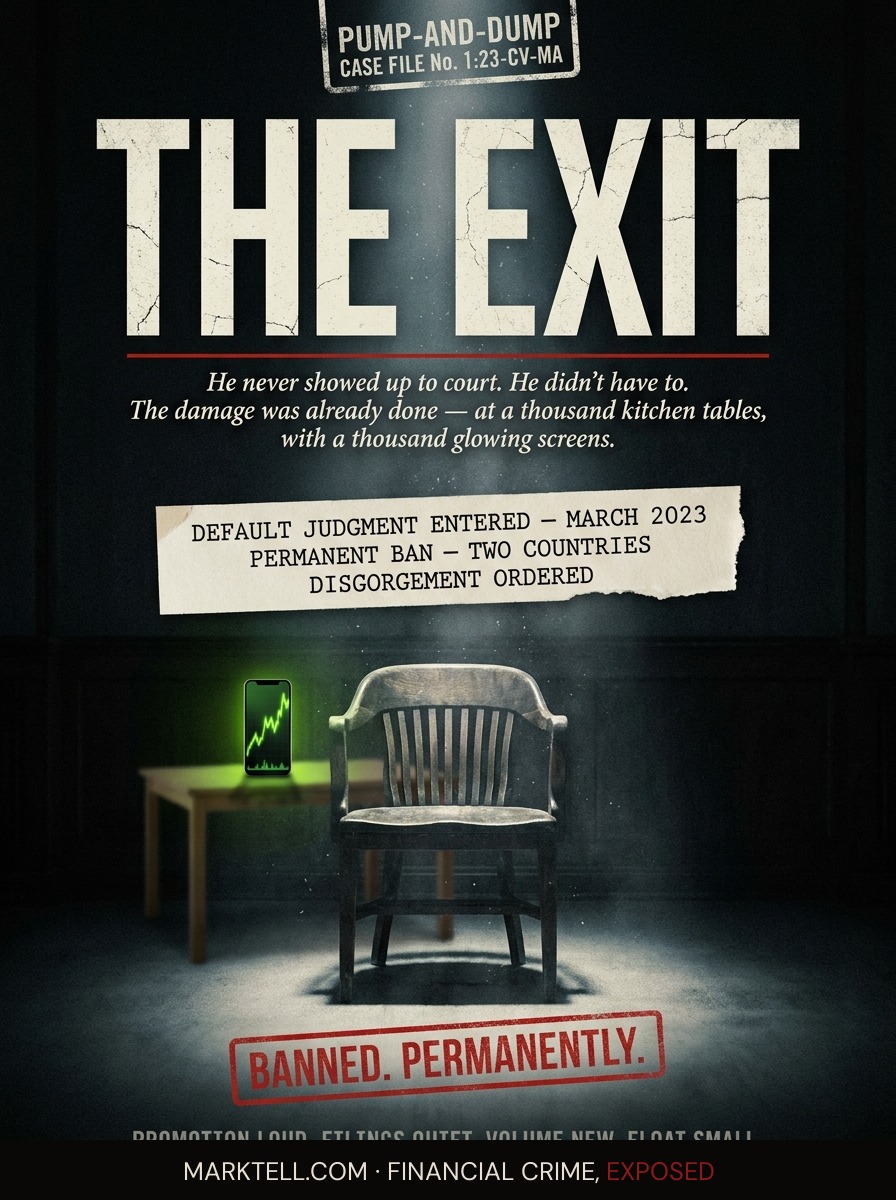
The hearing room in Toronto did not need him.
That is the first thing to understand about how this kind of case ends. The Ontario Capital Markets Tribunal sat down in early May 2026 to issue a permanent ban against a British Columbia resident named Amar Bahadoorsingh, and Bahadoorsingh was not there. He had not been in Boston either, three years earlier, when a U.S. federal judge entered a default judgment against him on the SEC's complaint. He was not in either room. The orders were issued anyway. That is what default means. The defendant declines to contest. The court rules on the record in front of it. The paper does the work.
A man can be permanently banned from the capital markets of two countries without ever sitting in a chair across from a regulator.
I want you to picture the other end of this. Not the empty chair in Toronto. The full chair somewhere in the United States. A retail buyer at his kitchen table with a brokerage app open. He is looking at a ticker he had never heard of a week ago. The ticker is moving. The volume is real. Or the volume looks real. He reads a promotional alert that arrived in his inbox. He reads a message board post. He buys.
That is the room where this fraud actually happens. Not the courtroom. The kitchen.
I.
Here is what the U.S. record says, and the U.S. record is the spine of this story.
In March 2023, the U.S. District Court of Massachusetts entered a default judgment against Amar Bahadoorsingh on a complaint brought by the U.S. Securities and Exchange Commission. The court ordered disgorgement of his alleged gains, imposed a civil penalty, and barred him permanently from trading in the securities the SEC named. The SEC's complaint described pump-and-dump schemes operated on the over-the-counter markets in the United States. The two tickers identified were Momentous Holdings Corp. and Uneeqo Inc.
A pump-and-dump is a simple machine. Define it cleanly so nobody loses the thread.
You quietly accumulate shares in a small company whose stock barely trades. You hire promoters, or you become the promoter, and you push the stock through email blasts, paid alerts, social posts, message-board hype. The price rises because the volume rises. New buyers arrive. They see a chart going up and a story being told and they buy in. That is the pump.
Then you sell. All at once, or in waves. You sell into the buying you created. The price collapses when your selling overwhelms the demand the promotion manufactured. The new buyers are left holding shares that are worth a fraction of what they paid. That is the dump.
The mechanism is older than the SEC itself. It works because human beings see a chart climbing and want in. The chart is the bait. The buyers are the fuel.
II.
Bahadoorsingh did not contest the SEC's complaint. He let the default judgment run. There are reasons people do this. Sometimes they are out of the country and out of reach. Sometimes the cost of fighting is more than the cost of being banned in markets they do not plan to use again. Sometimes silence is the lawyer's advice.
The Ontario Securities Commission watched the U.S. order and moved to reciprocate it. Reciprocation is a tool Canadian regulators use to make sure a person sanctioned in one jurisdiction cannot simply continue across the border. The OSC argued to the Capital Markets Tribunal that Bahadoorsingh's U.S. conduct, if it had happened in Ontario, would have constituted fraud under Ontario securities law. The Tribunal agreed. It granted a permanent ban from Ontario's capital markets without a hearing from the defendant.
Read that line again. Without a hearing from the defendant. Bahadoorsingh did not appear. The ban was granted on the record.
III.
This case is not alone. That is the part the headline does not carry.
In the same six-week window, Ontario's Capital Markets Tribunal moved against three other British Columbia residents on the same kind of conduct. On April 9, 2026, the Tribunal permanently banned Bradley J. Moynes, also of B.C., for a U.S. pump-and-dump involving Digatrade Financial Corp. and Formcap Corp. The U.S. record on Moynes ordered disgorgement of US$1.3M and a penalty above US$200K, with the alleged scheme generating close to US$6M in illicit proceeds.
On April 29, 2026, B.C. regulators moved on Jackson T. Friesen of Delta, B.C. A U.S. federal court had ordered Friesen in October 2023 to repay US$11.8M to investors and pay a US$1.56M civil penalty. The judgment was upheld on February 19, 2026. The U.S. action described Friesen's involvement in pump-and-dump activity touching fourteen public companies, part of a larger scheme the U.S. government alleged moved more than US$1B in illicit stock transactions.
Three names. One province. One pattern. One six-week window.
That is not three coincidences. That is a machine with a known location.
IV.
I have sat in rooms that fed machines like this one. Not these specific tickers. Not these specific defendants. The room. The room is the same room I have been describing in these chapters for forty years. A handful of guys, a list of phone numbers or a list of email addresses, a thinly-traded ticker that almost nobody is watching, and a story to tell about why the ticker is about to move.
The story is always tight. Some catalyst. Some announcement. Some "you have to be in by Friday." The urgency is the close. The exclusivity is the close. The story is engineered to make the buyer feel like he is early.
He is not early. He is the exit.
That is the renaming you should keep. The retail buyer who chases a promoted OTC ticker is not an investor in that moment. He is the exit. The structure of the trade requires somebody to buy what the operator is selling at the top. If nobody buys, the operator's shares cannot become money. The buyer's purchase is what completes the machine.
This is why pump-and-dump is so durable. The product is not a stock. The product is the buyer.
V.
What the public record cannot tell you is what Bahadoorsingh's life looks like in B.C. right now. We do not know where he is. We do not know whether he has any intention of trading again. We do not know what the proceeds funded or where they went. The U.S. court ordered disgorgement, which means the court ordered him to give back his alleged gains. Whether the SEC has collected is a separate question, and the public docket on default judgments often goes quiet after the order. Collection is the unglamorous part. It is also the part that determines whether justice was a piece of paper or a piece of money returned.
The Ontario ban is a fence. It says Bahadoorsingh cannot operate in Ontario's regulated markets. It does not undo the trades. It does not find the buyers. It does not return the difference between what the buyers paid and what the shares were worth when the volume disappeared.
The fence is still worth building. Fences slow the next operator down. Fences create a record the next regulator can reciprocate. Fences are how you starve a machine that runs on the assumption that crossing a border will let you start again.
VI.
The thing to take from this chapter is not Bahadoorsingh's name. He is a default judgment with a permanent ban attached. He is one of four B.C. names this spring.
The thing to take is the shape of the trade.
If a stock you have never heard of starts moving on volume that appeared from nowhere, somebody made that happen. If a newsletter or an alert or a Telegram channel or a YouTube clip is telling you why this OTC ticker is about to run, somebody paid for that telling. If the urgency in the message is high and the company's filings are thin, the ratio is the warning.
Promotion loud. Filings quiet. Volume new. Float small.
That is the shape. It does not change. The names of the tickers change. The names of the operators change. The province changes. The exchange changes. The pitch language gets refreshed every few years to match whatever the retail crowd is excited about. The shape underneath stays the same.
The empty chair in the Toronto tribunal room is the chair the operator was always going to leave empty. He did not need to be there. He had already done the work in the kitchens of the buyers. The hearing was the cleanup.
The buyer in the kitchen is the chair the story is actually about.
He is the one who showed up.
- Advisor.ca | May 4, 2026 | "Tribunal bans B.C. man over U.S. pump-and-dump"
- Ontario Capital Markets Tribunal | May 2026 | Reciprocal ban order against Amar Bahadoorsingh
- U.S. District Court of Massachusetts | March 2023 | Default judgment, SEC v. Bahadoorsingh
- U.S. Securities and Exchange Commission | 2022-2023 | Complaint re: Momentous Holdings Corp. and Uneeqo Inc.
- Ontario Capital Markets Tribunal | April 9, 2026 | Permanent ban order against Bradley J. Moynes
- U.S. federal court | October 2023, upheld February 19, 2026 | Order against Jackson T. Friesen
- B.C. Securities Commission proceedings | April 29, 2026 | Action against Jackson T. Friesen
Editorial Notice
MarkTell is a true crime publication about financial fraud. Some scenes, dialogue, and sequential details are reconstructed from court filings, enforcement actions, news reports, and public records. Where the public record does not provide exact details, editorial reconstruction is used to convey the documented pattern of events. Names of private individuals may be changed to protect identity. All factual claims are sourced to public documents cited in the Evidence Trail above. MarkTell does not provide investment, legal, or financial advice. Nothing published here constitutes a recommendation to buy, sell, or avoid any investment. Allegations described in active cases have not been adjudicated and defendants are presumed innocent until proven guilty. Readers should conduct their own due diligence before making financial decisions.