The marketplace died in 2019. The wallet woke up in 2022.
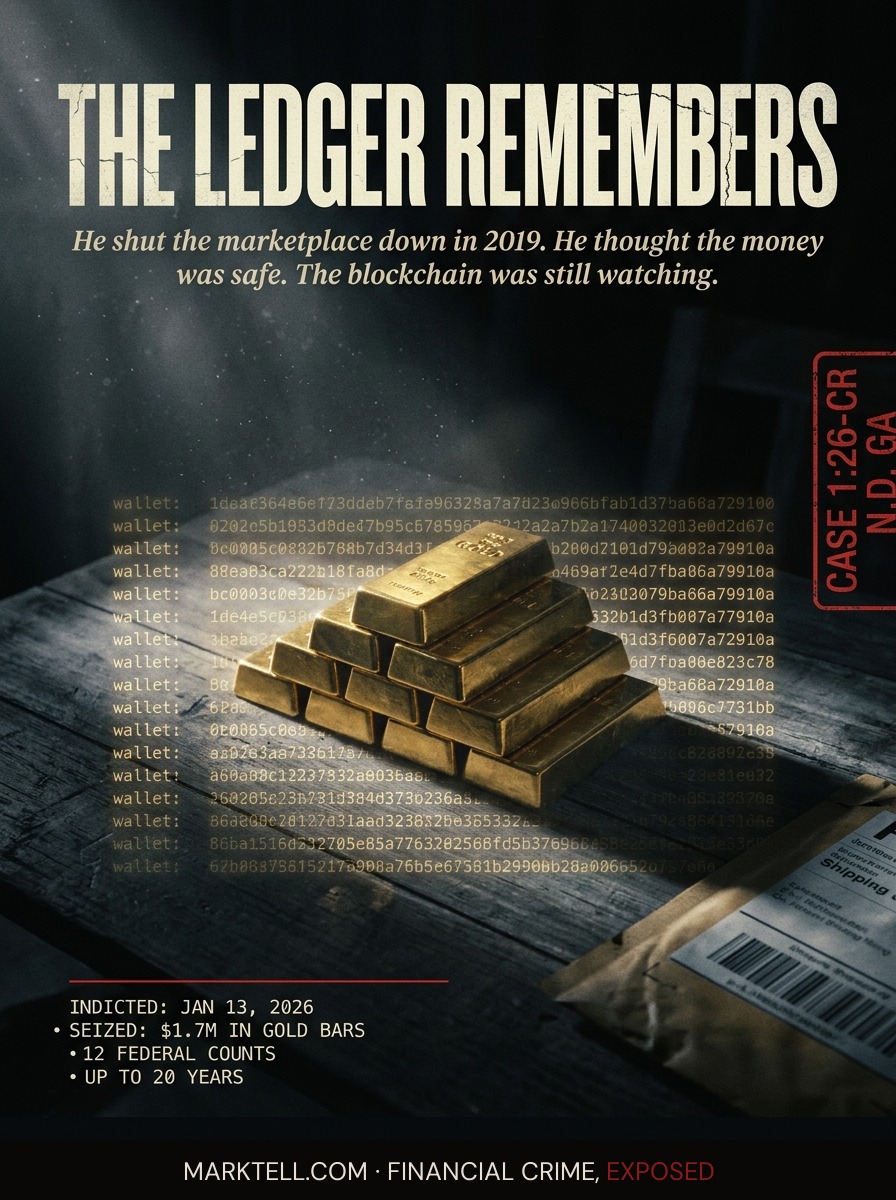
Federal prosecutors say Owe Martin Andresen sat on millions in administrator commissions from the shuttered Dream Market, then converted them to gold bars shipped to his door. The wallet he thought had gone quiet had been watched the whole time.
Trent is thirty-eight. He works in IT for a hospital system in the Midwest. In 2018 he bought something on the internet he should not have bought. Not a lot of it. Enough to fit in a padded envelope. He paid in Bitcoin because that was how the site worked. He clicked a button on a page that looked, if you squinted, like Amazon. Listings. Reviews. Stars. A cart. A checkout.
The site was called Dream Market. It ran from 2013 to April 2019. Drugs, mostly. Stolen identities. Fake passports. A flea market for things that get you arrested. When the site shut itself down in the spring of 2019, the people who ran it sent a polite message to users and went quiet.
Trent forgot about it. The package had come. The package had been used. The wallet he used to pay was on an old laptop in a closet. He moved on. He got married. He had a kid. He told himself the trail went cold the day the site went dark.
The trail did not go cold. The wallet did.
There is a difference.
A dormant cryptocurrency wallet is not a closed wallet. It is a wallet that is not moving. Every transaction that ever flowed into it is still visible on a public ledger that anyone with a laptop can read. The Bitcoin blockchain does not forget. It cannot forget. Forgetting is not in its design.
When Trent clicked checkout in 2018, his payment moved to a vendor's wallet. A small percentage of it, the marketplace's commission, moved to a wallet controlled by Dream Market's administrators. That wallet sat. For years it sat. Through the shutdown. Through the arrests of vendors. Through a pandemic. Through a presidential election. Through Trent's wedding.
In late 2022, according to a federal indictment returned in the Northern District of Georgia on January 13, 2026, the wallet woke up.
The indictment names Owe Martin Andresen, a 49-year-old German citizen, and alleges he is the person who operated Dream Market under the handle Speedstepper. Prosecutors say he accessed the marketplace's old administrator wallets, the ones holding years of accumulated commissions, and began moving the funds. Doing that required the original private keys. A private key, for the reader who has not had to care: it is the long string of characters that proves you own a cryptocurrency wallet. Lose it and the money is gone forever. Keep it and you control everything inside, even if the wallet has not moved in three years.
According to the U.S. Department of Justice, Andresen allegedly moved over $2 million between August 2023 and April 2025. He did not move it to a bank. Banks ask questions. He moved it, the indictment says, to an Atlanta-based cryptocurrency service that converts digital currency into physical gold. The gold was then shipped to his home in Germany.
Read that again. Gold bars. Shipped to a house.
On May 7, 2026, German law enforcement, coordinating with U.S. authorities, walked into Andresen's residence and searched it. They found approximately $1.7 million in gold bars. They found over $23,000 in cash. They found documentation pointing to bank accounts and additional cryptocurrency wallets holding roughly $1.2 million more. Every dollar of it, prosecutors allege, traces back to Dream Market.
Picture the room. The bars stacked somewhere. A closet. A safe. A drawer.
This is the part that is worth slowing down for, because it is the part the machine depends on you not understanding.
The people who ran Dream Market believed that when the site shut down, the heat would shut down with it. That the buyers would forget. That the vendors would scatter. That the wallets would just be numbers on a screen nobody was looking at anymore.
The buyers did forget. Trent forgot. The vendors did scatter, mostly.
The wallets were not numbers nobody was looking at. The wallets were a public address that any IRS Criminal Investigation analyst could pull up on a Tuesday morning with a cup of coffee. The ledger sat there waiting. The moment the operator decided to touch the money, the moment the wallet moved, the chase began. Not started. Continued. The watchers had been watching the whole time. They were waiting for the operator to get tired of looking at a number and want to hold something real.
Gold is what people want when they want to hold something real.
The U.S. Attorney for the Northern District of Georgia, Theodore S. Hertzberg, said in a statement that the goal of the prosecution is to make sure no one profits from running an online market for narcotics and fraud. The IRS Criminal Investigation special agent in charge, Kareem Carter, said the case shows that financial footprints last. The DEA said something about technology and trafficking. The press release said the things press releases say.
What the press release did not say, but what the case shows, is simpler. The site closed in April 2019. The arrest came in May 2026. Seven years. The machine was patient. Andresen, prosecutors allege, was not patient enough.
If he had left the wallets alone, he might still be free. The money would have sat there. He would have had nothing to spend. He would also have had nothing to lose.
The choice to move the money is the choice that ends the silence.
Trent is reading the news on his phone in his kitchen. He does not know the name Owe Martin Andresen. He does not know about the gold bars. He reads the headline. He scrolls past it. He has a kid to drop off at school.
The wallet he used in 2018 is in a closet on a laptop he has not opened in years. The transaction is still on the chain. It will be on the chain in 2030. It will be on the chain in 2050. The chain does not care about Trent's wedding or his kid or his career. The chain is a list.
Federal charges in the United States carry up to twenty years per count. Andresen faces twelve. The German charges carry up to five each. He has not entered a plea in U.S. court. He has not been extradited. The charges are allegations. A grand jury saw enough to indict. A trial jury has not seen anything yet.
The buyers who clicked checkout in 2018 are not the story. They were never the story. The vendors who shipped the packages, most of them, are not the story either. Many of them were caught years ago.
The story is the wallet that sat for three years and then did not.
The story is the operator who built a machine designed to outlast the heat and then could not outlast his own hunger to hold the money.
He waited three years and broke. Three years is a long time to a person. Three years is nothing to a ledger.
- U.S. Department of Justice, Northern District of Georgia | January 13, 2026 | Indictment of Owe Martin Andresen, twelve counts of money laundering
- U.S. Department of Justice press statements | May 2026 | Statements from U.S. Attorney Theodore S. Hertzberg, IRS-CI SAC Kareem Carter, DEA SAC Miles Aley
- German Federal Police coordinated arrest report | May 7, 2026 | Search and seizure at Andresen residence, recovery of approximately $1.7M in gold bars, $23K cash, $1.2M in wallets and accounts
- 11Alive.com / Gray News reporting | May 13, 2026 | German man indicted in U.S. for laundering millions tied to darknet 'Dream Market'
- Public reporting on Dream Market shutdown | April 2019 | Voluntary closure announcement
- Operation SaboTor public records | 2019 | Multinational darknet enforcement action
Editorial Notice
MarkTell is a true crime publication about financial fraud. Some scenes, dialogue, and sequential details are reconstructed from court filings, enforcement actions, news reports, and public records. Where the public record does not provide exact details, editorial reconstruction is used to convey the documented pattern of events. Names of private individuals may be changed to protect identity. All factual claims are sourced to public documents cited in the Evidence Trail above. MarkTell does not provide investment, legal, or financial advice. Nothing published here constitutes a recommendation to buy, sell, or avoid any investment. Allegations described in active cases have not been adjudicated and defendants are presumed innocent until proven guilty. Readers should conduct their own due diligence before making financial decisions.