The man who told you the stock was uninvestible was already covering his short.
A retail investor in Phoenix watched a Citron Research tweet and shorted Roku alongside the man he trusted. Federal prosecutors say that man had already closed his position. The trial of Andrew Left begins this week.
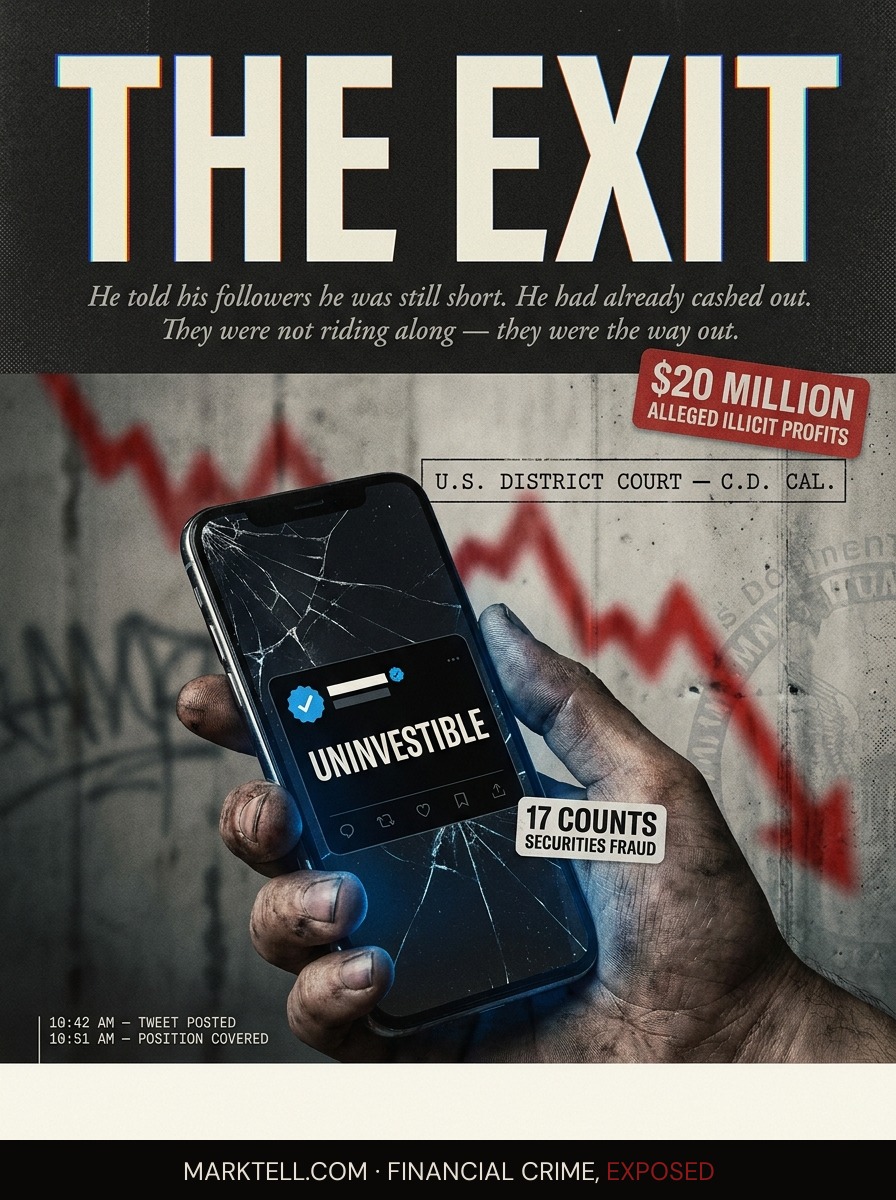
Daniel was forty-seven, a service manager at a Toyota dealership off the 51 in Phoenix, and on his lunch break in late October 2019 he was sitting on the bumper of a Tacoma in the back of the bay, scrolling his phone. The phone screen had a film of grease on it from the morning. He wiped it on his shirt and opened X. Citron Research had posted something about Roku.
"Uninvestible." That was the word in the post. Andrew Left, the man behind Citron, had been on CNBC the week before in a dark blazer, calm, fluent, making the case that Roku was a fad and the stock was going to crack. Daniel had been hearing the name Citron for years. The guy had taken down companies. The guy had been right about Valeant. The guy had been right about a lot of things.
Daniel had a small options account. Eleven thousand dollars in it that he had built up over two years. He went back to the service desk, opened his broker app, and bought puts on Roku. Not many. Enough to feel like he was riding along with someone who knew. He told himself he was being smart. He was siding with the short seller.
The stock dropped that day. Then it bounced. Daniel's puts ended the week underwater. Within a few sessions, he closed them at a loss he did not want to write down.
What Daniel did not know, what federal prosecutors now allege, is that Andrew Left was not still short Roku when the stock dropped. The Department of Justice alleges Left had already begun covering. Then he posted that he was "watching ROKU from the side." The indictment claims Left made roughly $700,000 on Roku that day. The people who followed him in were not riding along. They were the exit.
The criminal trial of Andrew Left, fifty-five, founder of Citron Research, began jury selection on Monday, May 11, 2026, in the United States District Court for the Central District of California. He faces one count of engaging in a securities fraud scheme, seventeen counts of securities fraud, and one count of making false statements to federal investigators. If convicted on the scheme count alone, the statutory maximum is twenty-five years in prison.
The Securities and Exchange Commission filed a parallel civil complaint. The SEC alleges a multi-year scheme that ran from March 2018 through December 2020 and generated at least $20 million in illicit profits. The DOJ pegs the criminal-side profits at at least $16 million. The companies named in the filings include Roku, Tesla, American Airlines, Nvidia, Meta, GameStop, Grand Canyon Education, and Peloton. Twenty-three tickers in all.
I want to slow down and explain the machine, because this is the part that touches everyone who has ever read a stock take on a phone screen and changed a trade because of it.
An activist short seller is someone who borrows shares of a company, sells them, and bets the price will fall so they can buy the shares back cheaper and pocket the difference. Then they publish a report or a tweet or a TV appearance explaining why the company is bad. The publication moves the price. That part is legal, mostly. Opinion is opinion. The First Amendment is a real thing.
The line, the line the government says Andrew Left crossed, is this. You are allowed to share your view. You are not allowed to tell your followers you are still holding a position when you have already closed it, because that statement is a lie about a material fact, and the lie is what moves the price into the trade you just exited. The bait is the public conviction. The switch is the quiet cover.
Prosecutors allege Left did this dozens of times. They allege he would short a stock, publish a bearish call, watch the price tank, buy back his shares, then tweet that he was still bearish. Or he would go long, publish a bullish call, ride the spike, sell, and tell his audience he was still in. The indictment alleges he sometimes reversed positions within hours of his own posts.
The SEC complaint also alleges Left concealed financial relationships with hedge funds. According to the SEC, he fabricated invoices and routed payments through third parties to hide the fact that hedge funds were paying for or benefiting from his commentary. If true, that means the loud independent voice on television was, in some moments, a paid speaker for the people on the other side of the trade from his audience.
Left denies the allegations. His public position, repeated in interviews including one in April of this year, is that he acted in good faith, that there is no rule requiring a short seller to hold a position for any specific period after publishing, and that his commentary is protected speech. He told one outlet he had been using an AI chatbot to help him prepare for trial. He said he believed in justice. He said he expected to prevail.
That is the case the jury will weigh. Allegation is not conviction. Twelve people in Los Angeles will sit through weeks of trade records, tweets, television clips, and witness testimony. The Justice Department has said it expects retail investors to testify.
Picture that for a moment. A retail investor on a witness stand, explaining to a jury that he saw a tweet, that he believed the man who wrote the tweet, that he placed a trade, that he lost money. Explaining that he thought he was on the same side as the man with the platform.
That is Daniel's story too, in a smaller way. Daniel did not lose his house. He lost eleven hundred dollars over the course of three trades that year, all of them taken in response to Citron posts. He told himself it was tuition. He told himself the next one would be different. He kept following.
The thing the case is really about, underneath the counts and the statutes and the free-speech argument his lawyers will raise, is the architecture of trust on financial social media. A person with a verified account and a track record gets believed. The belief moves money. If the person on the microphone is allowed to trade against the audience he just rallied, then the microphone is a weapon. If he is not, then a lot of what happens on financial X every day is a crime in slow motion.
The government is arguing for the second reading. The defense will argue for the first. Free speech, no holding-period rule, opinion is opinion.
Read the indictment slowly when it becomes public again during trial. The dates and the trades sit next to each other. The tweet goes out at one timestamp. The cover trade clears at another. The gap is sometimes minutes.
Daniel does not follow Citron anymore. He still trades a little, smaller now, mostly index funds in a Roth. He told a friend at the dealership last year that the part that still bothers him is not the money. The money was small. What bothers him is that for a year and a half he thought he was learning from someone. He thought he was getting smarter. He was reading the man who was running the trade he was on the wrong side of.
The trial that started Monday will decide, in the legal sense, whether that is what happened.
For Daniel, the verdict came a while ago. He just did not know he was on the witness stand the whole time.
- Reuters | May 11, 2026 | "Short seller Andrew Left to stand trial in LA over manipulation charges"
- U.S. Department of Justice, Central District of California | July 26, 2024 | Indictment, United States v. Andrew Left
- U.S. Securities and Exchange Commission | July 26, 2024 | SEC v. Andrew Left and Citron Capital LLC, civil complaint
- SEC Litigation Release | July 26, 2024 | Allegations of $20M multi-year fraud scheme, March 2018 to December 2020
- U.S. District Court, Central District of California | December 2025 | Order denying motion to dismiss
- Hong Kong Market Misconduct Tribunal | 2016 | Sanction against Andrew Left re: Evergrande Group commentary
- Bloomberg, CNBC, Reuters | 2018-2026 | Public appearances and tweets by Andrew Left referenced in the indictment
Editorial Notice
MarkTell is a true crime publication about financial fraud. Some scenes, dialogue, and sequential details are reconstructed from court filings, enforcement actions, news reports, and public records. Where the public record does not provide exact details, editorial reconstruction is used to convey the documented pattern of events. Names of private individuals may be changed to protect identity. All factual claims are sourced to public documents cited in the Evidence Trail above. MarkTell does not provide investment, legal, or financial advice. Nothing published here constitutes a recommendation to buy, sell, or avoid any investment. Allegations described in active cases have not been adjudicated and defendants are presumed innocent until proven guilty. Readers should conduct their own due diligence before making financial decisions.