The man at the door wore a badge that did not exist.
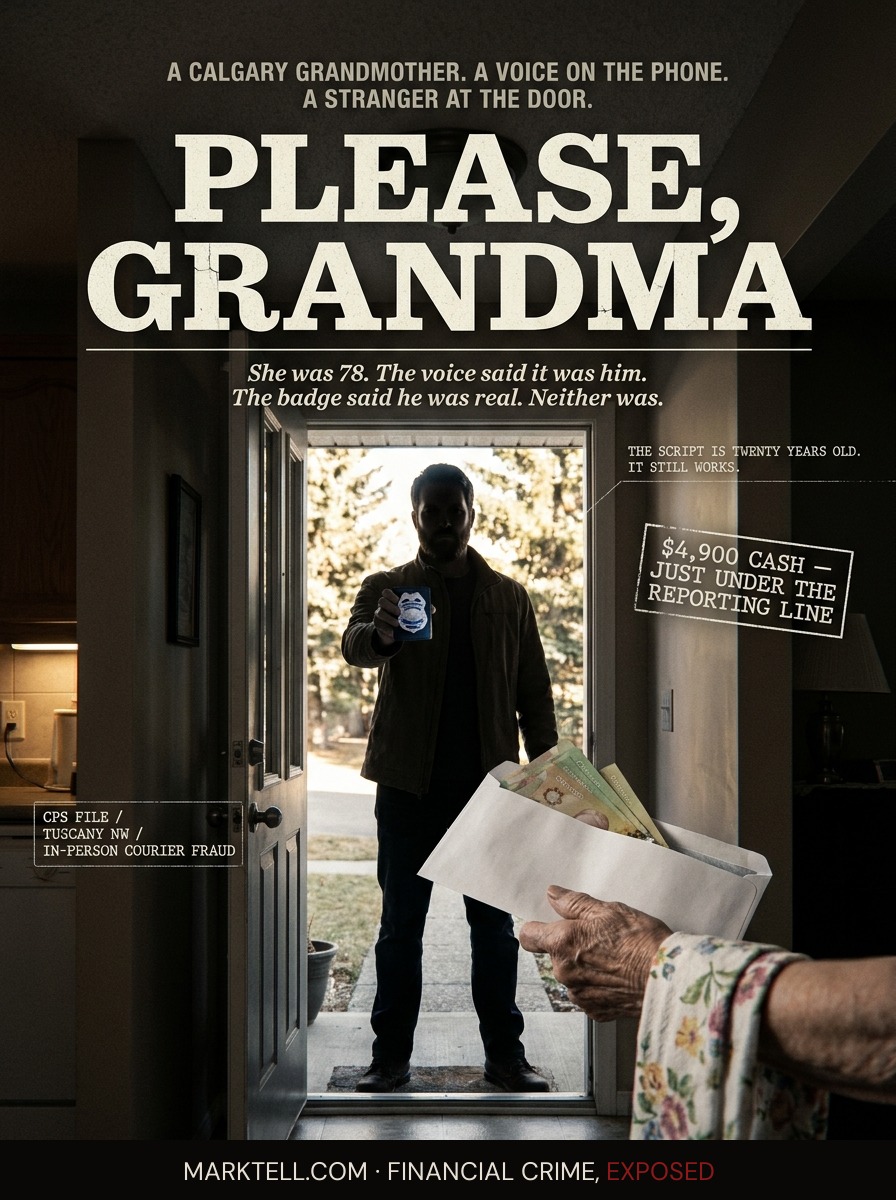
On a March afternoon in Tuscany Ride Close, a Calgary woman withdrew nearly $5,000 in cash because a voice on the phone said her grandson was in jail. The man who came to her door wore the costume of a detective who did not exist.
Margaret was rinsing a coffee mug when the phone rang.
The cordless one. The kitchen phone with the big buttons her son bought her after the cataract surgery. She dried her hands on the dishtowel hanging from the oven handle and picked it up on the third ring, the way she always did, because she did not want to seem too eager and she did not want to miss it.
A young man was crying.
"Grandma."
She said his name. She said the name of the grandson whose voice she thought she was hearing. She does not need to say it out loud now. The investigators have it. She said it.
The young man on the line said yes. Said he was in trouble. Said he was in Edmonton. Said there had been an accident and the other driver was hurt and the police had taken him in and he was scared and he did not want his mother to know, not yet, not until he could explain it himself. He said he needed bail money. He said the lawyer would not talk to him until the bail was paid. He said please.
He said please, Grandma. Don't tell Mom.
Margaret is seventy-eight. She worked thirty-one years in a school library and raised two children and buried a husband and she does not think of herself as someone who falls for things. She has read the warnings in the Tuscany community newsletter. She has heard her son say the word "scam" at Thanksgiving dinner more than once.
But the voice on the phone was crying.
And the voice on the phone was using the only word that mattered.
Grandma.
I.
This is the script. Read it slowly.
A senior picks up the phone. A young man says Grandma or Grandpa or Nana or Papa. He is crying or his voice is muffled because he says he hurt his face in the accident, which conveniently explains why he does not sound exactly like the grandchild she remembers. He is in another city. Edmonton works because Calgary does not have easy eyes on an Edmonton jail. He is in trouble. He needs money. He cannot let his parents know.
That last part is the lock on the door.
The instruction to keep it secret is what isolates the mark from the only people who could verify the story in thirty seconds. A phone call to her son would have ended the operation. The script knows that. The script has known that for twenty years.
Then a second voice gets on the line. The lawyer. The bail bondsman. The detective. He is calm where the grandson was panicked. He uses procedural language. He says terms like "release conditions" and "publication ban." He gives her a number to write down. He tells her how much money she will need and where she can get it.
In Margaret's case, according to Calgary Police Service, the amount was $4,900 (about $3.6K USD at the March 2026 rate). Under the $10,000 threshold that triggers automatic federal reporting in Canada. The number was not random.
II.
The drive to the bank took eleven minutes.
Margaret has lived in Tuscany since 2004. She knows the route to the branch the way she knows the route to her own bathroom in the dark. She parked. She walked in. She told the teller she needed to withdraw forty-nine hundred dollars in cash.
This is the moment a lot of these scams die. A teller asks a question. A teller pulls a manager. A teller slides a printed warning across the counter, the one most Canadian banks now keep within arm's reach, the one that says in plain language: are you being asked to send money to help a family member in trouble.
We do not know what was said at the counter that day. The Calgary Police Service public appeal does not include those details. What we know is that Margaret left the branch with the money in an envelope and drove home and sat in her kitchen and waited for the man who was coming to pick it up.
He arrived in the afternoon.
He was, according to police, between thirty and forty years old. Five foot ten. Black hair. A beard. He stood on her front step on Tuscany Ride Close NW and he told her he was a detective with the Edmonton Police Service. He may have shown her something. A badge. A wallet. A laminated card. The record does not say. What the record says is that she gave him the envelope.
And he walked back to whatever car he came in, and he drove away, and that was the end of his appearance in the story.
III.
The Calgary Police Service does not collect bail money at your door. The Edmonton Police Service does not collect bail money at your door. No police service in Canada collects bail money at your door. Bail in this country moves through courts and lawyers and bondsmen at courthouse counters. It does not move through a man in a beard who shows up at three in the afternoon in a residential cul-de-sac.
But Margaret did not know that. Margaret had never been arrested. Margaret had never posted bail. Margaret had no reason to know the procedural geography of the Canadian criminal justice system. She had a grandson she loved and a voice on the phone that said please.
That gap is the machine.
The machine is not the man at the door. The man at the door is a courier. He is the second actor in a two-actor play. The first actor, the caller, is somewhere else, possibly in a different country, working from a script that has been refined across thousands of calls. The courier is the local hire. The disposable face.
Calgary has seen this play before. In April 2026, a woman named Alana Love Duncan, forty-eight, pleaded guilty to seven counts of fraud over $5,000 for her work as an in-person courier in a 2023 Calgary grandparent scam that took $70,000 (about $51K USD) from seven victims. In December 2025, Calgary police charged Joshmin Jerrel Garnett, thirty-one, with twenty offenses, including thirteen counts of fraud over $5,000, alleging he and a female accomplice using the name "Linda Jones" took roughly $186,000 (about $137K USD) from more than twenty victims between August and October 2025.
Those cases are at different stages. Duncan's plea is a conviction. Garnett's charges are allegations and have not been proven in court.
The point is not that those are the same people who came to Margaret's door. We do not know who came to Margaret's door. The point is that the role exists. The role has a name. Courier. The role gets filled and refilled because the script keeps working.
IV.
The Calgary Police Service counted thirty-two grandparent scam incidents in the city as of January 2024, with twenty-one of them resulting in losses totaling roughly $180,000 (about $135K USD). Nationally, the Canadian Anti-Fraud Centre logged $11.3 million in losses to grandparent and emergency scams in 2023 (about $8.4M USD), and the CAFC says out loud what every fraud investigator knows in private: the real number is bigger. Most seniors who get taken do not report it. They are embarrassed. They do not want their children to find out. They do not want anyone to think they cannot live alone anymore.
Read that last sentence again. The reason underreporting exists is the same reason the scam works. Shame. The fear of being seen as someone who failed.
The script weaponizes that fear twice. First by telling the victim to keep the call a secret. Then by leaving her too ashamed to tell anyone after.
V.
Margaret figured it out the way most of them figure it out.
She called her grandson. Not because she suspected anything. Because she wanted to know if he was okay, if the bail had worked, if he was home. She called him in the early evening, after the man with the beard had been gone for a couple of hours, and her grandson answered the phone from his apartment in Calgary, where he had been all day, and he said hi, Grandma, what's up.
That is the moment the room rearranges.
That is the moment the kitchen she has stood in for twenty-two years stops being the same kitchen. The tin of butter cookies on the counter is the same tin. The dishtowel is the same dishtowel. The phone with the big buttons is the same phone. But the floor has moved. The voice she heard that morning was not him. The man at her door was not a detective. The envelope is gone. The forty-nine hundred dollars is gone.
She did not call the police first. She called her son.
She told him what happened in the order it happened, and she did not cry until she got to the part about the front door.
The front door is where the loss lives now. Not the money. The door. She used to open it without thinking. Now she stands behind it and waits, and she looks through the side window first, and her hand hesitates on the lock.
VI.
The Calgary Police Service issued the public appeal on May 20, 2026, almost two months after the incident. The suspect is still unidentified. Male, thirty to forty, five foot ten, black hair, beard. That description fits a significant portion of the adult male population of Calgary. Whoever he was, he has had two months to be somewhere else.
The caller is harder. The caller may not be in Canada. The caller may be one person who handles dozens of calls a week, or the caller may be a rotating shift in a room in another country where the script is taped to the wall and the supervisor walks the floor and the phones do not stop.
I have been in rooms like that. Not those rooms specifically. Different rooms. Rooms where the product was platinum or a magazine subscription or a small-cap stock in a company that did not really exist, but the architecture was the same. A script on the desk. A supervisor at the back. A list of names with phone numbers next to them and a column for notes about what worked.
What works on Margaret is not stupidity. Margaret is not stupid. What works on Margaret is the word Grandma, said in a young man's crying voice, on a Monday afternoon, when she is alone in her kitchen rinsing a coffee mug.
The machine is not designed to fool a skeptic. The machine is designed to bypass the skeptic and go straight to the part of her that loved her grandson before she finished hearing his name.
VII.
If you are reading this and your parent is older, or your grandparent is alive, or there is a phone in a kitchen somewhere that belongs to someone who would still pick up on the third ring, do this today.
Pick up your own phone. Call them. Tell them about the script. Tell them the part about the second voice, the detective, the lawyer. Tell them no police officer in this country will ever come to their door for bail. Tell them that if a grandchild calls in trouble, they should hang up and call the grandchild back on the number they already have.
Tell them the word that breaks the script.
The word is wait.
Just wait. Hang up. Wait. Call back.
Margaret did not get the chance to hear that from anyone before the phone rang. She heard it from her son two hours after the envelope was gone.
VIII.
The Calgary Police Service is asking for help identifying the man who came to the door. The investigation is open. The money is not coming back. The Edmonton Police Service detective Margaret let into her afternoon does not exist and never did.
What exists is the costume. The badge that may have been plastic. The bearded man on a doorstep on Tuscany Ride Close NW. The script that has been running in Calgary for years under different names and will be running next week under another one.
Margaret keeps the door locked now.
She used to open it for the mailman.
- CityNews Calgary | May 20, 2026 | Suspect wanted in Calgary 'Grandparent scam' disguised himself as EPS detective: police
- Calgary Police Service | May 20, 2026 | Public appeal for information, March 23, 2026 incident, Tuscany Ride Close NW
- Calgary Police Service | April 10, 2026 | Alana Love Duncan guilty plea, seven counts fraud over $5,000
- Calgary Police Service | December 23, 2025 | Joshmin Jerrel Garnett charges, 20 offenses including 13 counts fraud over $5,000
- Canadian Anti-Fraud Centre | 2023 annual data | Grandparent/emergency scam losses, $11.3M CAD
- Calgary Police Service | January 2024 | Grandparent scam incident totals, 32 incidents, ~$180,000 in losses
- Richmond RCMP | November 27, 2025 | Public warning, grandparent scam increase
- Canadian Bankers Association | public education materials | Senior fraud prevention tips
Editorial Notice
MarkTell is a true crime publication about financial fraud. Some scenes, dialogue, and sequential details are reconstructed from court filings, enforcement actions, news reports, and public records. Where the public record does not provide exact details, editorial reconstruction is used to convey the documented pattern of events. Names of private individuals may be changed to protect identity. All factual claims are sourced to public documents cited in the Evidence Trail above. MarkTell does not provide investment, legal, or financial advice. Nothing published here constitutes a recommendation to buy, sell, or avoid any investment. Allegations described in active cases have not been adjudicated and defendants are presumed innocent until proven guilty. Readers should conduct their own due diligence before making financial decisions.