The loan was approved. Only forty percent of it ever reached her account.
Kondagaon Police arrested five men this week in an alleged ₹12 crore ($1.4M USD) loan scheme that ran through 43 teachers' salary accounts. The pitch was simple. The math was the trap.
Sunita is forty-four. She has taught primary school in a village outside Kondagaon for nineteen years. Her salary is fixed. Her provident fund is fixed. Her husband drives a shared jeep on the district road, and the money comes in unevenly, so the household runs on her account. Two children in secondary school. Fees due in July. A roof that has needed work since last monsoon.
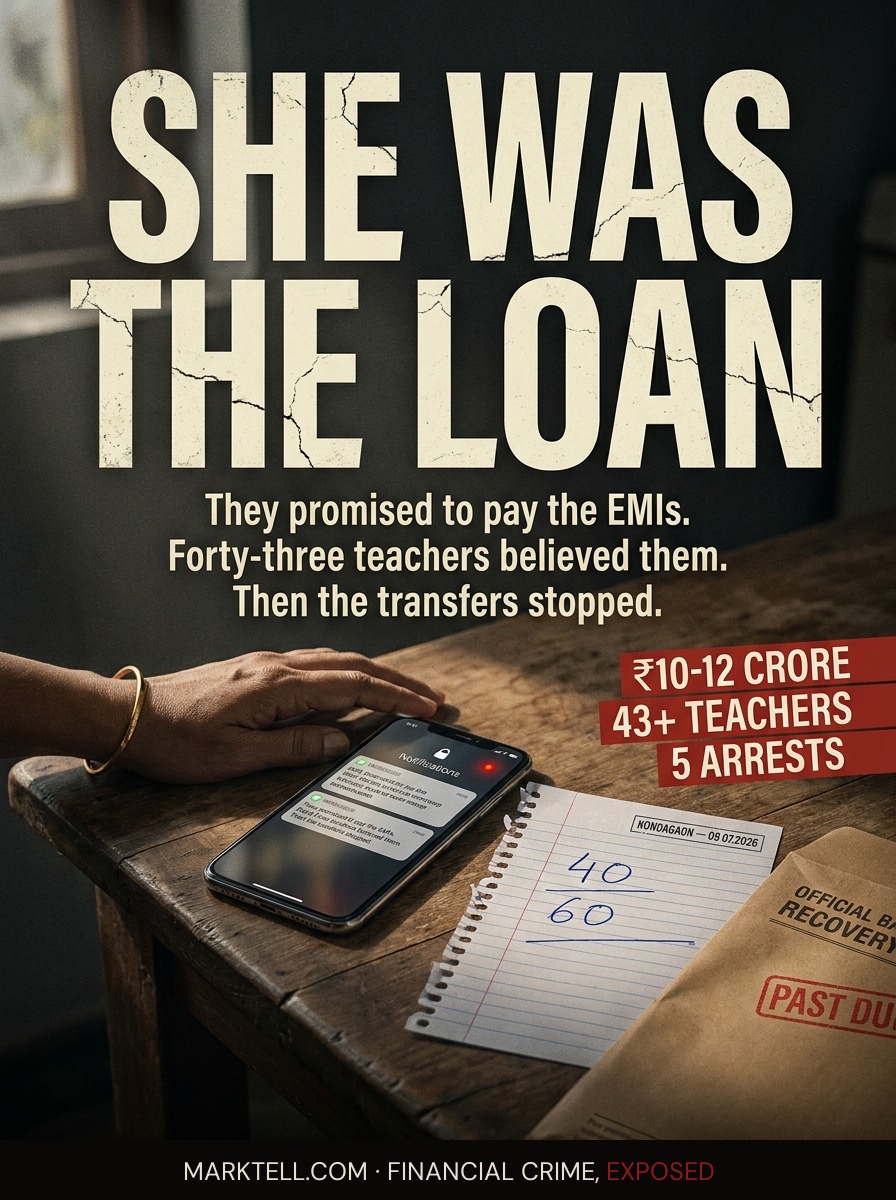
She is sitting at the kitchen table on a Tuesday morning with her phone flat on the wood. Two SMS messages are open. The first is from her bank. A personal loan of ₹18 lakh (about $21K USD) has been credited to her account. The second, twenty seconds later, is an outbound transfer of ₹10.8 lakh (about $13K USD) to an account she does not recognize but had agreed, on paper, to authorize.
She knows what the second message is. Sixty percent. That was the deal.
The deal was explained to her three months earlier by a colleague. Not by a stranger. By a woman she had eaten lunch with in the staff room for eight years. The colleague had done it herself, she said. Two loans already. The EMIs were being paid. She had used her forty percent to fix her mother's house.
The pitch, when Sunita finally sat down with the men her colleague introduced her to, was clean. They would arrange multiple personal loans in her name across multiple banks. She would receive forty percent of each sanction. They would keep sixty. In exchange, they would service every EMI for two to three years, at which point the loans would be closed or refinanced. Her credit would be clear. Her salary would not be touched.
They wrote it on a piece of paper. Forty. Sixty. Two to three years. She kept the paper in a drawer.
For the first four months, the EMIs came out of the sixty percent, as promised. She saw the deductions on her salary slip and matched them against the transfers coming into her account from an intermediary. The math worked. Her colleague's math also worked. The staff room began to fill with other teachers doing the same math.
Then, in a week she cannot pinpoint exactly, the transfers stopped. The EMI deductions did not. The salary slip line she had not expected to feel became the only line she could see.
On July 9, 2026, Kondagaon Police announced the arrest of five men from Ambikapur, Jashpur, and Sarangarh. The police allege the group ran an inter-district network that arranged personal loans for at least 43 teachers, siphoned sixty percent of each disbursement to accounts they controlled, and eventually stopped paying the EMIs they had promised to cover. The alleged loss is ₹10-12 crore (about $1.2M to $1.4M USD). Local estimates place the true victim count between 150 and 200 teachers across the district. Many have not come forward. In a small district, a teacher who has been taken is a teacher whose neighbors will know.
The investigation, according to police, ran for nearly three months before the arrests. Technical work. Financial work. Bank statements read line by line.
The machine is not new. On June 8, 2026, in Sarguja district, police arrested a man named Shiv Shankar Das who had run a nearly identical scheme against more than twenty-five government teachers. Same split. Forty to the teacher. Sixty to him. Same promise to pay the EMIs. Same collapse when the EMIs stopped. That case involved more than ₹3 crore (about $360K USD). The Kondagaon case is roughly four times the size.
Two districts. Two months apart. The same machine.
Here is what the machine does, in plain language. A teacher in India, especially a government teacher, is a preferred borrower. The salary is government-backed. The employment is stable. The banks approve personal loans quickly, and they approve them in large amounts. A single teacher can, across three or four banks, be sanctioned twenty to thirty lakh in personal debt in a matter of weeks. That is the fuel.
The operator does not need to steal the money. He only needs to be present when the money is disbursed. He convinces the borrower to hand over sixty percent voluntarily by promising to service the debt. He pays a few EMIs from the sixty he took, which costs him almost nothing relative to what he keeps. Then he disappears, and the borrower is left with one hundred percent of the liability and forty percent of the cash. On paper, the borrower authorized every transfer. On paper, the bank did nothing wrong.
That is the whole machine. Forty. Sixty. A few EMIs. Silence.
Sunita's kitchen table now has a brown envelope on it. A recovery notice from one of the banks. The EMI is three months past due. The bank does not know about the men in Ambikapur. The bank knows about Sunita. Her salary account is where the deductions will come from. Her name is on every document. Her signature is on every form.
She has not filed a complaint. Her colleague has not filed a complaint. Neither has the woman two classrooms down who took three loans instead of two. In the staff room, the lunches are quieter now. Nobody says the number out loud.
That part may be the saddest. The machine does not just take the money. It takes the ability to speak about the money. In a district where a teacher's reputation is the collateral behind everything else she has, the shame is a second lock on the door.
Picture it. Forty-three teachers. At least. Probably more. Each of them sitting at a kitchen table somewhere in Kondagaon district with a phone and a recovery notice and a piece of paper in a drawer that says forty and sixty and two to three years. Each of them doing the same math she did in March, only backwards now, and getting a different answer.
The five arrests will not close the machine. The machine ran in Sarguja in June and Kondagaon in July, and it will run somewhere else in August under a different name with a different colleague in a different staff room writing the same two numbers on the same piece of paper.
Sunita believed she was taking a loan. She was the loan.
- Dainik Jagran MP CG | July 9, 2026 | Report on Kondagaon Police arrests of five accused in ₹12 crore teacher loan fraud
- Kondagaon Police statement | July 9, 2026 | Public announcement of arrests from Ambikapur, Jashpur, Sarangarh
- Sarguja district police report | June 8, 2026 | Arrest of Shiv Shankar Das in ₹3 crore teacher loan fraud, parallel modus operandi
- Reserve Bank of India public warnings | ongoing | Advisories on online loan fraud and upfront payment schemes
Editorial Notice
MarkTell is a true crime publication about financial fraud. Some scenes, dialogue, and sequential details are reconstructed from court filings, enforcement actions, news reports, and public records. Where the public record does not provide exact details, editorial reconstruction is used to convey the documented pattern of events. Names of private individuals may be changed to protect identity. All factual claims are sourced to public documents cited in the Evidence Trail above. MarkTell does not provide investment, legal, or financial advice. Nothing published here constitutes a recommendation to buy, sell, or avoid any investment. Allegations described in active cases have not been adjudicated and defendants are presumed innocent until proven guilty. Readers should conduct their own due diligence before making financial decisions.