The lawyer who built the laundry: ten years for cleaning OneCoin's money
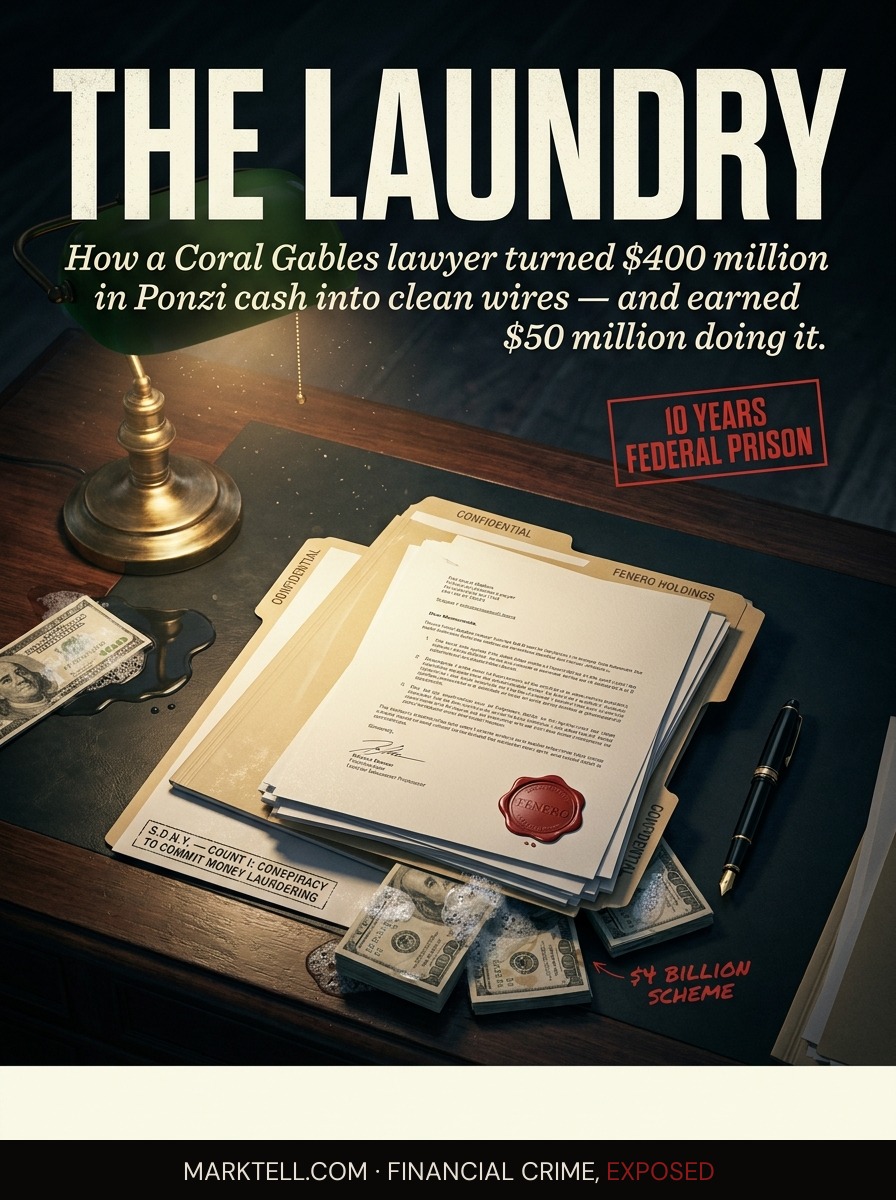
Mark Scott was the corporate attorney who turned $400 million in OneCoin Ponzi proceeds into something that looked like a private equity fund. He earned $50 million for the work. This month, he started his ten-year sentence.
Marisol was 51 the first time she heard the word OneCoin, and she heard it at a quinceañera in a banquet hall outside Tampa. Her cousin Hector had pulled her aside between the father-daughter dance and the cake. He had a phone in his hand and a brochure folded into quarters in his back pocket. He told her there was a new coin coming, bigger than Bitcoin, and that he had already made back what he put in.
She was a dental hygienist. She cleaned teeth four days a week and had a daughter who was about to start at USF. She trusted Hector because Hector was family, and because Hector had said the words "European," "audited," and "Dr. Ruja" in a sentence that made her feel like she was being let in on something that adults were already inside.
She put in $4,800. Then another $2,000 six months later, after a webinar she watched on her phone at 11:40 PM with her husband asleep next to her. On the screen, a woman in a red dress and pearl earrings was holding a microphone the way a TED speaker holds a microphone. The woman was Ruja Ignatova. She called herself the Cryptoqueen. She said OneCoin would replace Bitcoin within two years.
There was no blockchain. There was no coin. Federal prosecutors would later say so plainly. What there was, instead, was a laundry. And the man who built the laundry had an office in Coral Gables.
I.
Mark S. Scott was the kind of lawyer you hire when you have already won. He was a partner at Locke Lord, one of those old-line firms with marble in the lobby and a name that sounded like a Boston brokerage. He did corporate work. Funds. Offshore structures. The dry, expensive end of finance where the documents matter more than the deals.
According to the indictment filed in the Southern District of New York in September 2018, Scott met Ruja Ignatova in 2015. By 2016, he was working for her. Not as outside counsel reviewing contracts. As the architect of a set of investment funds called the Fenero Funds, registered in the British Virgin Islands, administered through an offshore firm there and through a Florida company Scott controlled called MSS International Consultants.
The Fenero Funds looked like private equity. They had offering memoranda. They had account structures. They had the vocabulary of legitimate finance. What they actually did, prosecutors proved at trial, was take OneCoin investor money that had been routed through payment processors in places like the UAE and turn it into something that could be wired into U.S. and European banks without those banks asking the questions banks are supposed to ask.
The Manhattan U.S. Attorney's office at the time put it cleanly. Scott "used his specialized knowledge as an experienced corporate lawyer to set up fake investment funds, which he used to launder hundreds of millions of dollars of fraud proceeds." Assistant U.S. Attorney Julieta Lozano told the jury that Scott "cleaned the fraud money that he knew was dirty."
The number the government landed on at trial was approximately $400 million in laundered proceeds. Scott's cut, prosecutors said, was approximately $50 million.
A laundry is not a metaphor. It is a structure. Money goes in dirty. It comes out wearing the clothes of a fund.
II.
OneCoin itself was the upstream river. The Department of Justice and European prosecutors have estimated the scheme generated roughly $4 billion in investor money between 2014 and 2017. It was sold the way Ponzi schemes have been sold for a hundred years, only with new vocabulary. Distributors recruited distributors. Webinars promised early-Bitcoin returns. Marisol's cousin showed her a back-office screen where a number kept climbing.
Picture the screen. That is what Marisol had. A login. A balance that grew. A "OneCoin Exchange" that was always almost open, always coming next quarter, always one regulatory approval away from letting you cash out.
She tried to withdraw once, in early 2017. The exchange said her tier was not eligible. She would need to upgrade her package. She did not upgrade. She did not panic either. She told herself she was in for the long term.
Ignatova was already preparing to vanish. She gave her last public speech in late 2017. She boarded a flight from Sofia to Athens that October and was never seen again. Her brother, Konstantin Ignatov, took over the operation. He was arrested at Los Angeles International Airport in March 2019. He pleaded guilty to money laundering and fraud charges and testified against Mark Scott at trial.
The Cryptoqueen is still on the FBI's Ten Most Wanted list. The reward is $250,000.
Scott was convicted in November 2019 of conspiracy to commit money laundering and conspiracy to commit bank fraud. Sentencing came years later, after motions and continuances. He drew ten years. Then he appealed. He argued there had been no evidence of bank fraud and no U.S. victims tied to the money laundering charge. The appeals ran their course. They did not save him.
This month, in June 2026, he reported to a federal facility in Miami to begin serving the sentence.
III.
What is worth sitting with is not Scott's downfall. It is what Scott built before it.
The Fenero Funds were not crude. They were not a Nigerian-prince email. They were assembled by a man who had spent his career assembling exactly this kind of structure for legitimate clients. He knew which jurisdiction would not ask. He knew which administrator would not check. He knew which bank's compliance team relied on the offering documents and which one read the wire memos.
He bought a Sunseeker yacht. He bought property on Cape Cod. He bought, according to court filings, the life of a man who had earned $50 million in three years from a single client. When the FBI started asking questions, he told banks the Fenero money came from a wealthy European family's investments. He produced documents. He produced more documents. The documents were lies in the form of paperwork.
Read that slowly. The fraud was not in the code. There was no code. OneCoin had no real blockchain. The fraud was in the paperwork. The paperwork was Scott's.
This is the part that matters for anyone who thinks crypto fraud is a technology problem. OneCoin did not need technology. It needed a lawyer. The same kind of lawyer who closes real deals on Tuesday closed the laundry on Wednesday. The structure was indistinguishable from a thousand real fund structures sitting in a thousand BVI registry filings right now.
That is the machine. Not the coin. The wrapper.
IV.
Marisol learned what OneCoin was the way most distributors learned. Slowly, then all at once. A news article in 2019. A friend's WhatsApp message asking if she had seen this. A Netflix-adjacent podcast in 2022 that her daughter sent her with a one-word text: "Mom."
She did not tell her husband the real number she had put in. She told him $1,500. She has never corrected it.
She still gets emails. The OneCoin community has not entirely dissolved. There are factions online that insist the coin is coming back, that Ruja is alive and negotiating with regulators, that the exchange will open. Marisol does not believe them. She does not unsubscribe either. She reads the emails the way you check a wound to see if it is still there.
When she heard, this month, that the lawyer had finally gone to prison, she did not feel anything she could name. She told her cousin Hector at a different family party, in passing, that the guy from Florida had started his sentence. Hector said he had not followed it. He had moved on to other things by then.
V.
Ten years is the sentence. The money is mostly gone. Ignatova is still gone. The Fenero Funds are dissolved on paper and immortal as a template.
The lesson the record offers is not about cryptocurrency. It is about who gets hired to make the dirty look clean. OneCoin was a Ponzi scheme that called itself a coin. What turned it from a scam into a $4 billion scam was the professional class that wrapped it. The lawyer in Coral Gables. The administrator in the BVI. The banks that took the wires.
The coin was the bait. The laundry was the business.
Marisol's $4,800 did not buy her OneCoin. There was nothing to buy. It bought a Sunseeker. It bought a beach house. It bought the $50 million fee of a man who knew exactly what he was doing and signed the documents anyway.
He is in Miami now. So is she. They have never met.
- Miami Herald | June 22, 2026 | "Ex-Coral Gables attorney begins 10-year sentence for global crypto fraud"
- U.S. Department of Justice, SDNY | September 2018 | Indictment of Mark S. Scott
- U.S. Department of Justice, SDNY | November 2019 | Jury verdict, U.S. v. Mark S. Scott
- U.S. Attorney's Office, SDNY press release | quoted statements from AUSA Julieta Lozano and former U.S. Attorney Geoffrey S. Berman
- U.S. Department of Justice | Konstantin Ignatov guilty plea, 2019
- FBI Ten Most Wanted Fugitives | Ruja Ignatova listing
- FBI IC3 | 2023 Internet Crime Report (cryptocurrency fraud loss figures)
Editorial Notice
MarkTell is a true crime publication about financial fraud. Some scenes, dialogue, and sequential details are reconstructed from court filings, enforcement actions, news reports, and public records. Where the public record does not provide exact details, editorial reconstruction is used to convey the documented pattern of events. Names of private individuals may be changed to protect identity. All factual claims are sourced to public documents cited in the Evidence Trail above. MarkTell does not provide investment, legal, or financial advice. Nothing published here constitutes a recommendation to buy, sell, or avoid any investment. Allegations described in active cases have not been adjudicated and defendants are presumed innocent until proven guilty. Readers should conduct their own due diligence before making financial decisions.