The lawyer on the phone. The gold in the bag. The car with Romanian plates.
A Romanian woman was arrested in Békés County on suspicion of collecting cash and gold from elderly Hungarians who believed their sons were in jail. She was the last link in a chain that started with a phone call and ended at a stranger's front door.
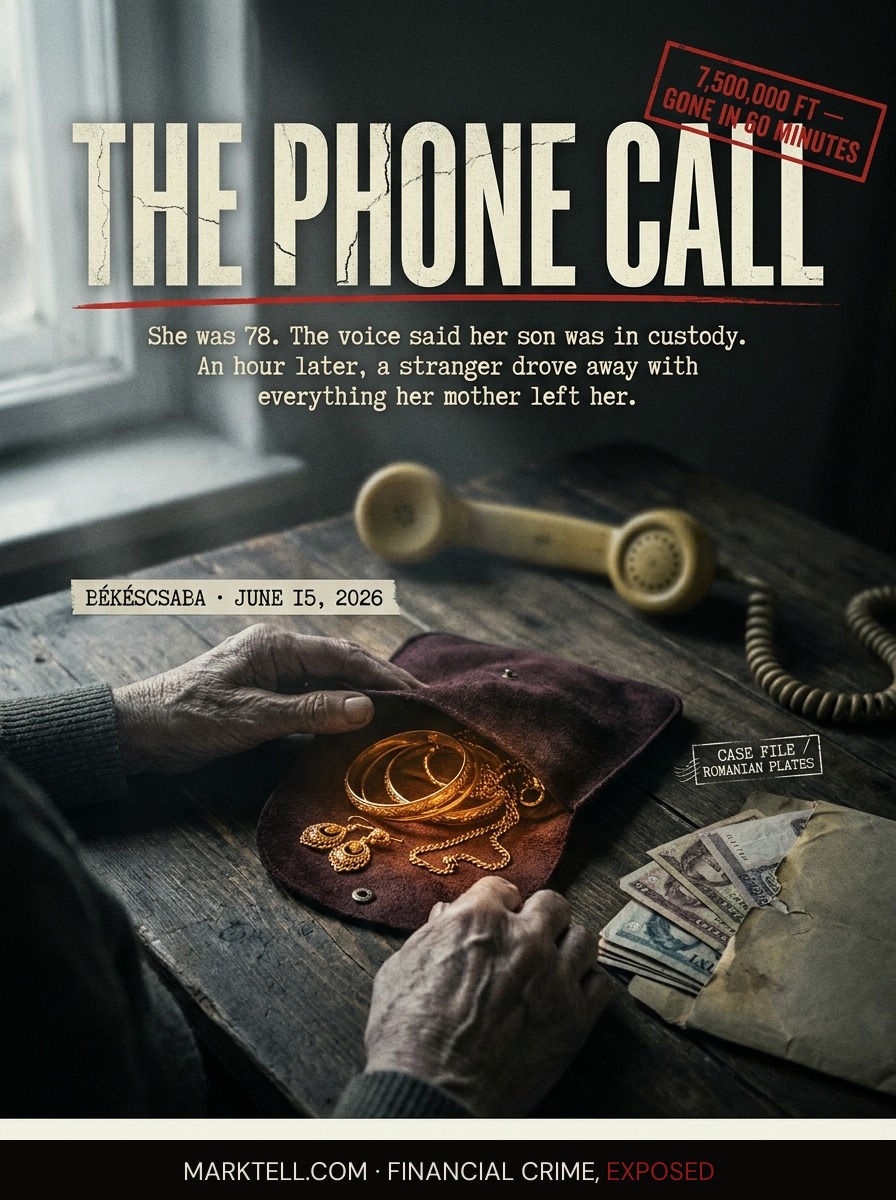
The phone in Erzsébet's hallway is older than most of the people who still call it. Rotary handset, plastic yellowed at the earpiece, sitting on a base her son installed for her in 2004. She is seventy-eight. She keeps the ringer loud because her hearing is not what it was.
It rings on a Monday afternoon in June. She is at the kitchen table, halfway through a cup of coffee that has gone cold, and she walks to the hallway the way she has walked to the hallway a thousand times before.
The voice on the other end says he is a lawyer. He says her son has been in a car accident. He says her son is in custody. He says her son needs bail money and he needs it in the next hour or the situation is going to get worse.
Read that slowly.
An hour. A stranger. Her son.
She does not ask for a case number. She does not hang up and call her son directly. She does not do the things that later, sitting in a police station in Békéscsaba, she will not be able to explain why she did not do. She goes to the drawer where she keeps the cash. She goes to the shelf where she keeps the felt pouch her mother left her. Inside the pouch are the bangles, the chain, the earrings her husband bought her in 1971.
7.5 million forints (about $21K USD). Her savings. Her mother's gold. Her husband's gift.
A woman comes to the door. Erzsébet does not know her. The woman is polite. The woman takes the envelope and the pouch and walks back to a car parked at the curb, engine running, license plates from Romania. The car pulls away.
Erzsébet closes the door. She goes back to the kitchen. The coffee is still there. She calls her son at four o'clock to ask how he is holding up.
He answers on the second ring. He is at work.
I.
The machine that just ran through Erzsébet's afternoon has a name in the police records of a dozen countries. In the United States it is called the grandparent scam. In Hungary it goes by a longer phrase. The mechanics do not vary.
There is a caller. There is a runner. There is a script.
The caller is on a phone somewhere she will never see. He may be in a call center in Bucharest. He may be in a rented apartment in Budapest. He may be reading from a laminated sheet or improvising off a template. He has done this before. He knows the pauses. He knows when to raise his voice and when to drop it. He knows to say "your son" and not the son's name until the mark says the name first. Then he uses it.
The runner is the person on the doorstep. She does not know the script. She does not need to. She knows an address, a time, and a package she is picking up. She has done this in other cities. She will do it in others.
The caller gets the emotion. The runner gets the gold.
II.
On July 3, 2026, according to Békés County Police, a Romanian woman was arrested in Hungary on suspicion of being the runner in a series of these calls. She is unnamed in the public record so far. The vehicle she was driving had Romanian plates. Investigators believe she collected cash and gold from elderly victims in Békés County, in other Hungarian counties, and in Budapest. Police described the total as "several million forints" across the network of jobs.
The June 15 incident in Békéscsaba, involving the 78-year-old woman and the 7.5 million forints, is one job in a sequence.
That is what the arrest tells us. One person on the corner of a much larger structure.
The caller has not been identified. The call center, if there is one, has not been located. The chain of people who wrote the script, who assigned the addresses, who received the packages after the runner delivered them, remains open. Police are asking anyone who has been contacted by a similar caller to come forward.
Allegation is not adjudication. The Romanian woman has been arrested, not convicted. What is on the record is the arrest, the June 15 loss, and the pattern of jobs the police attribute to her.
III.
Here is what makes this particular machine so efficient.
Most fraud requires you to convince the mark that a thing that is not real is real. The Nigerian prince. The investment fund. The tech-support engineer. You have to build a fake world and get the mark to walk into it.
The grandparent scam does not build a fake world. It uses the world the mark already lives in. Her son exists. Her son drives a car. Her son could, in theory, be in an accident. The caller does not have to construct anything. He only has to point at what is already there.
Then he adds urgency. An hour. Not tomorrow. Not this evening. Now.
Then he adds secrecy. Do not tell anyone. The case is sensitive. The lawyer is handling it.
Then he adds authority. He is a lawyer. He uses the word "bail." He uses the word "custody." He speaks in the register of someone who does this for a living.
Urgency, secrecy, authority. Three tools. That is the entire kit.
The person selling small-cap stock over the phone in Chicago in 1986 was using the same three tools. So was the man behind the timeshare desk at hour four. So was the voice on the other end of every boiler room in every language. The product changes. The three tools do not.
IV.
Erzsébet went to the police the following morning because her daughter-in-law noticed something was wrong. Erzsébet had mentioned, in passing, that she was glad her son's accident had turned out to be nothing serious. The daughter-in-law, who talks to her son every day, said there had been no accident.
That is the moment the structure became visible. Not when the woman took the pouch. Not when the car drove away. The morning after, in a kitchen, when a family member said one sentence that did not match the story the caller had told.
The realization is not that she lost the money. The realization is that the son she thought she was saving had never been in danger. She had reacted to a fiction. The fiction had used her love as its fuel.
That may be the worst part. Not the empty drawer. Not the missing pouch. The knowledge that the machine reached into the exact place where she kept her son and used it against her.
V.
The Békés County arrest is one node. The FBI reports over $3 billion in annual losses from elder financial exploitation in the United States alone, with an average loss per victim of $35,000. The FCC issued a warning in April 2026 about voice-cloning AI being used to make grandparent-scam calls more convincing. A Canadian man was sentenced in May 2026 to fifteen and a half years in a U.S. prison for running grandparent-scam call centers out of Montreal.
The runner in Békés County will be replaced. The caller has not been identified. If he is identified, he will also be replaced.
The machine does not depend on any one person. That is what makes it a machine.
VI.
Picture the drawer.
Picture the pouch.
Picture the woman at the door, polite, in a hurry, engine running behind her.
If you have a parent who lives alone and answers a landline, this is the conversation you have to have this week. Not next month. This week. Tell them the exact scenario. A call about a grandchild or a child in trouble. A demand for cash or gold. A stranger sent to collect it. Tell them the answer is always the same: hang up, call the family member directly, call the police.
Give them a code word. A word only the family knows. If anyone claiming to be family calls in a crisis, they have to say the word. If they cannot say the word, the story is a lie.
Erzsébet did not have a code word. She had a phone in a hallway, a drawer with her life in it, and a voice that used the word "son" at the exact second she was most likely to move.
The Romanian woman who drove away from her curb will get her day in a Hungarian courtroom. The man on the phone will not, unless someone finds him. The next call is being placed somewhere right now. The next runner is being dispatched. The next drawer is being opened by the next grandmother who is trying to save the child she raised.
The machine is running. It was running before this arrest. It is running after.
The felt pouch had been in her family for three generations. It held gold from her mother. Her husband's gift. Her wedding earrings.
She did not lose it in an accident.
She handed it over.
- Hungary Today | July 2026 | "Romanian Woman Arrested After Elderly Victims Lose Millions to Grandparent Scam"
- Békés County Police Headquarters | July 3, 2026 | Arrest announcement, Békéscsaba
- FBI Elder Fraud Report | 2022 data | Annual losses from elder financial exploitation
- FCC Consumer Warning | April 24, 2026 | AI voice-cloning in grandparent scams
- U.S. Department of Justice | May 13, 2026 | Sentencing of Montreal-based grandparent scam operator
- Consumer Financial Protection Bureau | Elder fraud prevention guidance for financial institutions
Editorial Notice
MarkTell is a true crime publication about financial fraud. Some scenes, dialogue, and sequential details are reconstructed from court filings, enforcement actions, news reports, and public records. Where the public record does not provide exact details, editorial reconstruction is used to convey the documented pattern of events. Names of private individuals may be changed to protect identity. All factual claims are sourced to public documents cited in the Evidence Trail above. MarkTell does not provide investment, legal, or financial advice. Nothing published here constitutes a recommendation to buy, sell, or avoid any investment. Allegations described in active cases have not been adjudicated and defendants are presumed innocent until proven guilty. Readers should conduct their own due diligence before making financial decisions.