The lawyer kept a second account named after a real company. That was the whole trick.
A disbarred South Carolina attorney funneled client settlement money through a bank account that mimicked the name of a legitimate firm. The properties came down this month. The machine is older than the headlines.
Wanda was sixty-one when she signed the paper.
She remembers the office because it smelled like furniture polish and old paper. Diplomas behind glass. A receptionist who called her "ma'am" the way her own mother had called women. The lawyer was tall and warm. He shook her hand with both of his hands, the way preachers do. He told her the check from her son's accident would not come to her in a lump. It would go into something called a structured settlement. A holding account. Money paid out in steady pieces so she would not blow through it. Safer that way. He said the word "safer" twice.
She signed where he pointed.
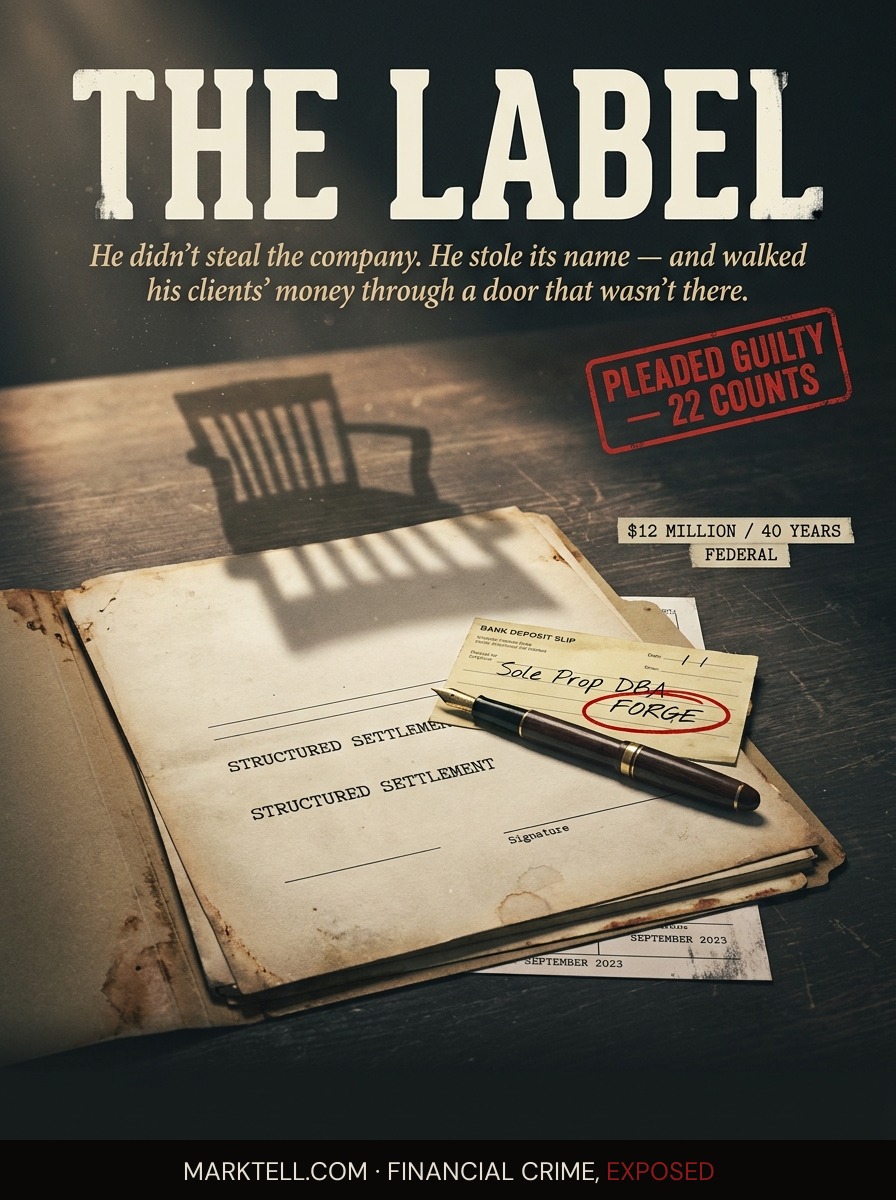
The account that received her son's settlement was not a structured settlement. It was a checking account at Palmetto State Bank, opened in the lawyer's own name, styled to look like a real company called Forge Consulting. The deposit slips read "Richard A Murdaugh Sole Prop DBA Forge." Six words. The whole machine fit inside six words.
Read that slowly.
There was a real Forge Consulting. A legitimate settlement planning firm in Columbia. Lawyers used it. Clients understood it. Alex Murdaugh used the name. He did not call the company. He did not partner with the company. He opened a bank account that wore the company's name like a coat and walked his clients' money into it.
This is the room. This is the chair Wanda sat in. This is what the room was doing while she sat in it.
II.
The federal record is now closed on the financial side. Murdaugh pleaded guilty in September 2023 to twenty-two federal financial crimes, including conspiracy to commit wire fraud, bank fraud, wire fraud, and money laundering. He admitted to stealing roughly $12 million from clients and from the law firm where his name was on the door. He is serving a 40-year federal sentence concurrent with a 27-year state sentence. The murder convictions for his wife Maggie and his son Paul were overturned this month by the South Carolina Supreme Court, on the grounds that the former Colleton County Clerk of Court, Rebecca Hill, tampered with jurors. He has filed a federal lawsuit against her. A retrial for the murders is expected.
The financial crimes are not in dispute. He pleaded to them. He sat in a federal courtroom and said the word "guilty" twenty-two times.
The Forge account is the spine of the case. From May 2017 through at least July 2021, according to the federal plea, Murdaugh funneled stolen personal injury settlements through it. A $403,500 settlement check intended for the sons of Gloria Satterfield, the family housekeeper, went into the account. Three checks totaling $3,483,431.95 written by a co-conspirator lawyer named Cory Fleming and made payable to "Forge" went into the account. Another $383,056 from his own law firm went into the account. Settlement proceeds of $70,000 from a client named Manuel Santis-Cristiani went into the account.
The clients believed the money was being held for them. The bank believed the account was a sole proprietorship. Forge Consulting, the actual company, did not know the account existed.
That is the machine. A door labeled like a real door. Behind the door, a single chair where one man sat.
III.
The second machine ran longer. From July 2011 until at least October 2021, Murdaugh worked with Russell Laffitte, then the CEO of Palmetto State Bank. Laffitte served as personal representative or conservator for Murdaugh's clients. In that role, he could sign for them. He could direct settlement checks. He could move money on their behalf and call it administration. Some of that money moved into Murdaugh's hands. Laffitte was convicted in November 2022 on six federal charges. He was sentenced in August 2023 to seven years in federal prison.
Picture what this looked like from Wanda's chair.
She does not know any of these names. She does not know a banker is signing on her son's behalf. She does not know her settlement check, when it lands, will be endorsed by a man she has never met and deposited into an account that wears another company's name. She sees a lawyer with diplomas on the wall. She sees a quarterly statement, when one comes. The statement shows a balance. The balance is not a balance. It is a number on a page.
That part may be the saddest. The statement looked correct.
IV.
The visible moment came on June 7, 2021. The CFO of Murdaugh's law firm, PMPED, confronted him in a hallway about missing fees on a wrongful-death case. Hours later, his wife and son were dead. Prosecutors have argued, and continue to argue, that the financial unraveling and the murders were connected in time and in motive. That theory will be tested again at retrial. The financial unraveling itself is no longer theory. The plea is on the record.
What followed was the slow surfacing of property. The 1,770-acre hunting estate at Moselle, where the murders occurred, sold for $3.9 million. The beach house at Edisto was listed for $920,000. The Business Journals reported this month on continuing seizures from a blockchain-adjacent matter that got confused in the headline cycle, but the assets that have actually come down in the Murdaugh case are the ones tied to client settlements and to the Forge account. Land. A beach house. The kind of property that does not move quickly and therefore cannot be hidden quickly.
Each property is a receipt. Each receipt points back to a client who signed a paper in a room that smelled like furniture polish.
V.
What the Forge account teaches is not a story about one disbarred lawyer in one Southern county. It is a pattern.
The pattern: a person of authority, embedded in a community, with the legal power to receive funds on behalf of clients who cannot easily verify what happens after receipt. Add a bank willing to accept account titles that mimic real companies. Add a culture in which clients do not request the bank statements directly. Add years.
A trust account is not magic. It is a checking account with a label. The label is the only thing standing between honest custody and theft. When the lawyer controls the label, and the bank does not question the label, and the client does not know to ask about the label, the label becomes a costume.
The federal plea documents are public. The conspiracy with Laffitte is public. The Satterfield diversion is public. The Forge account is named, dated, and itemized. You can read it. You can hold the document in your hand and see, line by line, where each check went.
VI.
Wanda did not get a letter. She got a phone call from another lawyer, months after the news broke, asking if she had been a client of Mr. Murdaugh's between certain dates. She said yes. The lawyer asked if she had received a structured settlement. She said yes. The lawyer asked if she had ever seen a bank statement from Forge Consulting. She said she had seen something with that name on it once. The lawyer was quiet for a moment. Then he asked for the address where he could send the questionnaire.
She kept the folder in the top drawer of her kitchen desk. She had kept it there for years. She took it out and laid it on the table and looked at the signature line and the date and the words "structured settlement." She looked at them for a long time.
He had not lied about the word "structured." He had built a structure. He just had not told her she was inside it.
That was the trick. A real word. A real company name. A real signature on a real paper. And underneath all of it, a chair where one man sat and signed checks to himself.
The properties are coming down now. The murder case will be tried again. The financial crimes are settled.
The account is closed. The room is empty. The folder is still in the drawer.
- U.S. Department of Justice, District of South Carolina | September 21, 2023 | Plea agreement and press release, United States v. Richard Alexander Murdaugh
- U.S. Attorney's Office, District of South Carolina | November 2022 | Conviction of Russell Laffitte
- U.S. Attorney's Office, District of South Carolina | August 2023 | Sentencing of Russell Laffitte (seven years)
- U.S. Attorney's Office, District of South Carolina | August 2023 | Sentencing of Cory Fleming (46 months)
- South Carolina Supreme Court | May 13, 2026 | Opinion overturning murder convictions of Richard Alexander Murdaugh
- Colleton County Court records | December 2025 | Plea and sentencing of Rebecca Hill
- The Business Journals | May 2026 | Reporting on property seizures
- South Carolina Attorney General's Office | 2023 | State sentencing materials, Murdaugh financial crimes
- Federal lawsuit filing | May 20, 2026 | Murdaugh v. Hill
Editorial Notice
MarkTell is a true crime publication about financial fraud. Some scenes, dialogue, and sequential details are reconstructed from court filings, enforcement actions, news reports, and public records. Where the public record does not provide exact details, editorial reconstruction is used to convey the documented pattern of events. Names of private individuals may be changed to protect identity. All factual claims are sourced to public documents cited in the Evidence Trail above. MarkTell does not provide investment, legal, or financial advice. Nothing published here constitutes a recommendation to buy, sell, or avoid any investment. Allegations described in active cases have not been adjudicated and defendants are presumed innocent until proven guilty. Readers should conduct their own due diligence before making financial decisions.