The land was always the lie. The hospital was where it hid.
The Enforcement Directorate attached 14 properties of Gian Sagar Educational and Charitable Trust this week, valued at ₹1,596 crore ($191M USD). The trust treated patients. The money, the ED alleges, came from a farmland Ponzi that ate ₹48,000 crore from people who thought they were buying soil.
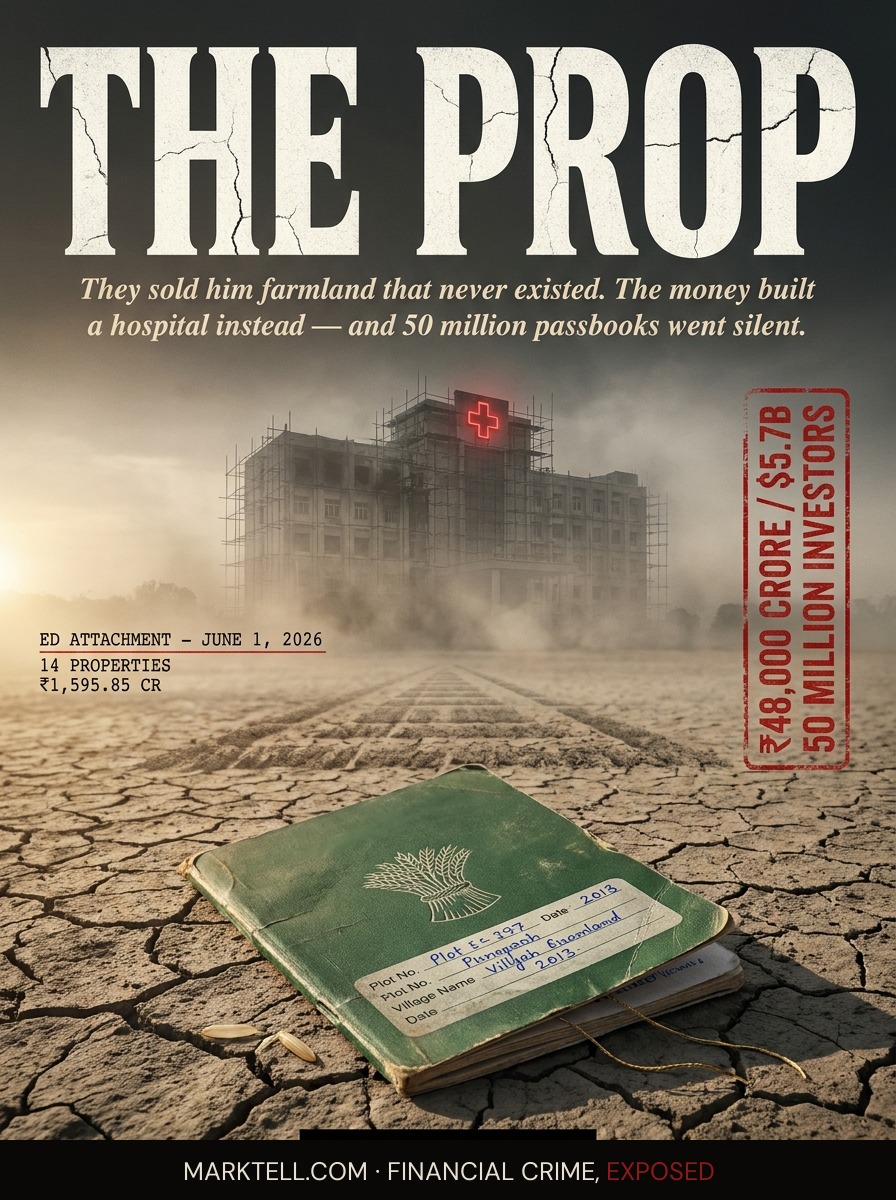
Sukhwinder keeps the passbook in the steel almirah, top shelf, behind his daughter's wedding jewelry. It is a thin booklet with a green cover and a PACL Ltd. logo on the front. Inside, in blue ballpoint, an agent wrote the plot number, the size, the village, and the date. The agent was a neighbor's son. That mattered. That was the whole transaction, really. The neighbor's son sat at Sukhwinder's kitchen table in 2013 and said the land would mature in six years and the price would double, and Sukhwinder gave him ₹1.2 lakh (about $1.5K USD) in cash because he had been saving since the buses got newer engines and he no longer had to work overtime.
He never saw the land. Nobody who signed those passbooks ever saw the land. The land was the cover story. What Sukhwinder actually bought was a seat on a machine, and the machine is still being unwound, twelve years later, one ED order at a time.
This week the Enforcement Directorate attached 14 immovable properties belonging to the Gian Sagar Educational and Charitable Trust in Ramnagar, Punjab. The valuation, per the ED's provisional order announced June 1, 2026: ₹1,595.85 crore (about $191M USD). The properties are land, a medical college, a hospital. The trust treats patients. The ED alleges the trust was built with money that belonged to people like Sukhwinder.
That is the whole sentence. Read it again.
The hospital was the second life of the farmland Ponzi.
I.
Pearls Agrotech Corporation Limited. PACL. The name has the shape of something legitimate. A company. A sector. A class of asset every Indian villager understands. Land does not lie. Land is what your grandfather left you and what you leave your son. PACL took that instinct and weaponized it.
The pitch was simple enough to repeat at a chai stall. You give us money. We allot you a parcel. In five or six years, when the land is developed, you get the land or you get the appreciated cash value. The agent on your doorstep was your neighbor's son or your cousin's husband. The receipt looked like a receipt. The plot number looked like a plot number.
SEBI, the Indian markets regulator, looked at that arrangement in 2014 and called it what it was. Not a land sale. A collective investment scheme operated without registration. A pool of money taken from the public on a promise of return, which is the legal definition of the thing PACL was sworn not to be.
The Supreme Court referred the matter to the CBI the same year. The CBI registered an FIR, eventually chargesheeting 33 accused persons and corporate entities. The total amount allegedly mobilized from investors across India, per the CBI and subsequent ED filings, climbed past ₹48,000 crore ($5.7B USD). Some estimates put the gross intake above ₹60,000 crore ($7.2B USD). The number of investors ran into the millions. Five crore is the figure that appears most often in the record. Fifty million people.
Picture fifty million passbooks. Picture fifty million almirahs.
II.
The man at the center was Nirmal Singh Bhangoo. PACL's promoter. A Punjabi businessman with a portfolio that grew into hotels, media, Australian real estate, and a charitable trust that operated a medical college and a multi-specialty hospital in Ramnagar. Bhangoo died in custody in 2022, the case still unfinished, the recoveries still being chased through the bureaucratic plumbing of three different agencies.
The machine outlived him. That is the part that matters.
The Gian Sagar Educational and Charitable Trust was, until 2018, owned by family members of Bhangoo. The trust ran the hospital. The hospital had real doctors and real patients and a real cafeteria. None of that is in dispute. What the ED alleges, and what this week's attachment formalizes, is that the soil under the hospital, the wires inside the walls, the beds in the wards, were paid for with money that came in through PACL agents in villages like Sukhwinder's.
In 2018, the trust was transferred to JSB Group. The ED's view, per the public record of its attachments and chargesheets, is that the change of nameplate does not change the origin of the bricks. Proceeds of crime under the Prevention of Money Laundering Act do not get clean by changing hands. The agency attaches them where it finds them.
Fourteen properties. ₹1,596 crore ($191M USD).
That is just this week.
III.
Run the running total.
The cumulative value of assets attached by the ED in the PACL case, in India and abroad, is now approximately ₹28,626 crore ($3.4B USD). That includes properties in Australia. That includes hotels. That includes land parcels the company actually did hold, just not on behalf of the people who paid for them.
In April 2026, the ED transferred 455 attached properties valued at approximately ₹15,582 crore ($1.9B USD) to the Justice R.M. Lodha Committee. The Lodha Committee is the Supreme Court's appointed liquidator, the entity tasked with turning attached real estate into cash and routing the cash back to defrauded investors through the SEBI refund portal.
The refund portal opened years ago. Most claims under ₹10,000 ($120 USD) have been processed. The larger claims move slowly. Many investors had their applications rejected the first time on a technicality. A bank account that no longer exists. A spelling mismatch between the passbook name and the Aadhaar card. A village address the system did not recognize.
In May 2026, SEBI opened a correction window. Investors whose applications were rejected can refile, with corrected bank details, until August 6, 2026.
Sukhwinder has refiled twice. The second time, his nephew did it for him from a phone in Bathinda. The screen returned a confirmation number. Sukhwinder wrote it on the inside cover of the passbook in the same blue ballpoint the agent used in 2013.
IV.
This is the part that is easy to lose in the agency acronyms.
The CBI investigates. The ED attaches. The Supreme Court supervises. The Lodha Committee liquidates. SEBI refunds. Each agency does its part. None of them issued the passbook. None of them sat at Sukhwinder's kitchen table.
The neighbor's son did that.
The collective investment scheme, as a structure, only works because the last mile is a relationship. The villager does not trust SEBI. The villager trusts the cousin who is doing well. The cousin was paid a commission to bring in his uncle. The uncle was paid a smaller commission, eventually, to bring in his neighbor. The pyramid is not just financial. It is social. The fraud rides the wedding invitations and the funeral visits.
When the structure failed, the cousin lost his commission, the uncle lost his deposit, the neighbor lost his savings, and the relationships went silent. That part may be the saddest. The PACL scam took ₹48,000 crore. It also took family dinners.
V.
Look at what is left. A hospital in Ramnagar with a new gate and an old foundation. A medical college that still graduates doctors. Fourteen properties on a list. A trust that has been passed from one set of hands to another and is now, again, in the hands of the state.
If the Lodha Committee can liquidate the attached assets, including these, some of Sukhwinder's ₹1.2 lakh ($1.5K USD) comes home. Not all of it. Probably not soon. The current attachment will be contested. The trust will argue, through counsel, that its assets were not financed by PACL investor funds, or that the chain of title was broken in 2018, or that the medical mission of the hospital should weigh against forfeiture. Those are defenses any lawyer would raise. The court will decide.
What the court cannot decide is what the machine took beyond the money. Sukhwinder is 58 now. He was 45 when he signed. He saved for two more years after that, expecting the land to mature. He told his daughter the dowry would come from the plot. The dowry came from the steel almirah instead, which had less in it than he had planned.
The agent, the neighbor's son, moved to Ludhiana. Sukhwinder still sees the agent's father at the gurdwara. They nod. They do not speak about it.
VI.
The renaming is overdue.
The CBI calls it a money laundering case. The ED calls it proceeds of crime. SEBI calls it an unregistered collective investment scheme. Those are the legal names. They are accurate. They are also evasions.
The thing PACL ran was a Ponzi scheme dressed in agricultural clothes. Money from new investors paid the maturities of old investors and built the visible assets that made the operation look real. A hospital is a very persuasive prop. A medical college is a very persuasive prop. You can take a photograph of them. You can drive a journalist past them. They have addresses.
That is why the ED's work matters. Attaching the hospital is the regulator pulling the prop off the stage. Whatever the hospital is now, whatever it once treated, the building is being recovered for the people who paid for it without knowing they did.
The number this week was ₹1,596 crore ($191M USD). The cumulative number is ₹28,626 crore ($3.4B USD). The amount owed is ₹48,000 crore ($5.7B USD). The gap between the third number and the second is the homework that remains. Years of it. More attachments. More litigation. More August 6 correction windows.
Sukhwinder is not waiting at his computer. He does not have one. His nephew checks the portal once a month and tells him there is no update, and Sukhwinder nods and goes back to whatever he was doing.
The passbook is still in the almirah. The wedding jewelry is gone. The daughter is married. The agent does not visit anymore.
The land was always the lie. The hospital was where it hid.
This week, the state walked into the hospital and started counting.
- Moneylife | June 2, 2026 | PACL Scam: ED Attaches 14 Assets Worth ₹1,596 Crore of Gian Sagar Educational & Charitable Trust
- Enforcement Directorate | June 1-2, 2026 | Provisional Attachment Order, PACL case
- Securities and Exchange Board of India | August 22, 2014 | SEBI Order against PACL Ltd. and directors
- Supreme Court of India | February 2, 2016 | Subrata Bhattacharya v. SEBI, direction to constitute Lodha Committee
- Central Bureau of Investigation | 2014 | FIR and subsequent chargesheets against PACL accused
- Enforcement Directorate | April 2026 | Restitution of 455 properties (₹15,582 crore) to Lodha Committee
- SEBI | May 2026 | PACL Refund Portal correction window notice, open through August 6, 2026
Editorial Notice
MarkTell is a true crime publication about financial fraud. Some scenes, dialogue, and sequential details are reconstructed from court filings, enforcement actions, news reports, and public records. Where the public record does not provide exact details, editorial reconstruction is used to convey the documented pattern of events. Names of private individuals may be changed to protect identity. All factual claims are sourced to public documents cited in the Evidence Trail above. MarkTell does not provide investment, legal, or financial advice. Nothing published here constitutes a recommendation to buy, sell, or avoid any investment. Allegations described in active cases have not been adjudicated and defendants are presumed innocent until proven guilty. Readers should conduct their own due diligence before making financial decisions.