The ladder only goes one direction when you are standing at the bottom
On April 25, 2026, Hyderabad police arrested a 61-year-old Country Sales Manager for Forever Living Imports India, alleging his operation pulled money from youth and housewives across multiple districts using three-tier packages and social media videos of a life nobody in the room was actually living. Police say the accounts they found held ₹3 crore (about $359,000 USD). The deputy commissioner says the real number is closer to ₹600 crore (about $71.8 million USD), spread across one lakh victims. That gap between those two figures is where this story lives.
I. The Bottom Rung
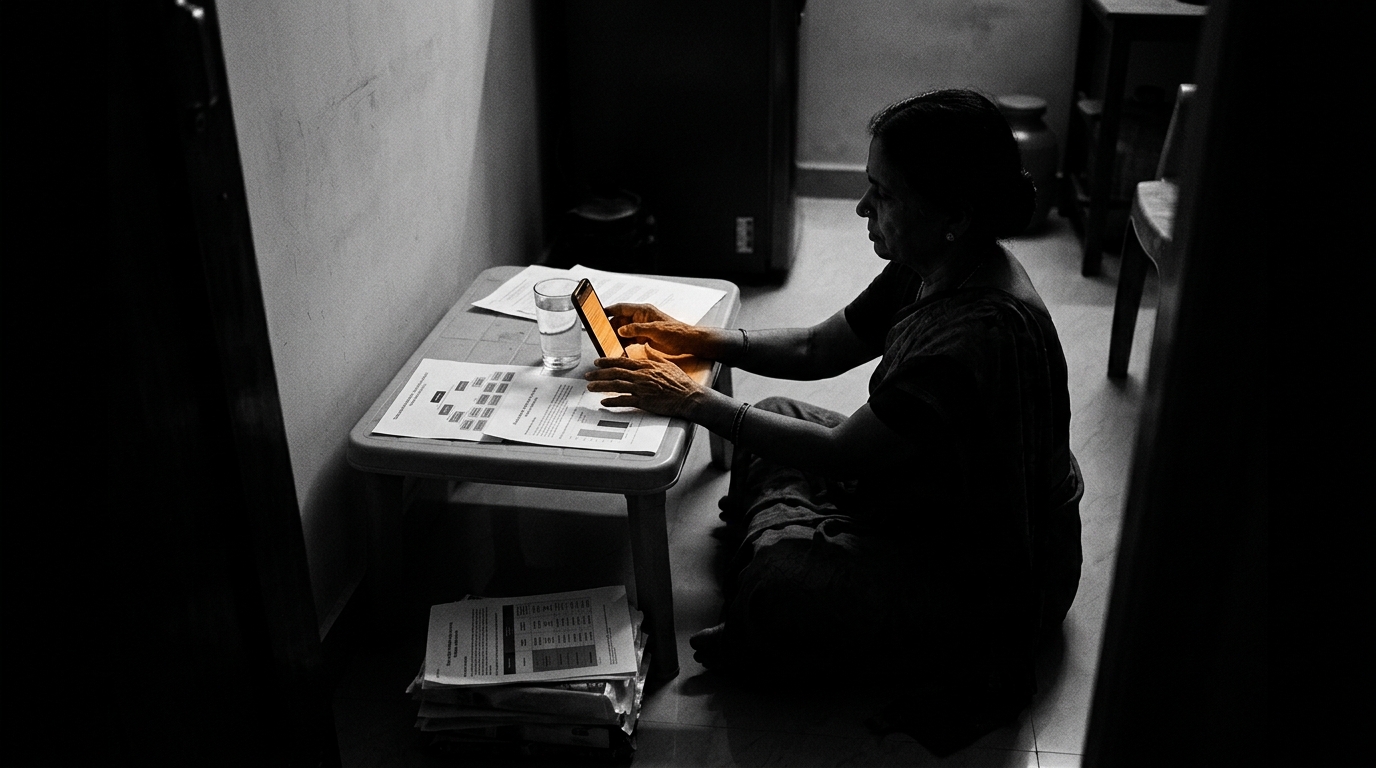
The student did not think he was being recruited. He thought he was being hired.
He was somewhere in Hyderabad's Old City, eighteen or nineteen years old, in the middle of intermediate studies, which in India means the two years between secondary school and whatever comes next. His family was not wealthy. The work-from-home part-time job offer arrived the way these things arrive now: through a phone, through a video, through a friend who had already seen the video and believed it.
The video showed a man in pressed clothes. Behind him, or maybe in the frame with him, there was evidence of prosperity. The narration was about freedom. About supplemental income. About a company with global reach and products people actually used. The man in the video was not lying about the products. Aloe vera. Health supplements. Skin creams. Real things in real bottles with real barcodes. Forever Living Products has been manufacturing and selling this line since 1978. The company operates in more than 160 countries. It is a legitimate company selling legitimate products.
That is important to understand, because the machine does not need the products to be fake. The machine only needs the products to be present. Present enough to point at.
The student paid ₹30,000 (about $3,590 USD) to join. This is described in police filings as a joining and membership fee. He was given a place in a structure. He was told, as the complaint alleges, that he could earn by bringing others in.
Nobody told him what the structure looked like from above.
II. The Achiever's Club
Picture the office in Karmanghat. Not a headquarters. A franchise node, what the police reports describe as a subsidiary operating under the Forever Living name. It has a name: the Achiever's Club.
That name was chosen deliberately. The name tells you what happens when you walk through the door. You are an achiever or you are working toward becoming one. The framing does the first part of the work before anyone says a word.
The three local agents who worked this office were named Mohd Akram, Mohd Nouman Raza, and Mohd Aslam. They were arrested before the main arrest. They were the bottom of the visible structure. Below the man in Gurugram. Above the student with the complaint form.
The packages they offered had tracks. Slow Track. Medium Track. Fast Track.
Read those names carefully. Not because they are unusual, but because of what they are not. They are not "Aloe Vera Distributor Package." They are not "Sales Commission Tier One." They are acceleration metaphors. They are about speed toward a destination. The destination is implied by the tracks: income, independence, the life in the video.
Under India's Consumer Protection (Direct Selling) Rules, 2021, any MLM or direct-selling company operating legally in India must base compensation on actual product sales. Not recruitment. Not sign-up fees. Product sales. The distinction matters because one model produces goods and the other produces only new people who produce new people.
Police allege the Karmanghat operation ran the second model.
Three First Information Reports were filed: at Rein Bazar, Mirchowk, and Madannapet police stations. Three FIRs means three jurisdictions saw enough to act. The machine was not invisible. It had left footprints across districts.
III. The Man in Sector 54
Harish Kumar Singla was sixty-one years old when Hyderabad police arrested him on April 25, 2026.
His title was Country Sales Manager at Forever Living Imports (India) Pvt Ltd. He lived in Sector 54, Gurugram, Haryana. Gurugram is where India's corporate corridors run. It is glassy towers and organized streets and the sense that serious business is conducted there seriously.
When police arrived at the Sector 54 residence, they found what they found.
Two iPhones. One OnePlus phone. An iPad. A MacBook, Model A3240. Cases of Forever Living products. And a red Mercedes-Benz, license plate TS15FA0555, parked where it would be seen.
Those objects are not evidence of crime by themselves. Successful sales executives own phones and laptops and sometimes nice cars. But those objects were paid for by something. The question the police were answering is what.
Deputy Commissioner of Police Khareh Kiran Prabhakar, of the Charminar zone, stated publicly that the alleged total fraud moves well beyond what was frozen. The accounts police identified held ₹3 crore (about $359,000 USD). The DCP's figure for the total scheme: ₹600 crore (about $71.8 million USD). One lakh victims. That is 100,000 people.
₹3 crore is what the accounts showed.
₹600 crore is what the machine allegedly moved.
Those two numbers do not need commentary. Place them side by side and let the distance between them do the work.
IV. The Pitch Builds Itself
Here is what the machine looks like from the outside, based on what police allege and what the pattern recognizes.
Someone gets a message. Work from home. Part time. Good company. Global brand. The entry point is soft: ₹199, or ₹200, or ₹249. Less than a lunch. You are paying to register, to train, to begin. The money is almost nothing, which is how you know the pitch is serious. Serious opportunities do not cost serious money up front.
That is what the ₹199 is doing. It is not raising capital. It is lowering the cost of the first yes.
Once you have said yes to ₹199, you are inside the frame. You are an FBO now, a Forever Business Owner, which is the official company language for an independent distributor. You are shown the tracks. Slow. Medium. Fast. You are shown the video again, or a video like it. You are shown what the person above you is earning, or what they say they are earning, which is a different thing.
Then comes the upgrade. The ₹30,000 package. The premium membership. The faster track.
And then comes the moment the machine actually turns on: you are told that the real income is in building your network. Bring in two people. They bring in two people. Each person pays to enter. A portion moves up. The ladder climbs.
Police allege the scheme was focused on this recruitment mechanism, not on selling aloe vera to consumers who wanted aloe vera. That is the line India's regulations draw. The moment income depends primarily on adding people rather than moving products, the structure stops being direct selling and starts being a money circulation scheme. That is not a technicality. That is the Prize Chits and Money Circulation Schemes (Banning) Act of 1978, which exists because India watched this happen before and wrote a law about it.
Harish Kumar Singla faces charges under that Act. He faces charges under the Telangana Protection of Depositors Act. Under the Bharatiya Nyaya Sanhita. Under the Information Technology Act. The legal architecture around this arrest is not thin.
V. Who Was Standing at the Bottom
Do the math on what one lakh victims at average entry cost looks like.
If half the alleged 100,000 victims paid only the low-tier entry of ₹200 and half paid the ₹30,000 premium package, the aggregate is not subtle. Even at the conservative end, the structure was built on many small payments climbing upward, not on a company selling wellness products to satisfied retail customers.
The people at the bottom were not foolish. They were, according to police, youth aged 18 to 24 and housewives. People looking for supplemental income. People who watched a video and recognized something they wanted. The wanting was not greed. It was the wanting that comes from a household budget that does not stretch far enough, from an intermediate student who sees the years ahead and needs a different outcome.
They paid ₹199 or ₹249 or ₹30,000 and they were handed a rung and told to climb.
The ladder, police allege, was not going anywhere most of them could reach. The ladder was built so that the weight of the climbers held up the people already at the top.
The student in the Old City sat down and wrote a complaint. He said he had been duped. He named the company. He named the amount. ₹30,000.
Police say there are 99,999 others who might say the same. Those cases are ongoing. Allegation is not adjudication. The courts will determine what is proven.
But the complaint form exists. The ₹30,000 is gone. And the man at the top of the structure was arrested on a Friday, in a house in Gurugram, with a red Mercedes in the driveway.
VI. The Same Ladder
Before this draft closes, one thing.
Forever Living Products, the American parent company founded in 1978 by Rex Maughan and now run by CEO Gregg Maughan, has not publicly acknowledged the arrest of its Country Sales Manager in India. The company's stated business model requires product sales as the foundation of distributor income. Whether what was running in Karmanghat reflected that stated model or departed from it is for Indian courts to determine.
What the public record shows is this: three local agents were arrested. Then the senior manager. Four arrests in one case. Three FIRs across three police stations. Accounts frozen. Assets seized. An operation with a name, a tiered package structure, social media videos, and allegedly 100,000 people who paid to join something that may never have been designed to pay most of them back.
India's Central Consumer Protection Authority has at various points investigated seventeen direct selling companies for alleged unfair trade practices. This is not the first case. The Enforcement Directorate froze Amway India assets of ₹757.77 crore in 2022 on similar grounds. QNet. PACL. The list is not short.
The machine builds a ladder. The ladder has rungs. The rungs feel solid when you first test your weight on them.
The student in the Old City tested the rung. Then he sat down with the complaint form and started writing.
That part, I think, takes something out of a person. Not just the ₹30,000. The specific cost of learning that the room you walked into was not the room they described. That the ladder went somewhere, just not somewhere you were going.
The accounts are frozen. The case is active. The ladder is still standing somewhere, maybe under a different name, definitely waiting.
That is why the ugly question is not "how did they fall for it." The ugly question is: what does the next version of this pitch look like, and whose phone is it heading toward right now.
- Hyderabad Mail | April 26-29, 2026 | "Hyderabad police arrest Forever Living India sales manager in ₹3 crore MLM fraud case" | source article
- DCP Khareh Kiran Prabhakar public statement | April 2026 | via research brief, Charminar Zone press statement
- Hyderabad Police FIRs | April 2026 | Rein Bazar, Mirchowk, and Madannapet police stations (three FIRs, case active)
- Bharatiya Nyaya Sanhita (BNS) | current Indian law | charges cited
- Telangana Protection of Depositors of Financial Establishments Act, 1999 | state law | charges cited
- Prize Chits and Money Circulation Schemes (Banning) Act, 1978 | central law | charges cited
- Information Technology Act | central law | charges cited
- Consumer Protection (Direct Selling) Rules, 2021 | Ministry of Consumer Affairs | regulatory framework cited
- Forever Living Products corporate background | company-sourced public record | founding 1978, operations in 160+ countries, India operations began 2000
- Central Consumer Protection Authority investigation record | December 2024 reports | 17 direct selling firms under notice, 13 cases under investigation
- Enforcement Directorate action against Amway India | 2022 | ₹757.77 crore asset freeze, public record
- Research brief compiled from Hyderabad Mail and secondary reporting | April 29, 2026
Editorial Notice
MarkTell is a true crime publication about financial fraud. Some scenes, dialogue, and sequential details are reconstructed from court filings, enforcement actions, news reports, and public records. Where the public record does not provide exact details, editorial reconstruction is used to convey the documented pattern of events. Names of private individuals may be changed to protect identity. All factual claims are sourced to public documents cited in the Evidence Trail above. MarkTell does not provide investment, legal, or financial advice. Nothing published here constitutes a recommendation to buy, sell, or avoid any investment. Allegations described in active cases have not been adjudicated and defendants are presumed innocent until proven guilty. Readers should conduct their own due diligence before making financial decisions.