The L Bond looked like income. It was a mansion in Dallas.
Bradley Heppner was convicted on all counts in Manhattan last week. The retirees who bought GWG's L Bonds learned what the yield was really paying for.
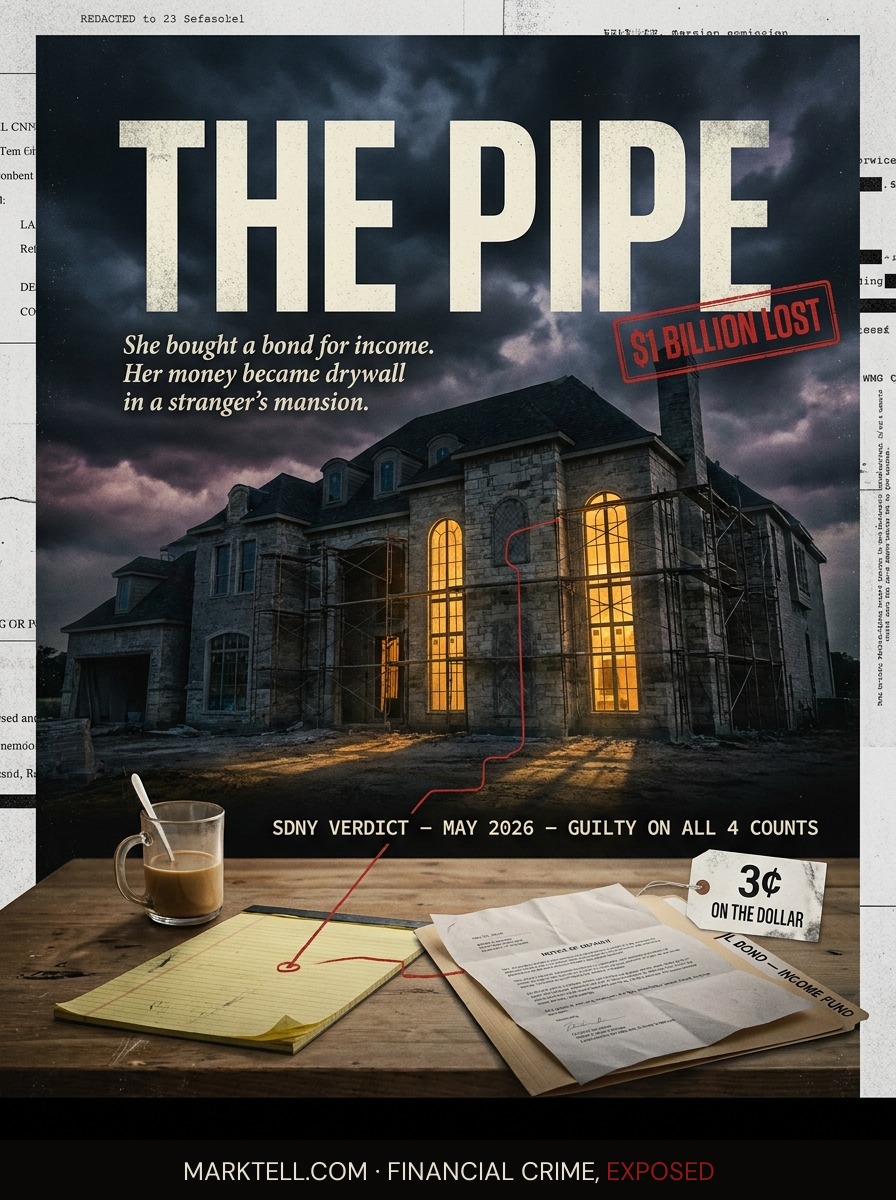
Eleanor read the letter twice. Then a third time, because the words on the page did not match what the man in her broker's office had said in 2019.
She was seventy-one. She had been a bookkeeper for a school district outside Phoenix for thirty-one years before she retired. She knew what an interest payment looked like. She knew what a default looked like. The letter was telling her, in language designed not to say it plainly, that GWG Holdings had missed $13.6 million in combined interest and principal payments on its L Bonds in January 2022. Hers was in there. Eighty-four thousand dollars of hers was in there.
She was still in her robe. The coffee had gone cold an hour ago.
The bond had been sold to her as income. That was the word. Income. Her broker, a man she had known for nine years, had walked her through a glossy folder at his office on a Tuesday afternoon. The L Bonds paid better than CDs. They were backed by life insurance policies. The company bought the policies on the secondary market and collected the death benefits. Steady. Predictable. The kind of thing a retired bookkeeper could understand on a yellow legal pad.
She bought eighty-four thousand dollars' worth. She signed at the bottom of the page where he had put a small pencil tick.
She was not stupid. She had asked the questions she knew to ask. The questions she did not know to ask were the ones the machine was built around.
II. The pipe.
Picture a pipe. One end of it is in Eleanor's checking account in Phoenix. The other end is in a 22,000-square-foot mansion in Dallas under renovation.
The pipe ran like this. GWG Holdings sold L Bonds to retail investors, roughly $1.6 billion of them, through a network of about forty independent broker-dealers. The money came in. Some of it bought life insurance policies, which was the business as advertised. A lot of it moved somewhere else.
In 2018, GWG bought a stake in a company called Beneficient. In 2019, Bradley Heppner became chairman of both companies. Heppner had founded Beneficient. He was sixty years old, lived in Dallas, and ran what the federal prosecutors in Manhattan would later call "shell companies to hide his scheme."
The central shell was a limited partnership called Highland Consolidated Limited Partnership. HCLP for short. Heppner controlled it. On paper, Beneficient owed HCLP $141 million.
That debt was fabricated. The trial established this. The jury established this. The U.S. Attorney for the Southern District of New York, Jay Clayton, said it plainly after the verdict: Heppner "used shell companies to hide his scheme." He "doubled down by falsifying emails and backdating documents to lie to the auditors, directors, and the SEC."
GWG sent money to Beneficient. Beneficient sent money to HCLP. HCLP was Heppner. The pipe ended in Dallas.
According to the indictment and trial record, Heppner spent $59 million of the diverted funds on renovations to his 22,000-square-foot Dallas mansion. He spent more on private jet travel. He spent more on jewelry. His official compensation from Beneficient over a four-year span ending in 2022 was about $2.7 million. The disparity was the tell.
Total extracted: more than $150 million, according to federal prosecutors.
Total lost by retail investors who held L Bonds: more than $1 billion.
Read that pair slowly. One hundred fifty million out the back. One billion lost out the front. The ratio is what makes the machine a machine. The money that left was a fraction of the money that died.
III. The minutes.
In October 2020, GWG received a subpoena from the SEC. The regulators were asking questions about accounting irregularities and how the L Bonds were being sold.
What Heppner did after that subpoena is the part of the record that should not be skipped.
He went back and falsified the minutes of an October 2019 board meeting. The minutes were rewritten to support a story he needed the auditors to believe. He fabricated emails. He backdated documents. He told the special committee of GWG's board, the auditors, and the SEC that he did not personally control HCLP and did not personally benefit from the payments.
He did control it. He did benefit. The jury found all of that.
In a true crime book, this is the chapter where the killer cleans the kitchen. The crime is already done. The cleaning is what gets him convicted.
IV. Eleanor, again.
GWG filed for Chapter 11 bankruptcy in April 2022. Three months after the missed payment. Eleanor was not told by her broker. She found out from a forwarded news link sent by her son, who had seen the headline on his phone and called her on his lunch break.
She sat with that for a while.
The L Bonds were illiquid. That was a word she had to look up in 2019 and look up again in 2022. Illiquid means you cannot sell it. Means there is no buyer waiting on the other side of the screen. Means the only way out is for the company to pay you back, and the company was not paying anyone back.
The L Bonds were unrated. That meant no major rating agency had looked at them and assigned a credit score. There was no Moody's, no S&P, telling investors what the risk really was. The folder her broker had walked her through did not lead with that.
The L Bonds were backed by life settlements. That was true. The folder said it. What the folder did not say was that the money could also be sent down a pipe to a shell company controlled by the chairman.
In March 2025, Beneficient offered $50.5 million to resolve remaining claims from L Bond holders. After deductions, that worked out to roughly three cents on the dollar.
Three cents.
Eleanor's eighty-four thousand dollars, on paper, was now worth about twenty-five hundred dollars. If the settlement closed. If the deductions held. If nothing else fell apart.
She did the math on a yellow legal pad. She had bought the bond to generate income for the second half of her retirement. The income was going to cover the gap her Social Security and her teachers' pension did not cover. The trip to see her grandson in Oregon. The new roof her house was going to need in 2027. The dental work she had been putting off.
She did not need to be rich. She needed eighty-four thousand dollars to stay eighty-four thousand dollars and to throw off five percent a year. She needed the boring thing the folder had described.
The folder had described a boring thing. The pipe had not been boring.
V. The verdict.
On a Thursday in early May 2026, a federal jury in Manhattan convicted Bradley Heppner on all four counts. The trial had lasted three weeks. Judge Jed S. Rakoff presided. Sentencing is set for October 7, 2026. Heppner faces a maximum of twenty years in prison on each fraud count and five on the conspiracy count.
Beneficient, the company Heppner founded, issued a statement on May 11 confirming the conviction and emphasizing that it had separated from him and cooperated with the investigation. The company said it was now positioned to challenge the fabricated debt to HCLP. The stock, which trades on Nasdaq as BENF, had fallen fifty-one percent year-to-date. Market capitalization was $48.9 million as of the day Beneficient issued its statement.
Read that number against the one above. The whole company is now worth less than a third of what its founder is alleged to have personally extracted.
Around forty broker-dealers sold L Bonds. FINRA has issued more than $675,000 in penalties and reached settlements with at least fifteen brokers and firms since 2021 related to GWG. Those cases are continuing. Allegation is not adjudication. But the sales floors that fed Eleanor into the machine are still being examined one by one.
VI. The chair at the kitchen table.
Eleanor still has the folder. It is in the top drawer of her kitchen desk, behind the warranty for her dishwasher. She has not thrown it out.
She does not read it anymore. She just knows it is there.
The folder is the story she was told. The verdict is the story that was true. The gap between them is where the eighty-four thousand dollars went.
It did not vanish. That is the part the headline does not capture. Money does not vanish. Money moves. Her eighty-four thousand dollars moved. Some of it bought life insurance policies. Some of it went down the pipe. Some of it became drywall in a Dallas mansion, became a flight on a private jet, became a piece of jewelry on a shelf in a house she will never see.
The bond was not an income product. The bond was the fuel.
She thought she was a lender. She was a contractor's invoice.
- U.S. Attorney's Office, Southern District of New York | May 2026 | Press release on Heppner conviction
- InvestmentNews | May 2026 | "GWG, Beneficient boss guilty of all charges in securities fraud trial"
- GWG Holdings, Inc. | April 2022 | Chapter 11 bankruptcy filing
- SEC | October 2020 | Subpoena and investigation of GWG accounting and L Bond sales practices
- Beneficient | May 11, 2026 | Public statement on Heppner conviction
- Beneficient | March 2025 | $50.5 million settlement offer to L Bond holders
- FINRA | 2021-2026 | Enforcement actions and settlements against brokers and firms selling GWG L Bonds
- U.S. District Court, Southern District of New York | May 2026 | Trial record, Judge Jed S. Rakoff presiding
Editorial Notice
MarkTell is a true crime publication about financial fraud. Some scenes, dialogue, and sequential details are reconstructed from court filings, enforcement actions, news reports, and public records. Where the public record does not provide exact details, editorial reconstruction is used to convey the documented pattern of events. Names of private individuals may be changed to protect identity. All factual claims are sourced to public documents cited in the Evidence Trail above. MarkTell does not provide investment, legal, or financial advice. Nothing published here constitutes a recommendation to buy, sell, or avoid any investment. Allegations described in active cases have not been adjudicated and defendants are presumed innocent until proven guilty. Readers should conduct their own due diligence before making financial decisions.