The judge held the escrow. That was the whole pitch.
Federal prosecutors say a sitting New York Supreme Court justice let his name sit on a bank account two investors believed was an escrow. The wire cleared. The money moved. Only a fraction came home.
Daniel was fifty-eight and had wired money into escrow a hundred times.
That was the job. You found a building. You agreed on a price. You sent earnest money into an account that did not belong to the seller and did not belong to you, and the account sat between you until the lawyers were done. That is what escrow is. A pot of money held by a third party who has no reason to touch it. The whole thing only works because the name on the account is somebody nobody would steal from.
In February 2025, Daniel sat at his desk and looked at a wire confirmation for his portion of a $6.5 million transfer. The deal was a commercial property in Freehold, New Jersey. The escrow holder on the wire instructions was not a title company. It was a man. The man was a sitting justice of the New York Supreme Court in Brooklyn.
Daniel hit send.
That is the moment the story turns on. Not because Daniel was careless. Because Daniel was the opposite of careless. He read the instructions. He saw the name. He saw the word judge. He did what a reasonable person does when a deal has a judge's name on the escrow line. He relaxed.
I.
The man on the wire instructions was Edward Harold King. Seventy-two years old. A justice on the Kings County Supreme Court. According to the indictment unsealed in the Eastern District of New York on May 13, 2026, between November 2024 and May 2025, King and a thirty-seven-year-old real estate investor named Sam Sprei solicited money from investors for what prosecutors call fictitious investment opportunities.
In February 2025, two investors wired roughly $6.5 million into a bank account in King's name. They believed the account was an escrow for the Freehold bid.
It was not an escrow account. It was a personal bank account belonging to a sitting judge.
The complaint alleges that immediately after the wires cleared, millions were withdrawn or transferred to a bank account in Sprei's name. Some of the money, prosecutors say, went to pay King's own bills.
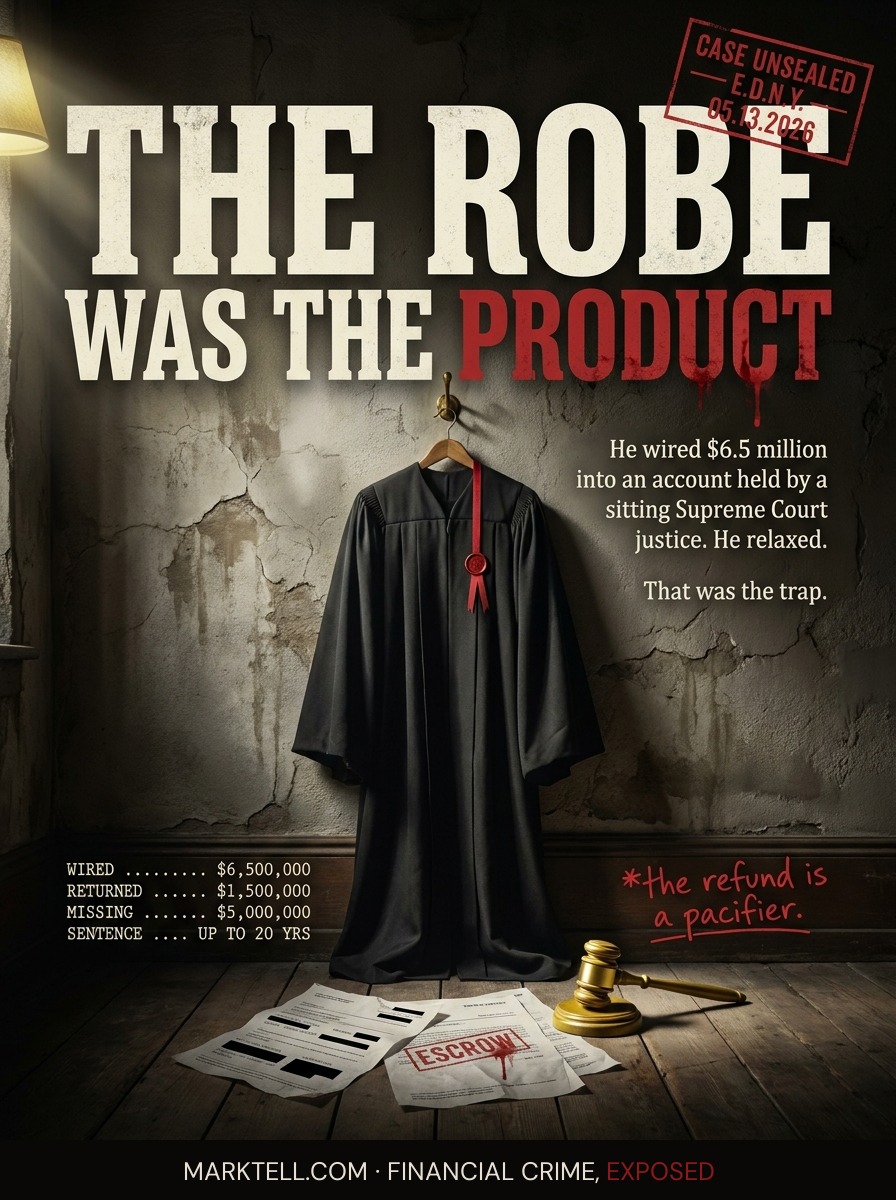
Later, $1.5 million came back to the investors. At least $5 million did not.
If the math feels familiar, it is because it is the oldest math in the file cabinet. Take more than you need to return. Give back enough to keep the complaint conversational for a few months. Hope the rest gets lost in the noise of a deal that did not close.
II.
A judge is not a financial product. A judge is a piece of furniture you cannot move.
In a courtroom, a judge sits above the parties. The robe says everything. You do not need to know his record. You do not need to know his bank statements. You walk into the room and you assume the chair behind the bench has been earned and audited and is being watched by other people whose job it is to watch.
That is the asset King allegedly rented out.
U.S. Attorney Joseph Nocella Jr. and Assistant U.S. Attorney Andrew Wang, who is handling the case, allege that King's position was used to "lend false legitimacy" to the deals. Harry T. Chavis Jr., who runs the IRS Criminal Investigation office in New York, put it this way in the announcement: "fraud that hides behind a veneer of legitimacy, especially the authority of a judge, strikes at the heart of public trust."
Read that slowly. The robe was not a credential. The robe was the product.
A bank account in the name of a sitting Supreme Court justice does not look like a bank account. It looks like a vault. Investors who would have asked twenty questions about a title company in Freehold did not ask one question about a judge in Brooklyn.
That is the machine. Borrow the robe. Put the robe on the wire instructions. Let the investor's own respect for institutions close the deal for you.
III.
This is the part of the file Daniel did not see when he sent the wire.
According to the public record, King had been the subject of civil lawsuits and complaints filed with the state Commission on Judicial Conduct before the federal case landed. Those complaints, which prompted his resignation from the bench at the end of 2025, described conduct similar to what the federal indictment now charges.
In plain English: the pattern in the criminal complaint was not new. There had been people raising hands. There had been filings. There had been a judicial conduct file thick enough to end a career.
None of that was visible from Daniel's desk in February 2025. A civil lawsuit against a sitting judge is a needle in a county the size of Brooklyn. A Commission on Judicial Conduct file is confidential until it is not. Daniel did what a careful investor does. He searched the name. He saw a sitting judge. He sent the wire.
The gap between what was in the file cabinet and what was visible on Google is where this kind of fraud lives. Not in the dark web. In the gap.
IV.
The escalating shape of the case, as the government tells it:
A bank account in a judge's name. A wire for $6.5 million. An immediate transfer to a co-defendant's account. Personal bills paid from investor funds. A $1.5 million refund. A $5 million hole. A resignation from the bench. A federal arrest. A perp walk on a Wednesday in May.
Assistant U.S. Attorney Andrew Wang told the court that the Freehold transaction is "one of several schemes that the government has been investigating." Read that line twice. The indictment unsealed on May 13 is one episode. The investigation is broader. The number of victims in the public record is two. The number of victims in the file is a question the government has not answered yet.
Sprei, at his arrest, is separately accused of lying to FBI agents about whether he was carrying electronic devices. His lawyer, Ezra Lent, declined to comment. King declined to comment. Both men were released on bail and are scheduled to appear in Brooklyn federal court on Monday, May 18, 2026, to finalize bond.
Allegation is not adjudication. The indictment is a starting line, not a finish line. Both defendants are presumed innocent.
V.
Daniel got a partial refund. That is the cruelest part of this kind of scheme. The refund is not a refund. The refund is a pacifier. $1.5 million back on a $6.5 million wire is enough to make a reasonable investor think the deal collapsed and the rest is coming. The rest is always coming. Next week. Next month. After the holidays. After the new year.
By the time Daniel understood what the rest meant, the bench was empty. The judge had resigned. The file had moved from a civil docket to a federal one. The word escrow had quietly become the word indictment.
He still has the wire confirmation. He still has the instructions with the judge's name on the escrow line. He prints them out now and looks at them the way you look at a photograph of a house that has since burned down.
What he keeps coming back to is not the money. It is the line on the wire instructions. The line that said the account was held by a justice of the Supreme Court.
He read it. He believed it. He was right to believe it.
That is the part that does not leave.
The robe was real. The escrow was not. The federal prosecutors allege the man inside the robe knew the difference and rented one to cover the other.
If convicted, King and Sprei face up to twenty years.
The robe is already gone. The investigation, the government says, is not finished.
- U.S. Attorney's Office, Eastern District of New York | May 13, 2026 | Press release announcing arrests of Edward Harold King and Sam Sprei on wire fraud conspiracy charges
- Federal criminal complaint, EDNY | May 13, 2026 | Allegations regarding February 2025 wire transfers, fund diversion, and partial $1.5M refund
- IRS Criminal Investigation, New York Field Office | May 13, 2026 | Statement of Special Agent in Charge Harry T. Chavis Jr.
- New York State Commission on Judicial Conduct | 2025 | Investigation prompting King's resignation from the bench
- Laredo Morning Times | May 13, 2026 | "Ex-Brooklyn judge accused of swindling real estate investors out of millions of dollars"
Editorial Notice
MarkTell is a true crime publication about financial fraud. Some scenes, dialogue, and sequential details are reconstructed from court filings, enforcement actions, news reports, and public records. Where the public record does not provide exact details, editorial reconstruction is used to convey the documented pattern of events. Names of private individuals may be changed to protect identity. All factual claims are sourced to public documents cited in the Evidence Trail above. MarkTell does not provide investment, legal, or financial advice. Nothing published here constitutes a recommendation to buy, sell, or avoid any investment. Allegations described in active cases have not been adjudicated and defendants are presumed innocent until proven guilty. Readers should conduct their own due diligence before making financial decisions.