The IT guy installed the cameras. He also installed a door for himself.
Billie Conley Jr. pleaded guilty to wire fraud on June 1, 2026, after federal prosecutors said the Ridgefield Tech owner hid unauthorized remote-access software inside a funeral home's surveillance system. The cameras were watching the parking lot. Something else was watching the cameras.
Anthony was fifty-eight the September he let the IT man into the back room.
He ran a funeral home his father had opened in 1971. Two viewing parlors, a chapel that seated ninety, an embalming suite in the basement that he kept locked because the families never needed to see that door. He signed every check by hand. He kept the books in a green ledger because his father had kept the books in a green ledger. He was not a technology man. He was a man who knew which families wanted the Catholic prayer card and which families wanted the Protestant one, and he had been right about that distinction for thirty years.
The break-ins on the block were what pushed him. Two businesses up the street had been hit that summer. His insurance carrier had asked, gently, whether he had cameras. He did not. He had a deadbolt and a habit of leaving the lights on.
So he called a local IT shop. Ridgefield Tech, LLC. The man who showed up was forty-six, polite, talked fast about switches and NVRs and the difference between PoE and standard cabling. Anthony did not follow most of it. He followed the price, which was reasonable, and the handshake, which was firm. He signed the contract on a Tuesday.
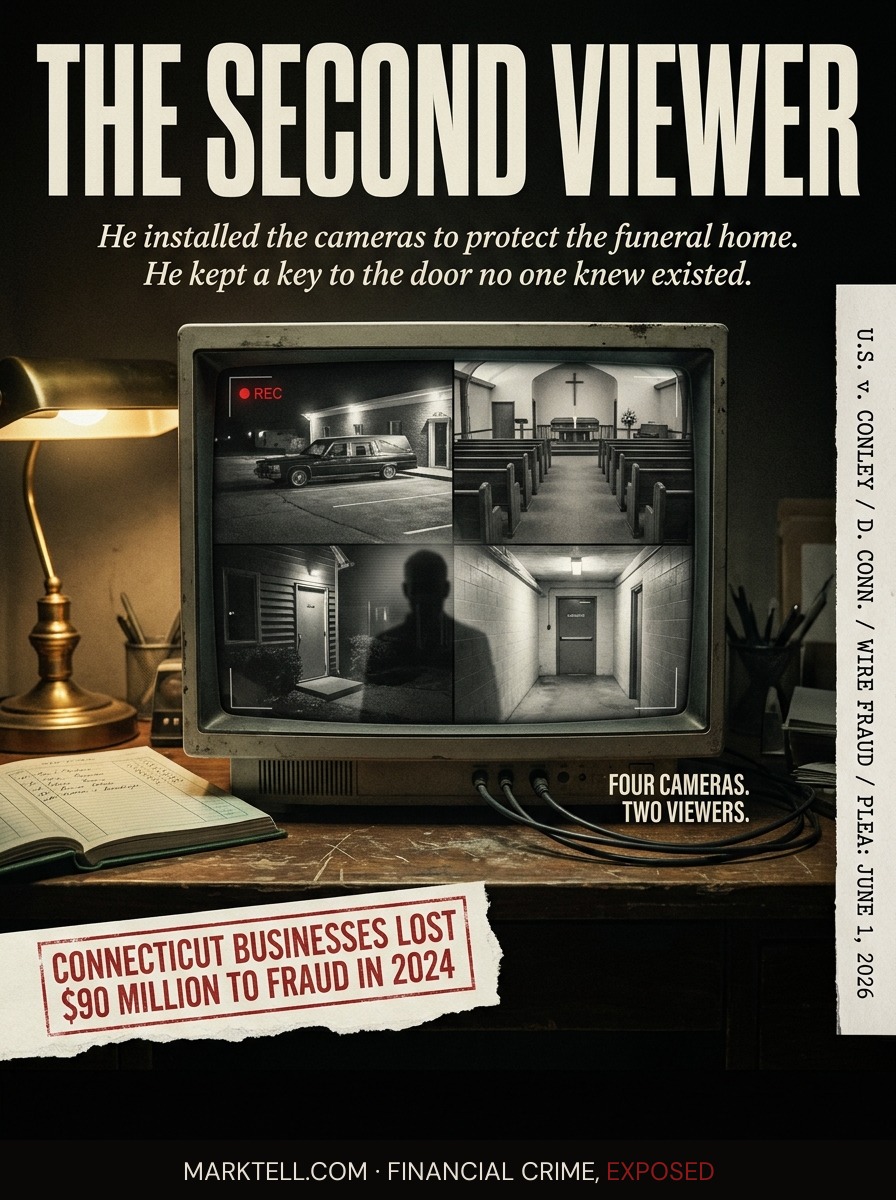
The man ran cable through the ceiling tiles for two days. He mounted four cameras: parking lot, chapel entrance, side door, the hallway outside the embalming suite. He set up a small black box in the server closet behind the office. He showed Anthony how to pull up the feeds on the monitor at the front desk. Four little squares. The parking lot. The chapel. The side door. The hallway.
The cameras were watching the building.
Something else, according to the federal government, was watching the cameras.
II.
On Monday, June 1, 2026, in federal court in New Haven, Billie Conley Jr., 46, formerly of Shelton, Connecticut, the owner of Ridgefield Tech, LLC, pleaded guilty to wire fraud.
The U.S. Attorney's office for the District of Connecticut, under David X. Sullivan, described what Conley admitted to as a computer intrusion scheme. The charging language is specific. Conley was hired in September 2023 to set up a computer network and a video surveillance system for the owner of a funeral service business. He did the job he was hired to do. He also, the government says, installed software that allowed him unauthorized remote access to the client's network.
He built the lock. He kept a copy of the key.
The specific dollar amount of loss is not in the public record as of this plea. That part will come. Wire fraud is the charge because the access ran across interstate wires, which is the federal hook. The intrusion is the act. The wire is the jurisdiction.
Read that slowly. The man who installed the cameras to protect the business installed a way into the business he did not tell the business about.
III.
There is a kind of fraud that does not look like fraud when it is happening. It looks like a service call. It looks like an invoice. It looks like a man on a ladder threading cable through a drop ceiling while the owner makes coffee in the front office and asks if he wants a cup.
This is the trusted-vendor model, and it is older than computers. The locksmith who keeps a copy of the key. The accountant who knows where the safe is. The contractor who builds the addition and remembers which window does not latch. The technology version is just faster and harder to see, because the door he leaves open does not have hinges. It has a port number.
What did Conley do with the access? The public record does not yet say. The plea establishes the intrusion. The sentencing will, presumably, establish more. There is a reason wire fraud was the chosen charge and not, say, simple unauthorized access. Wire fraud requires a scheme to defraud. The government, by accepting his plea to that charge, is saying the access was not curiosity. It was part of a scheme.
That is the line in the record. The rest is pending.
IV.
Picture Anthony's monitor at the front desk. Four squares. The parking lot in the upper left, where a hearse pulls in on a Wednesday morning to collect a Mrs. Capelli, ninety-one, congestive heart failure. The chapel in the upper right, where Anthony's assistant is setting out the prayer cards. The side door in the lower left, where the florist delivers the standing sprays. The hallway in the lower right, outside the embalming suite, empty.
Anthony glances at the monitor maybe ten times a day. He likes the four squares. They make him feel he is paying attention to everything at once.
He does not know, in 2023 or 2024 or most of 2025, that the cameras have a second viewer.
This is the part that is hard to write without overreaching, so let me say what the record supports and what it does not. The record supports that Conley installed unauthorized remote-access software. The record does not, as of this plea, specify what he did with it, how long it ran, or what data crossed it. The government's word for what he did is intrusion. The government's word for the larger frame is scheme.
A funeral home holds an unusual quantity of sensitive information. Death certificates. Social Security numbers of the deceased, which are gold for identity theft because the deceased do not check their credit reports. Family contact information. Payment information. Pre-need contracts, which are essentially small annuities with named beneficiaries. The systems are old. The owners are often Anthonys. The trust given to the IT vendor is total because the alternative is to learn networking at fifty-eight, and nobody learns networking at fifty-eight.
I am not saying that is what happened here. The record has not yet said. I am saying that is what a funeral home's network is, sitting on a table, for anyone who has the key.
V.
The story of how the federal government found Conley is not in the press release. Most of the time, in these cases, it is one of three things. A bank sees an outbound wire it does not like. A second victim reports the same vendor. Or the access itself trips an alarm at a third party, a credit-card processor, an email host, a payroll service, and the trail walks backward to the server closet.
What we do know is this. Last week, on May 18, 2026, Trumbull police arrested a man in connection with a separate computer fraud scheme that convinced a Trumbull resident to transfer $900,000 in gold coins. The pretext there was a fake Microsoft Windows pop-up. Different mechanism. Same family. The same week the Conley plea was announced, the Connecticut Secretary of the State, Stephanie Thomas, issued a warning to businesses about a spoofing email pretending to be from the state's business registry and carrying malware.
Connecticut businesses lost roughly $90 million to fraud in 2024. That is the number the state has been using in its press materials this year. The cases stack up the same way. Trust given to a vendor, a pop-up, an email, a phone call. Access taken. Money or data moved. The funeral home version is just quieter because the cameras keep working and the invoices keep coming and the owner glances at the four squares ten times a day and feels watched-over.
VI.
I sold a lot of things over the phone in my twenties. I sold metals to dentists. I sold magazine subscriptions to people who already had too many magazines. I learned the script. I learned the trial close. I never installed software on anyone's network, because in the 1980s that was not a thing you could do from a desk in Chicago, but I understood the principle, which is this. The fraud is not the product. The fraud is the access. Once they let you in, you can sell them the second thing and the third thing, and they will buy it because they let you in the first time and they do not want to admit that was a mistake.
A man who installs cameras in a funeral home has been let in. He has walked the building. He has seen the server closet. He has met the owner's assistant. He has, in the case the government brought, written software that gave him a second way in that the owner did not know about.
That is not a technician. That is, by his own plea, a man running a scheme.
VII.
Anthony, the composite, sits at his desk in the front office. The green ledger is open. The four squares are on the monitor. A family is coming in at two o'clock to plan a service for a father who died on Saturday.
He does not know yet whether his is one of the funeral homes. The federal indictment names a victim. The press release describes the victim as the owner of a funeral service business. That could be him. That could be someone else. Conley operated Ridgefield Tech for years. The plea, as filed, references one client. Whether others existed is one of the open questions.
Anthony will get a phone call, or he will not. The U.S. Attorney's office will tell him what was taken, or his bank will, or his customers will when their data shows up somewhere it should not be. The cost will not all be money. Some of it will be the way he looks at the monitor now. Four squares. Parking lot. Chapel. Side door. Hallway. A man at fifty-eight learning that the cameras he installed to watch the doors had been a door themselves.
The cameras were watching the building.
He was the one being watched.
- New Haven Register | June 1-2, 2026 | "Owner of Connecticut IT business scammed client with unauthorized software, feds say"
- U.S. Attorney's Office, District of Connecticut | June 1, 2026 | Announcement of guilty plea, United States v. Billie Conley Jr.
- Connecticut Secretary of the State Stephanie Thomas | June 1, 2026 | Public warning regarding spoofing email impersonating Connecticut Business Registry
- Trumbull Police Department | May 18, 2026 | Arrest announcement, $900,000 gold coin computer fraud scheme
- State of Connecticut fraud loss reporting | 2024 | Approximately $90M in business fraud losses
Editorial Notice
MarkTell is a true crime publication about financial fraud. Some scenes, dialogue, and sequential details are reconstructed from court filings, enforcement actions, news reports, and public records. Where the public record does not provide exact details, editorial reconstruction is used to convey the documented pattern of events. Names of private individuals may be changed to protect identity. All factual claims are sourced to public documents cited in the Evidence Trail above. MarkTell does not provide investment, legal, or financial advice. Nothing published here constitutes a recommendation to buy, sell, or avoid any investment. Allegations described in active cases have not been adjudicated and defendants are presumed innocent until proven guilty. Readers should conduct their own due diligence before making financial decisions.