The inspector signed his own invoices and called it repair work.
Adebanjo Popoola inspected the buildings. He also owned the companies pretending to fix them. For seventeen months, the certification he signed at the end of the job was the last lock on the door, and he had the key.
Delores is seventy-one. She worked twenty-nine years as a custodian at a public high school on the north side of St. Louis and she retired with a small pension and a paid-off house on a street where four of the eleven other houses are boarded up.
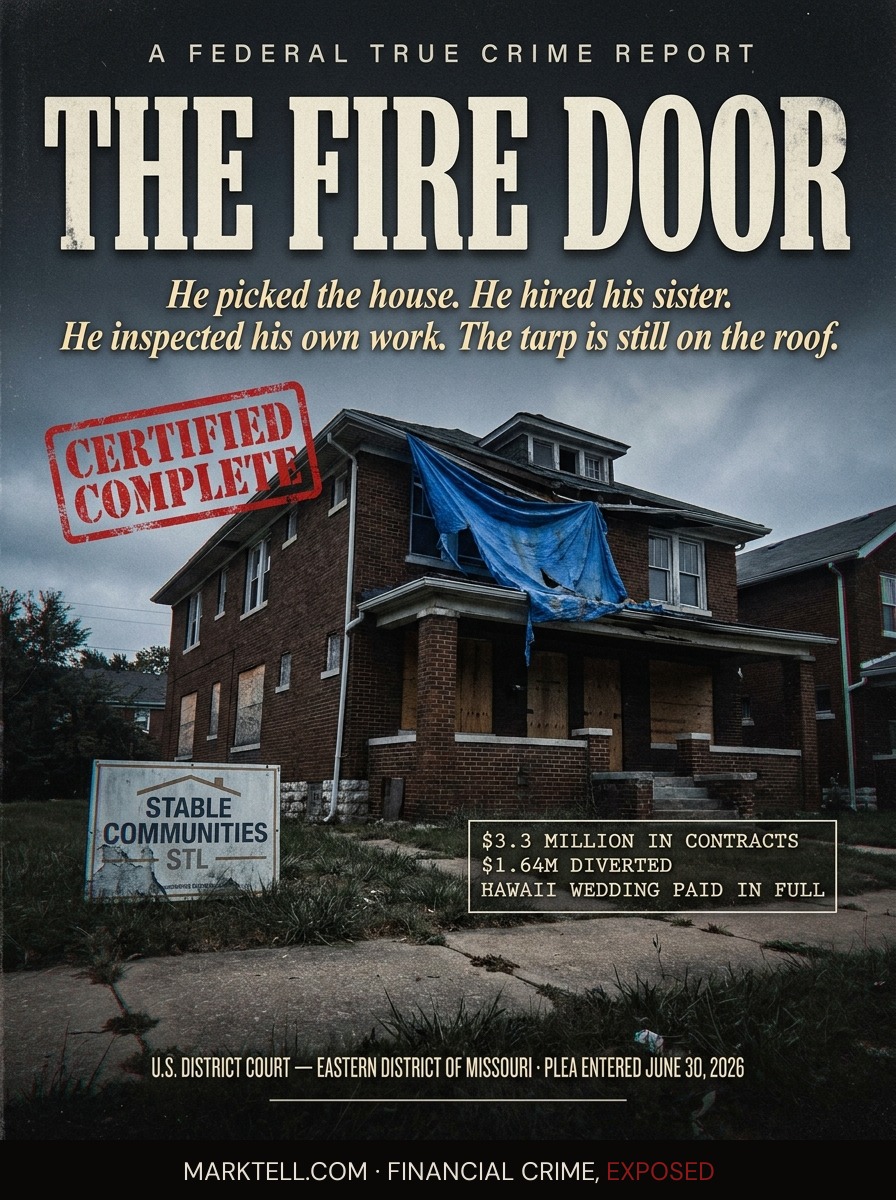
The one two doors down from her leans. She can see it from her porch. Brick two-family, plywood over the first-floor windows, a tarp on part of the roof that has been there since before her sister passed. In the summer of 2023, a sign went up in the yard. Something about rehabilitation. A city program. A phone number. Delores read it twice and felt something she had not felt on that block in a long time, which was the small clean feeling that somebody was coming.
A crew showed up. Not for long. They tore some things out. They left a dumpster for a while. Then the dumpster went away and the crew went away and the house kept leaning.
She called the number on the sign a few times. She got a voicemail. She did not leave a message the third time because by then she had understood that the sign was the whole event.
I.
The program was called Stable Communities STL. The money in it was federal, American Rescue Plan Act dollars, which is to say the pandemic relief money Congress sent to cities to spend on things like the leaning brick house two doors down from Delores. There was a second program running alongside it called Prop NS, funded by city general obligation bonds, which is a fancy way of saying the city borrowed money from investors and promised to pay it back with taxes in order to fix the houses now.
Between the two programs, the City of St. Louis had a real pot of money and a real intention. Identify the dilapidated buildings. Write a scope of work. Solicit bids. Award contracts. Send crews. Inspect the finished job. Certify completion. Release the payment.
That last step is the one that mattered. Certify completion. Release the payment. Somebody had to stand on the property, look at what got done, and sign the piece of paper that said the work was real. The signature was the last lock on the money.
Adebanjo Popoola had the key.
II.
Popoola is fifty-seven. Nigerian-born, engineer by training, employed by the City of St. Louis as a building division inspector. According to the plea documents entered June 30, 2026 in the United States District Court for the Eastern District of Missouri, his job on the Stable Communities STL and Prop NS programs was to identify the properties, develop the scope of work, solicit and review bids, award contracts, inspect the completed work, and certify completion so the funds could be released.
Read that list again. He picked the houses. He wrote the specs. He chose the contractor. He inspected the finished job. He signed the paper.
Now watch what he did with it.
In February 2021, a woman who would later become his wife established a Missouri LLC called Premier Finish Contractors. In October 2022, his sister incorporated a second Missouri LLC called Farst Construction. Two companies. Two relatives. Neither connection disclosed on the Employee Secondary Employment Questionnaires the city required him to file. He filed those questionnaires in 2022 and 2023. The federal complaint says he filed them falsely.
Then, from about June 12, 2023 through November 22, 2024, the contracts started landing. Farst Construction picked up roughly $1.4 million under Stable Communities STL and another $339,500 under Prop NS. Premier Finish Contractors picked up its own share. In total, per the DOJ, the two companies received more than $3.3 million in city rehabilitation contracts.
The inspector picked the contractor. The contractor was his sister. The contractor was his fiancée. The inspector inspected the work. The inspector certified the work was done. The money was released.
That is not a conflict of interest. That is a closed circuit.
III.
The work, according to the plea, was often incomplete or badly done. That part will matter to Delores in a minute. Popoola certified it as properly and fully completed anyway. The certification was the whole trick. Once the paper was signed, the wire went out. Once the wire went out, the money was gone.
Of the $3.3 million in contracts, the plea says approximately $1.64 million was diverted to Popoola himself, his sister, and his soon-to-be wife.
Where the money went is on the record.
Residential mortgage payments. Vehicle purchases. Vehicle repairs. Casino gambling. Restaurants. Entertainment. A wedding in Hawaii in September 2023, paid for out of a fund that was supposed to make sure the roof on the house two doors down from Delores stopped leaking.
Picture that wedding. Federal pandemic relief dollars, routed through a program named Stable Communities, sitting on a beach in Hawaii. That is not a metaphor. That is the flight of the money.
IV.
Here is the machine, named plainly.
The certification loop is what you get when the person doing the work is the person inspecting the work is the person approving the payment. It is a specific kind of fraud that grows in municipal procurement the way mold grows in a wet basement. It does not require a genius. It requires one person with three jobs and no one behind him checking.
The city had a form for this. The Employee Secondary Employment Questionnaire. The whole point of that form is to break the loop before it closes. You disclose your outside interests, someone else reviews them, someone else assigns the contracts. The form is the fire door.
Popoola, according to the DOJ, filed the form and left the doors closed. Farst was not on it. Premier Finish was not on it. His sister was not on it. His fiancée was not on it.
That is the fraud in a single sentence. The fire door was there. He walked past it and signed his name saying there was no fire.
V.
Delores does not know the phrase certification loop. She does not know what an Employee Secondary Employment Questionnaire is. She knows that in the summer of 2023 a sign went up in the yard of the leaning brick two-family and a crew came out for a little while and then the crew stopped coming and the sign got faded and eventually the sign fell down.
She knows that the tarp on the roof is still there.
She knows the property tax on her own paid-off house went up again this year, and that some of what she is paying is servicing the bond debt on Prop NS, which is the program that paid $339,500 to a company owned by the sister of the inspector who signed the paper that said the work was done.
She would not put it that way. She would say the house next door is still leaning.
VI.
The case broke because the City of St. Louis Comptroller's office started asking questions and the FBI followed the money. Assistant United States Attorney Hal Goldsmith brought the charges. Popoola pleaded guilty to three counts of wire fraud on Tuesday, June 30, 2026. Sentencing is set for October 6, 2026. He faces up to twenty years on each count, up to $250,000 in fines, and an order to repay what he took.
Repay from what, is the question Delores would ask if anyone brought her a microphone. The mortgages are on houses now. The cars are cars now. The Hawaii wedding happened three years ago and the pictures are on somebody's phone.
The federal money is spent. That is what "diverted" means when you read it in a plea. Not delayed. Not misplaced. Spent. On other things. On a life the inspector was building on top of the life he was supposed to be inspecting.
VII.
The thing to understand about the certification loop is that it will run again. Not by Popoola. He is going to prison. But somewhere in another city, in another municipal building department, another inspector has another sister with an LLC and another form to file and another set of doors that only close if he closes them.
Federal rehabilitation dollars are still flowing. Cities are still hiring inspectors. Sisters are still incorporating construction companies. The machine does not need Popoola. It needed the shape of his job.
If you live on a block where the city put a sign up in a yard and a crew came for a little while and then never came back, you are not paranoid. You are looking at the machine from the outside. Delores has been looking at it from her porch for three years.
The house next door is still leaning.
That is the story.
- U.S. Department of Justice, Eastern District of Missouri | June 30, 2026 | Plea announcement, United States v. Adebanjo Popoola, wire fraud (18 U.S.C. § 1343)
- TheNigeriaLawyer | July 2, 2026 | "'Guilty Of Wire Fraud' — U.S. Court Convicts Nigerian-Born Engineer For Diverting $1.64m Building Repair Funds To Himself, Relatives"
- City of St. Louis Comptroller's Office | investigative referral, cited in DOJ release
- Missouri Secretary of State business filings | Farst Construction LLC (October 2022), Premier Finish Contractors LLC (February 2021)
- City of St. Louis, Stable Communities STL program documentation (ARPA-funded)
- City of St. Louis, Prop NS general obligation bond program
Editorial Notice
MarkTell is a true crime publication about financial fraud. Some scenes, dialogue, and sequential details are reconstructed from court filings, enforcement actions, news reports, and public records. Where the public record does not provide exact details, editorial reconstruction is used to convey the documented pattern of events. Names of private individuals may be changed to protect identity. All factual claims are sourced to public documents cited in the Evidence Trail above. MarkTell does not provide investment, legal, or financial advice. Nothing published here constitutes a recommendation to buy, sell, or avoid any investment. Allegations described in active cases have not been adjudicated and defendants are presumed innocent until proven guilty. Readers should conduct their own due diligence before making financial decisions.