The hedge fund was a man with no face and a wallet that ate the deposit.
Utah's Division of Securities issued an emergency cease-and-desist on June 1 against BG Wealth Sharing, a crypto pyramid that promised 60% monthly returns and ran on an AI-generated founder. The machine collapsed the same week. The fees to "release" the money kept coming.
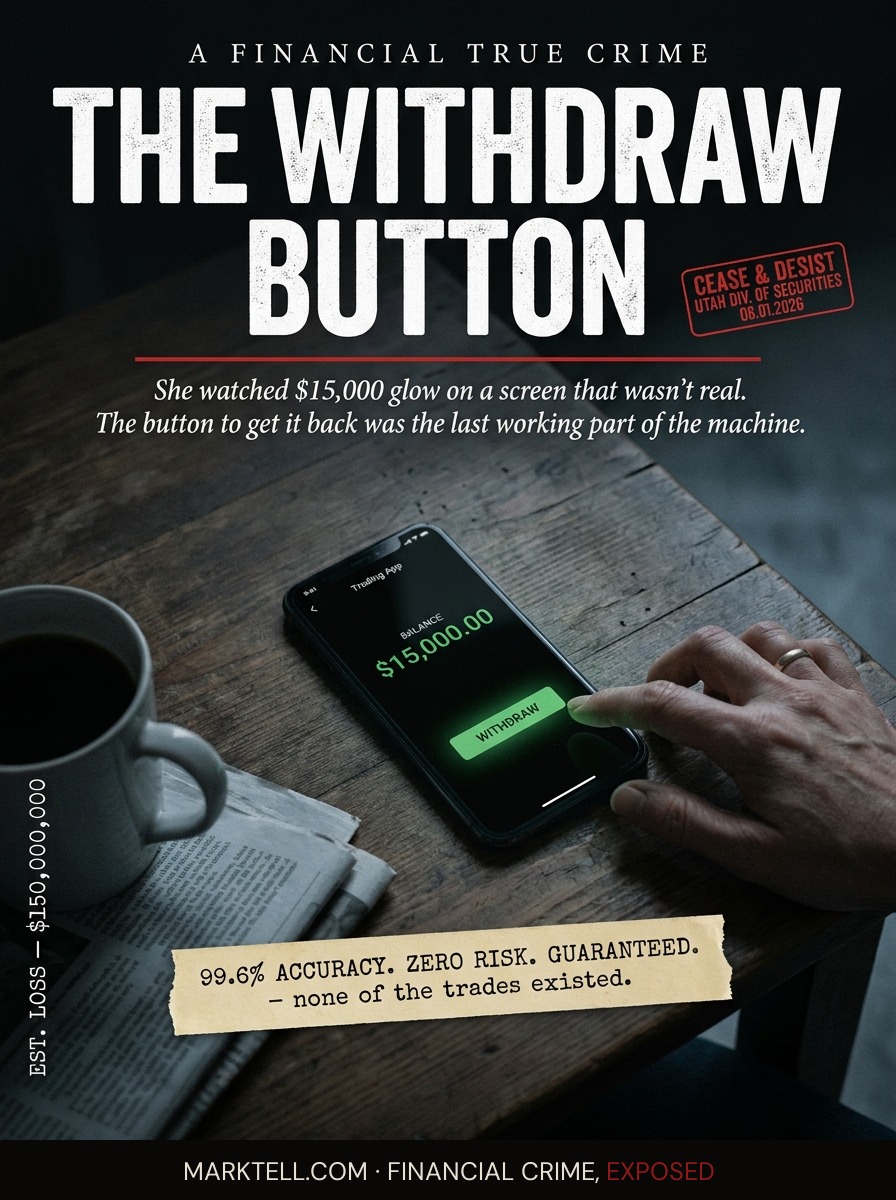
Linda set the phone face-up on the kitchen table the way you set a thermometer next to a sick child. She kept refreshing. The number on the screen did not move. Fifteen thousand dollars. A green balance against a black background. The withdraw button was still there. It still glowed. It just did not do anything when she pressed it.
It was Tuesday, June 2. The message from Bonchat had come in on Sunday night at 11:14. To complete your withdrawal, the system requires a one-time verification payment of twelve percent of your account balance. The number she would need to send to get her money back was $1,800. She did not have $1,800 that was not already inside the app.
She is fifty-eight. She has cleaned teeth at the same dental practice in West Jordan for nineteen years. Her hands are steady. She is the person at family parties who reads the warranty before plugging anything in. None of that helped her here.
The seminar was in April. A hotel meeting room off Bangerter Highway. Folding chairs, a coffee urn, a projector running cool. The man who introduced himself as the local director said his name was Richard. He wore a navy blazer. He spoke softly. He said the company was the world's largest hedge fund. He said the founder, Professor Stephen Beard, had spent years inside the International Monetary Fund before he decided ordinary people deserved access to the kind of AI trading the institutions had been hoarding.
Professor Beard appeared on the projector screen. He had silver hair and a navy blazer that matched Richard's. He did not blink quite right. He spoke for eleven minutes about volatility and signal accuracy and the duty he felt toward the small investor. Linda would learn later, from a Utah Division of Securities order dated June 1, 2026, that regulators believe Professor Beard is an actor hiding behind an AI avatar and that no IMF affiliation has been verified. She did not know that in April. In April, she wrote down the phrase ninety-nine point six percent accuracy on the back of the program.
The pitch had a number. Daily returns of 1.3 to 2.6 percent. Monthly returns of at least sixty percent. Guaranteed. Zero risk. The minimum to open a live trade account was five hundred dollars. Linda put in five hundred. The dashboard began to grow the next morning.
I.
A hedge fund is a pool of money that pays a manager to invest it. The manager keeps a share of the profits. Legitimate ones are registered with the SEC, audited by outside firms, and required to disclose what they hold. BG Wealth Sharing was not registered to sell securities or provide investment advice in Utah. It claimed to be licensed by the SEC. It was not.
The trading platform was called DSJ Exchange. The accuracy rate was 99.6 percent. The signals were AI-powered. None of the trades existed. Regulators found no evidence of legitimate trading activity. The account balances, the Utah order states, were believed to be fake.
Read that slowly. The number on Linda's screen was not a record of money she owned. It was a graphic. The graphic was the product.
II.
The way the dashboard grows is the way the dashboard always grows in these schemes. The early deposits are small. The early withdrawals are honored. The first withdrawal is the most important transaction in a Ponzi. It is the receipt the investor shows their sister.
Linda's sister came in at three thousand. Her sister's neighbor came in at two. By the end of April, Linda's downline, the chain of people she had personally recruited, was nine deep. Her dashboard rewarded her for it. The recruitment bonuses showed up as separate line items. She did not have to ask what a pyramid was to participate in one. She just had to ask her sister.
That is the move. The mark is not stupid. The machine is built to make the mark into the salesperson. The mark recruits because the dashboard tells her she is winning, and the dashboard tells her she is winning because the operator needs her to recruit. The math only works if the money keeps coming in. When it stops coming in, the machine has to choose between paying out and disappearing. It always chooses the same thing.
III.
The disappearance was paced. On May 31, HQI Exchange, a reboot platform investors had been told to migrate to, disabled withdrawals. Washington State's Department of Financial Institutions had warned about HQI on May 15. Hawaii had issued a cease-and-desist on May 6. The Alberta Securities Commission had issued one in late May. The warnings were stacking up across regulators in Washington, Alaska, Louisiana, Canada, New Zealand, Tonga, Samoa, the United Kingdom, the Philippines, Australia, Saskatchewan, and the Bahamas. The website itself had been seized by U.S. law enforcement in April. A federal seal replaced the login page.
Linda did not see the seal. She had been told the U.S. seizure was a misunderstanding being worked out at a higher level. She had been told to move her balance to HQI. She had moved it. On May 31, the withdraw button on HQI stopped working too.
Then the message came. The twelve percent verification fee. The exit tax. The unlock fee. The language varied. The structure did not. To get your money out, send more money in.
This is called an advance-fee scam. It is the second pass through the mark's wallet. The first pass took the deposit. The second pass takes what is left of the hope. People paid the fee. The Utah order notes that the accounts were not unlocked even after payment.
IV.
On June 1, the Utah Division of Securities issued an emergency cease-and-desist order against BG Wealth Sharing LTD, DSJ Exchange PTY LTD, HQI Exchange, Richard Chea, and Sumana Chea. The director of the division, Robert Cummings, described the operation as a large-scale international cryptocurrency multi-level marketing Ponzi and advance-fee fraudulent scheme. Richard Chea was identified as the local organizer in West Jordan. He responded by email that the referenced activity has been discontinued and that he and his wife intend to comply. He did not admit wrongdoing.
The federal piece was already moving. On April 23, wire fraud charges were unsealed against two men, Huang Xingshan and Jiang Wen Jie, identified as Chinese nationals behind BG Wealth Sharing and arrested in Thailand between November 2025 and April 2026. On April 27, U.S. authorities seized $41.5 million tied to the scheme. Federal investigators have publicly estimated the total scale at $150 million.
The Utah Commerce Department added one more sentence to the record. Schemes of this kind, the department warned, may be connected to forced-labor scam compounds overseas, where workers are trafficked and coerced into running the fraud from inside the call centers. The voice on the other end of Linda's customer service chat may not have been free to leave the building.
V.
Linda's kitchen table on June 2 looked like every other kitchen table in West Jordan that morning. A mug. A folded newspaper. A phone face-up. The difference was that the phone was open to an app that did not work and a balance that did not exist and a fee she could not pay to release the money she did not have.
She had recruited her sister. Her sister had recruited a neighbor. The neighbor had a husband on dialysis.
Linda has not called her sister yet. That is the part that is taking the longest. The money is one phone call. The conversation is another.
VI.
The Utah order is eight pages. It is dated June 1, 2026. The legal language is dry. The language Professor Beard used was warm. He talked about access. He talked about the small investor. He talked about the duty he felt.
He was not a professor. He was not a man. He was a navy blazer and a script and a face the operators rendered because a face was cheaper than a hedge fund. The hedge fund was a wallet. The wallet was offshore. The withdraw button glowed because it was supposed to glow. It was the last working part of the machine.
It will glow again. The next version will have a different name and a different avatar and a different hotel meeting room off a different highway. The pitch will be the same. The number will be the same. The dashboard will grow the same way.
Linda kept refreshing the screen because the screen was the last place the money still existed.
- Utah Division of Securities | June 1, 2026 | Emergency Cease-and-Desist Order, In the Matter of BG Wealth Sharing LTD, DSJ Exchange PTY LTD, HQI Exchange, Richard Chea, and Sumana Chea
- KSL TV 5 | June 2026 | "Utah issues cease-and-desist against suspected crypto pyramid group, BG Wealth Sharing"
- U.S. Department of Justice | April 23, 2026 | Unsealed wire fraud charges against Huang Xingshan and Jiang Wen Jie
- U.S. federal seizure announcement | April 27, 2026 | $41.5M seizure tied to BG Wealth Sharing
- Hawaii Department of Commerce and Consumer Affairs | May 6, 2026 | Cease-and-desist order against BG Wealth Sharing LTD
- Washington State Department of Financial Institutions | May 4 and May 15, 2026 | Investor warnings on BG Wealth Sharing, DSJ Exchange, HQI Exchange
- Alberta Securities Commission | Late May 2026 | Cease-and-desist order
- Silver Miller Law | May 7, 2026 | Investor investigation announcement
- Utah Commerce Department | 2026 | Public warning on forced-labor scam compound connections
- Utah Legislature | HB 72, effective May 6, 2026 | Criminal Use of Cryptocurrency Amendments
Editorial Notice
MarkTell is a true crime publication about financial fraud. Some scenes, dialogue, and sequential details are reconstructed from court filings, enforcement actions, news reports, and public records. Where the public record does not provide exact details, editorial reconstruction is used to convey the documented pattern of events. Names of private individuals may be changed to protect identity. All factual claims are sourced to public documents cited in the Evidence Trail above. MarkTell does not provide investment, legal, or financial advice. Nothing published here constitutes a recommendation to buy, sell, or avoid any investment. Allegations described in active cases have not been adjudicated and defendants are presumed innocent until proven guilty. Readers should conduct their own due diligence before making financial decisions.