The headline moved the gold. The pitch moved the retiree.
A Reuters wire moves a market by half a percent. In a strip-mall office a thousand miles from the news, a closer reads the same headline and dials the next number on the list. This is how a geopolitical story becomes a sales script.
The price of gold on Friday morning was $4,636.72 an ounce. That is a real number. Reuters put it on the wire at 10:36 a.m. Eastern. Spot was up about three-tenths of a percent on the day. Oil was down. Brent had given back a buck and a half on a single sentence out of Islamabad: Iran had handed a new proposal to Pakistani mediators, who handed it to Washington. The President said he was not satisfied. The market did not care what he said. The market cared that there was a piece of paper.
In a recliner in a single-story house off a state highway, a man I will call Earl had the television on. Local news at the top, then the national feed, then the crawl. He kept the volume low because his wife was on a call in the kitchen. He watched the chyron say gold and Iran and talks and watched the little arrow point up.
The phone rang.
The voice on the other end was warm. First name. Not aggressive. The voice said he was calling from a metals advisory firm Earl had spoken to once, maybe a year ago, after a radio ad. The voice asked if Earl had seen what gold was doing this morning.
Earl had.
The voice said this was the window. The voice said with Iran the way it was, with the dollar the way it was, with the Fed the way it was, a man Earl's age should not be sitting in paper. The voice did not say stocks. The voice said paper. There is a difference in a metals room. Stocks are something you sell. Paper is something you escape.
Earl listened. He was sixty-eight. He had a rollover IRA at a brokerage he could not remember the name of without checking the statement. The voice on the phone remembered the name without checking.
I want to stop here and tell you what I know.
I sold metals in a room like the one Earl was talking to. Not this firm. A different one, a long time ago, in a building in the Loop with a hundred desks and a hundred phones. I do not know who Earl was talking to on May 1, 2026. I am not naming a firm. What I am telling you is the shape of the call, because the shape of the call has not changed in forty years. The headline changes. The script does not.
Here is the script.
A real piece of news creates a real move in a real market. Reuters does the work. Bloomberg does the work. The closer reads it the same way you read it. He just reads it with a phone in his hand and a list of names in front of him. The names are old. The names came from a lead broker who bought them from a list broker who built them from radio response cards and warranty registrations and people who once requested a free silver guide. The names are sorted by age and by estimated investable assets. Earl was on a list.
The closer does not have to lie about the headline. The headline is true. Gold did move. Iran did submit a proposal. The Strait of Hormuz is a real place and one-fifth of the world's oil really does pass through it. The truth is the bait. The lie comes later, in the markup.
This is the part the chyron does not tell you.
When Earl rolls his IRA into a self-directed account and the self-directed account buys coins from the firm on the phone, the coins do not cost what gold costs. They cost what the firm says they cost. The polite word is premium. The honest word is markup. In the case the Commodity Futures Trading Commission brought against TMTE Inc., doing business as Metals.com and Chase Metals, in September 2020, the markups on coins sold to elderly customers ran between thirty and three hundred percent over the metal value. The settlement was $185 million in restitution and penalties. That case is closed. That case is on the record. I am citing it because the mechanism in that case is the mechanism I am describing now.
If Earl buys ten thousand dollars of gold at the spot price on the chyron, Earl owns about 2.16 ounces. If Earl buys ten thousand dollars of an exclusive semi-numismatic coin from a firm with a script and a list, Earl might own 1.4 ounces of gold inside a coin the firm valued at ten thousand and the wholesale market values at six. The chyron told the truth. The closer told a different truth. Earl signed the paperwork at hour five of a phone call that started at hour one and got friendlier at hour three.
Read that slowly. The chyron is not the pitch. The chyron is the doorway to the pitch.
The Reuters story on Friday morning was a real story. Spot gold rose to $4,636.72. Oil eased. Brent went to $108.78. The Iran proposal was real. The President's dissatisfaction was real. Traders on April 30 had pegged the odds of a U.S.-Iran nuclear agreement by May 31 at 15.5 percent, which is a long shot in any room. All of that is on the wire and in the record.
What is also true, and what does not get a chyron, is that on every day a major geopolitical move shows up on a financial news crawl, phones ring in offices in Beverly Hills and Plano and Boca and Salt Lake. The script is updated by lunch. The opening line on Friday afternoon, in some room I cannot name and will not name, was some version of: did you see what gold did this morning.
The closer is not reading the news to you. The closer is reading the news with you, and then walking you out of the room the news is in and into a room the news is not in. That second room is where the spread lives.
I want to tell you what the second room looks like, because I worked in it.
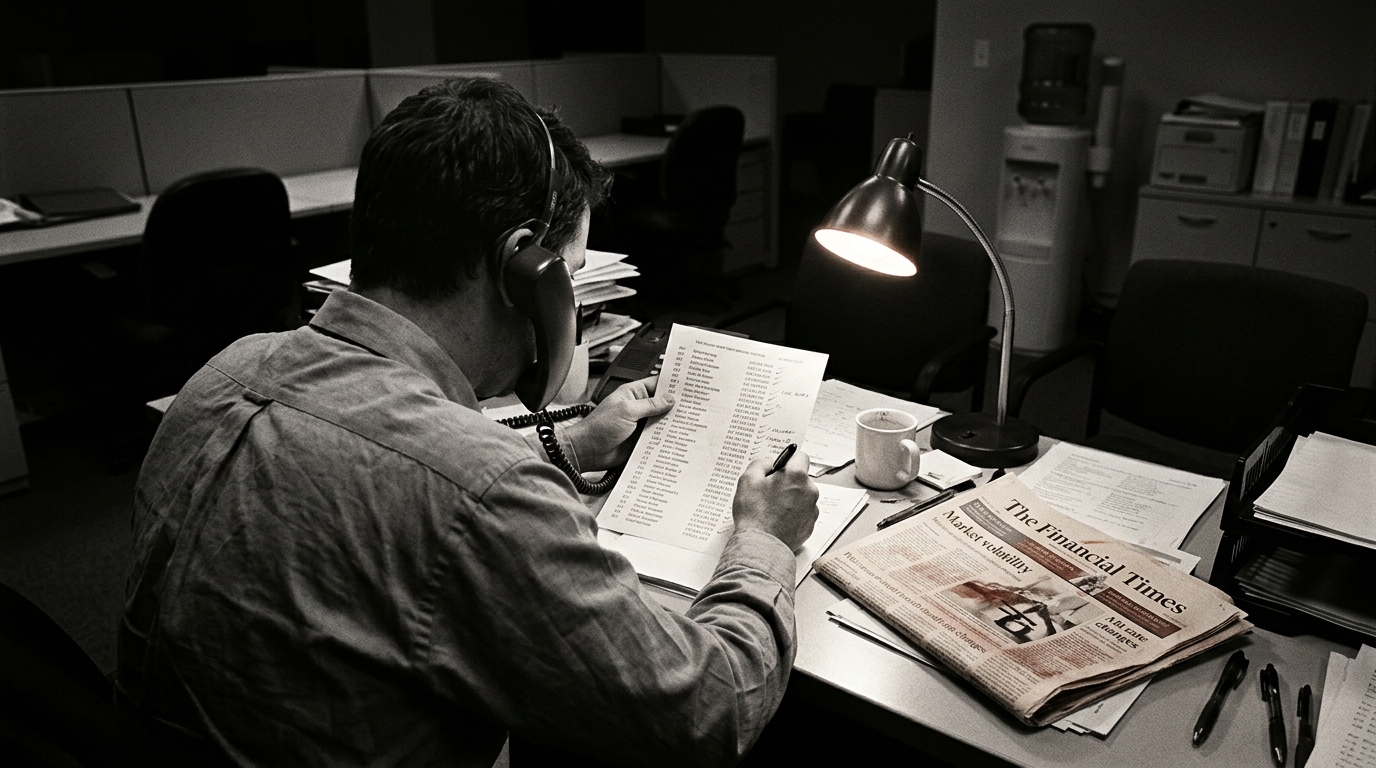
The desks are cheap. The phones are not. The script is taped to the desk because nobody trusts memory at hour four. There is a manager who walks the floor and listens to calls on a headset. There is a whiteboard with first names and dollar figures. There is coffee that has been sitting since seven. There is a guy in a polo shirt who closed a hundred-thousand-dollar ticket on Tuesday and got a steak dinner Wednesday. There is another guy who has not closed in two weeks and will not be there next month. The room runs on the difference between what the customer thinks he is paying for and what the customer is paying for. That difference has a name. The name is the spread. The spread is the rent, the steak, the polo shirt, the lease on the building, and the ad budget that put Earl on the list in the first place.
Six weeks after the Friday call, Earl gets his first statement.
This is the moment the structure becomes visible, if Earl is the kind of man who looks. The statement shows his coins. The statement shows a value. The value is the firm's value. Earl turns on the television. The chyron says spot gold is at some number. Earl does the math. The math does not work. Earl calls the firm. The voice on the phone is still warm. The voice explains that semi-numismatic coins do not track spot. The voice explains that Earl is in for the long term. The voice uses the words safe and hedge and inflation and Iran. The voice does not use the word markup.
Earl hangs up. Earl does not call back for a year.
That is not the worst case. The worst case is Earl never looks. The worst case is Earl dies and his daughter looks, and his daughter is the one who finds out what semi-numismatic means.
I am not saying any specific firm did this to Earl on Friday, May 1, 2026. I do not know who called Earl. Earl is a composite. The mechanism is not.
The mechanism is this: a real news event with a real number creates real urgency in a real listener, and the urgency is harvested by a room whose product is not gold. The product is the spread. Gold is the wrapper. Iran is the wrapper for the wrapper. The President's dissatisfaction is the wrapper for the wrapper for the wrapper. By the time the wrapping is done, Earl is holding a coin and the room is holding the difference.
Picture it.
The chyron says $4,636.72. The closer says trust me. Earl signs.
Somewhere a man who has not made a sale in two weeks watches the manager walk past his desk and prays for one more headline. He will get one. There is always one more headline. Iran or Russia or a bank in Switzerland or a number on a Tuesday morning. The headline is the fuel. The room is the engine. Earl is what gets burned.
Gold did turn positive on Friday. Oil did ease. Reuters got it right.
The chyron is not lying to you. The chyron is just not the whole sentence.
- Reuters | May 1, 2026 | "Gold turns positive as oil eases on hopes for Iran talks"
- CFTC | September 22, 2020 | Press Release 8260-20, In re TMTE Inc. a/k/a Metals.com, Chase Metals LLC, et al., $185M settlement
- U.S. Energy Information Administration | ongoing | Strait of Hormuz oil flow estimates
- Reuters / market data | April 30, 2026 | implied probability of U.S.-Iran nuclear agreement by May 31, 2026
- White House / public statements | May 1, 2026 | President Trump remarks on Iran proposal
Editorial Notice
MarkTell is a true crime publication about financial fraud. Some scenes, dialogue, and sequential details are reconstructed from court filings, enforcement actions, news reports, and public records. Where the public record does not provide exact details, editorial reconstruction is used to convey the documented pattern of events. Names of private individuals may be changed to protect identity. All factual claims are sourced to public documents cited in the Evidence Trail above. MarkTell does not provide investment, legal, or financial advice. Nothing published here constitutes a recommendation to buy, sell, or avoid any investment. Allegations described in active cases have not been adjudicated and defendants are presumed innocent until proven guilty. Readers should conduct their own due diligence before making financial decisions.