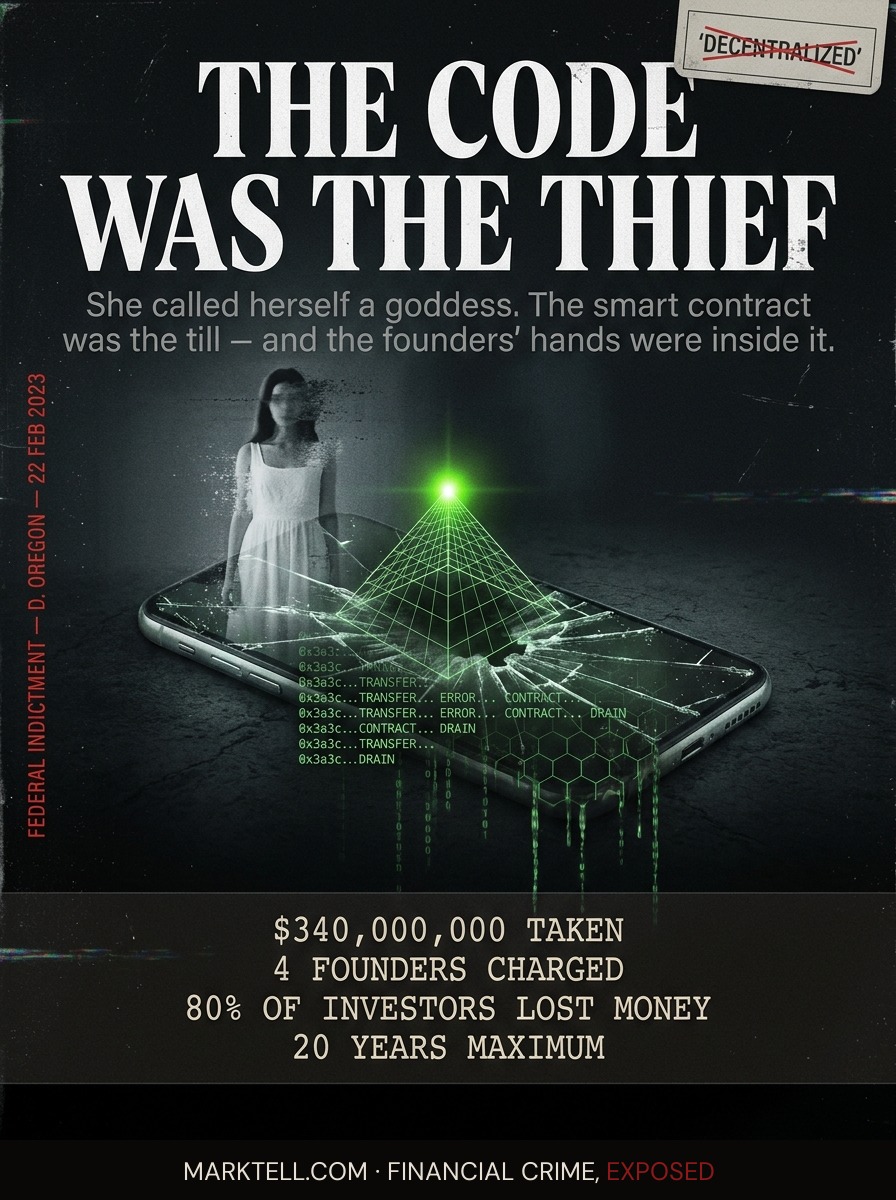
The goddess promised the blockchain could not steal. The smart contract was the theft.
Olena Oblamska called herself the goddess of Forsage and told investors the blockchain made fraud impossible. A federal indictment in Oregon says the code itself was the trap.
Marcos was on his lunch break in the cab of a delivery van in Beaverton when he first heard the word goddess applied to a crypto investment. He was thirty-eight. He had a daughter in fifth grade who needed braces and a wife who worked retail and an envelope in the kitchen drawer with $1,800 in it that he had been adding to twenty dollars at a time. He was watching a YouTube video on his phone. The woman on the screen wore a white dress and said the blockchain could not lie. She said the smart contract was the boss. She said no human being could touch the money because the code was the law.
Her name, on the video, was Lola Ferrari. Her name, on the federal indictment that would come down in Oregon in February 2023, was Olena Oblamska.
That was the pitch. The blockchain cannot steal from you. The math is the math. There is no CEO. There is no office. There is only the code, and the code pays you when someone joins below you. It is decentralized, she said, which is a word that to a lot of people in 2021 sounded the way the word federally insured sounded to people in 1985. It sounded like a promise that someone had already kept.
Marcos went home that night and read the Forsage website on his laptop at the kitchen counter while his daughter slept down the hall. The site had a grid. The grid had slots. The slots filled up green as new people joined. He read about Ethereum. He read about a thing called a smart contract, which the site explained as a piece of software that runs by itself on the blockchain and pays out automatically. No middleman. No trust required.
He installed a wallet called MetaMask. He bought $1,800 of ether. He clicked a button on the Forsage site that said Confirm. A second screen came up that showed the gas fee and the contract address. He clicked Confirm again.
He believed he had just bought a slot in a machine that nobody owned.
II.
The machine had four owners.
According to the indictment returned by a federal grand jury in the District of Oregon on February 22, 2023, four Russian nationals built Forsage and ran it. Vladimir Okhotnikov, who went by Lado. Mikhail Sergeev, who went by Mike Mooney and Gleb and Gleb Million. Sergey Maslakov, who called himself the creator. And Olena Oblamska, the goddess, Lola Ferrari.
The website launched in January 2020. By the time the U.S. Securities and Exchange Commission filed its civil complaint in August 2022, Forsage had taken in approximately $340 million from investors around the world. The SEC complaint named the four founders and seven U.S.-based promoters. The complaint described Forsage as a fraudulent pyramid and Ponzi scheme dressed in the language of decentralized finance.
Here is what a Ponzi scheme is, in plain English. It is a structure where the money paid to old investors comes from the money put in by new investors. There is no underlying business. There is no return. There is only the flow of new money paying old money, and when the new money stops, the structure dies and the last people in lose everything.
Here is what a pyramid scheme is. It is a Ponzi where the participants are rewarded for recruiting more participants. The math at the bottom does not work. It cannot work. There are not enough humans on earth to keep a pyramid growing forever.
Forsage was both. The SEC complaint alleges that the smart contracts at the heart of Forsage were coded to do exactly what a Ponzi scheme does. Money from new investors flowed automatically to earlier investors. That was not a side effect. That was the design.
And there was something worse. The complaint alleges that at least one Forsage smart contract, called xGold, on the Ethereum blockchain, was coded to siphon investor funds directly into wallets controlled by the founders. The pitch had been that one hundred percent of every dollar went to other members. Zero to administration. Zero risk. The code, the SEC says, did something else.
III.
Picture what Marcos saw when he looked at his slot.
He saw a grid on a website. He saw green. He saw a small notification when someone joined below him and a tiny amount of ether arrived in his wallet. He saw, in those first weeks, what looked like the system working.
What he did not see was the part of the contract that ran while he was not looking.
He did not see the routing of new investor funds through layers that paid out the top of the pyramid first. He did not see the wallets that received the siphoned fees. He did not see that over eighty percent of Forsage investors, according to blockchain analysis cited in the SEC complaint, received less ether back than they put in. He did not see that over fifty percent never received a single payout.
He saw the grid. He saw the green slots. He saw the goddess on YouTube saying the blockchain does not lie.
That part may be the saddest. The thing he was told to trust was the thing that was robbing him. The smart contract was not a neutral machine. It was a till with the founders' hands inside it. And it was running on a public blockchain, which meant every transaction was visible to anyone who knew how to read it. The fraud was not hidden in a back office. It was hidden in plain sight, in code, behind a word that sounded like a promise.
Decentralized.
Read that word slowly. It is doing more work in the Forsage story than any other word. It was the word that told Marcos no one could steal from him. It was the word that told the goddess's audience that there was no administration to hold the money. It was the word that allowed a pyramid to look like a protocol.
The Philippines Securities and Exchange Commission saw through it in September 2020 and issued a cease-and-desist order. The Montana Commissioner of Securities and Insurance saw through it in March 2021. Forsage kept running. In a YouTube video posted in August 2022, after the SEC complaint was filed, Okhotnikov denied the charges. Oblamska, on her own channels, had earlier dismissed pyramid allegations by saying the blockchain itself prevented administrators from holding the money.
The indictment alleges the administrators wrote the blockchain.
IV.
The four founders face one count each of conspiracy to commit wire fraud. The maximum penalty is twenty years in federal prison. The case is being prosecuted by the U.S. Attorney's Office for the District of Oregon. The investigation has been carried out by the FBI Portland Field Office, the U.S. Postal Inspection Service, and Homeland Security Investigations' El Dorado Task Force in New York. The charges are pending. The founders have not been convicted. Allegation is not adjudication.
But the SEC civil complaint, the DOJ indictment, and the blockchain analysis cited in both describe the same machine. New investor money in. Old investor money out. Founders' wallets in the middle, taking a cut the pitch said did not exist.
V.
Marcos figured it out months later. He was at the kitchen counter again. He had stopped checking his slot. The notifications had thinned. He opened Etherscan on his phone, which is a website that lets anyone look at the public record of the Ethereum blockchain, and he typed in the contract address he had clicked Confirm on. He followed the flow of the ether he had sent. Some of it had gone to a wallet above him in the matrix, the way he expected. Some of it had gone somewhere else. He clicked through to that wallet. He saw the size of it. He saw the addresses it connected to.
He did not understand all of it. He understood enough.
His daughter still needs braces. The envelope in the drawer is empty. He did not lose his house. He did not lose his marriage. He lost something smaller and harder to name. He lost the belief that a word can be a guarantee. He lost the version of himself that watched a video on a lunch break and thought he had found a door no one else had noticed.
The goddess told him the blockchain could not steal.
The indictment says the code was the thief.
- U.S. Department of Justice, District of Oregon | February 22, 2023 | Federal grand jury indictment of Vladimir Okhotnikov, Mikhail Sergeev, Sergey Maslakov, and Olena Oblamska on conspiracy to commit wire fraud
- U.S. Securities and Exchange Commission | August 1, 2022 | SEC civil complaint charging 11 individuals in connection with Forsage
- Philippines Securities and Exchange Commission | September 2020 | Cease-and-desist order against Forsage
- Montana Commissioner of Securities and Insurance | March 2021 | Cease-and-desist order against Forsage
- FBI Portland Field Office, USPIS, HSI El Dorado Task Force | Investigation materials cited in DOJ filings
- AOL.com / Google News | May 2026 | Source article referencing wire fraud charges
Editorial Notice
MarkTell is a true crime publication about financial fraud. Some scenes, dialogue, and sequential details are reconstructed from court filings, enforcement actions, news reports, and public records. Where the public record does not provide exact details, editorial reconstruction is used to convey the documented pattern of events. Names of private individuals may be changed to protect identity. All factual claims are sourced to public documents cited in the Evidence Trail above. MarkTell does not provide investment, legal, or financial advice. Nothing published here constitutes a recommendation to buy, sell, or avoid any investment. Allegations described in active cases have not been adjudicated and defendants are presumed innocent until proven guilty. Readers should conduct their own due diligence before making financial decisions.