The gallons were paper. The credits were real. The market bought both.
Christopher Burdett ran a biodiesel company in Fort Pierce that produced more paperwork than fuel. On May 29, 2026, a federal judge handed him 18 months and a $2.8M restitution bill for a scheme that printed credits the market treated as real.
Karen opened the spreadsheet at 7:14 on a Tuesday.
She was 54. She had been a compliance officer at a small Midwest refiner for eleven years. Her job was unglamorous and exact. The federal government required her company to either blend a certain volume of renewable fuel into the gasoline it sold or buy credits proving someone else had done the blending for them. The credits were called Renewable Identification Numbers. RINs. Thirty-eight digits each. One RIN, one gallon, in theory.
Karen did not make the fuel. She bought the paperwork that said the fuel existed.
That morning, she was reconciling a batch she had purchased from a broker who had sourced from a Florida producer she had never met. The producer was called Indian River Biodiesel. The batch numbers were sequential. The volumes were round. The documentation was clean. She clicked through, marked the rows green, and moved on to the next supplier.
She did not know yet that the gallons she had just bought had never existed.
I.
The Renewable Fuel Standard is a law Congress passed in 2005 and expanded in 2007. The idea was to cut petroleum dependence by forcing refiners to mix biofuels into the national fuel supply. Refiners who could not blend the required volume themselves were allowed to buy credits from producers who did the blending for them. The credit, the RIN, traveled with the gallon when the gallon was produced. The refiner retired the RIN at the end of the year to prove compliance.
The whole system rested on one assumption.
The gallon was real.
II.
Christopher Burdett owned a biofuel company in Fort Pierce, Florida. The town sits on the Atlantic side of the state, about two hours north of Miami. The company had tanks. It had a yard. It had a sign. To anyone driving past on US-1, it looked like a small industrial operation doing what small industrial operations do.
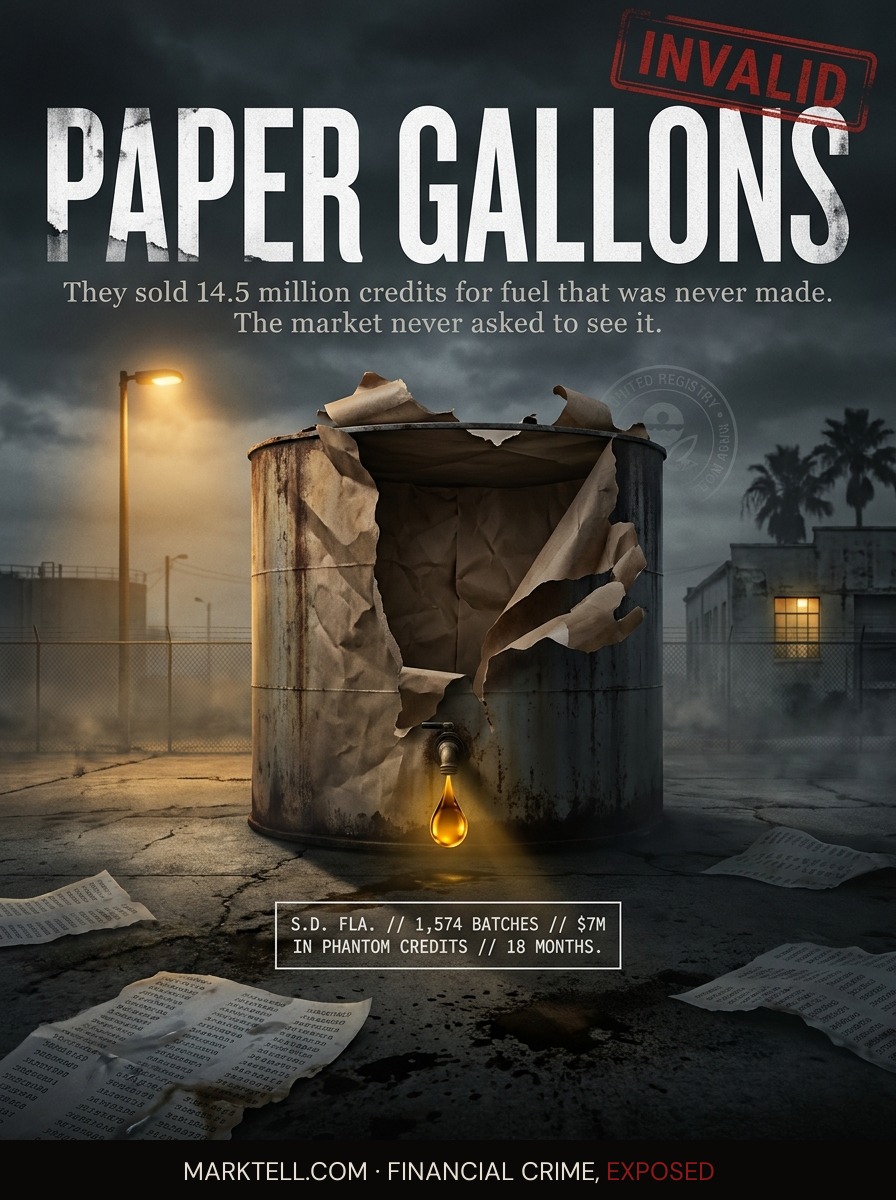
Between February 17, 2017, and April 19, 2019, according to court documents in the Southern District of Florida, Burdett's general manager Royce Gillham and another employee generated 1,574 batches of RINs. They claimed 9.7 million gallons of biodiesel production. They sold 14.5 million RINs into the open market between April 19, 2017, and April 16, 2019.
Read that pair of numbers slowly.
1,574 batches.
14.5 million credits.
Each credit a paper representation of a gallon of fuel that, according to the government's case, was never made.
The scheme generated over $7 million in fraudulent EPA renewable fuel credits, the Department of Justice said. It also sought over $6 million in fraudulent tax credits from the IRS on the same phantom production.
The same gallon, monetized twice. Once at the EPA. Once at the Treasury.
III.
This is how the machine worked.
A real biodiesel producer takes in feedstock. Soybean oil. Used cooking grease. Animal fats. The feedstock goes through a chemical process called transesterification, which separates the fats into methyl esters and glycerin. The methyl esters are the biodiesel. The producer measures the output, files a report with the EPA's electronic RIN registry, and a RIN is born for every gallon.
The paperwork is the credit. The credit is what the market trades.
If you can fabricate the paperwork, you can fabricate the credit. The fuel becomes optional.
According to the government, that is what Indian River Biodiesel did. They overstated production volumes to the IRS and the EPA. When auditors asked for more information about the fuel and the customers, they provided false details.
The credits looked like every other credit. They sat in the registry next to credits backed by real gallons. They traded at market prices. They were bought by brokers and refiners and importers who had no way of knowing, sitting at their desks, which gallons behind which credits had ever existed.
That is the EPA's "buyer beware" policy. If you bought an invalid RIN, even unknowingly, you are responsible for replacing it. The fraud rolls downhill to the last person holding the paper.
Karen was, somewhere in that supply chain, one of those people.
IV.
The pattern is older than Indian River.
In 2009 and 2010, a man named Rodney Hailey ran a Maryland company called Clean Green Fuel that produced no fuel at all. He sold roughly $9 million in fraudulent RINs and was eventually sentenced to 151 months in prison. In a separate case, Philip Rivkin generated 60 million fraudulent RINs and was ordered to pay $87 million in restitution and forfeit $51 million more.
RIN fraud has been a feature of the program since the program existed.
The machine is the same in every case. A facility that may or may not produce fuel. A registry that accepts what the facility reports. A market that buys what the registry lists. An auditor who arrives years later.
The fuel is the optional part.
V.
Karen found out about Indian River the way buyers usually find out. A notice. A letter. A broker reaching out about retired RINs that needed to be replaced. The credits she had bought in 2018 were being invalidated. Her company would need to source replacements at current market prices, which were higher than what she had paid.
She did the math at the same desk where she had clicked the original purchase. The coffee mug was different. The spreadsheet was the same.
She had done nothing wrong. She had followed the procedure. She had bought from a broker who had sourced from a registered producer in good standing with the EPA. The fraud had been upstream of her, two hands removed, in a yard in Fort Pierce she had never visited and a registry entry she had no power to verify.
That part may be the saddest. The compliance officer is the person who is supposed to catch this. The system was built so that she could not.
VI.
On May 29, 2026, in a federal courtroom in the Southern District of Florida, Christopher Burdett was sentenced to 18 months in prison and two years of supervised release. He was ordered to pay $2,857,029 in restitution and a $150,000 fine. He had pleaded guilty to conspiring to commit wire fraud and to file false claims.
Royce Gillham, the general manager, had already been sentenced to 37 months.
Eighteen months for a scheme that generated over $7 million in fraudulent credits and sought another $6 million from the Treasury. Do the math on the per-month rate of the fraud against the per-month rate of the punishment. The arithmetic does not require commentary.
The same month Burdett was sentenced, the EPA was also closing other RIN cases. In March 2026, Chevron USA settled for $1 million and retired 2.2 million invalidly generated advanced biofuel RINs worth roughly $3.6 million. In April 2026, NGL Crude Logistics agreed to a $25 million civil penalty and the retirement of 36 million valid RINs over allegations dating to 2011.
The cases stack up. The registry keeps running. The buyers keep buying.
VII.
Picture Karen at her desk again. It is late 2026 now. She is reconciling a new batch from a new supplier. The batch numbers are sequential. The volumes are round. The documentation is clean.
She has no way to know which gallons exist.
That is not a flaw in her judgment. That is the design of the market she works in. The RIN is a paper representation of a physical thing, and the paper is what trades, and the physical thing is what nobody verifies until an auditor shows up three years later asking for records that were fabricated on the way in.
Burdett built a facility that made paper gallons. The market did not care that the gallons were paper. It cared that the paper was clean.
The fuel was the optional part.
That was the machine.
- U.S. Department of Justice, Environment and Natural Resources Division | May 29, 2026 | Sentencing announcement for Christopher Burdett, Southern District of Florida
- U.S. Environmental Protection Agency, Office of Enforcement and Compliance Assurance | May 2026 | Statement on Indian River Biodiesel prosecution
- Treasure Coast News | May 29, 2026 | "Owner of Florida biofuel company sentenced for fraudulent EPA credits"
- EPA Renewable Fuel Standard program documentation | ongoing | RIN registry and "buyer beware" policy framework
- U.S. v. Hailey | 2012 | Maryland, 151-month sentence for RIN fraud (background pattern)
- U.S. v. Rivkin | 2014 | Southern District of Texas, $87M restitution (background pattern)
- EPA settlement with Chevron USA Inc. | March 11, 2026 | $1M civil penalty, 2.2M RINs retired
- EPA settlement with NGL Crude Logistics LLC | April 3, 2026 | $25M civil penalty, 36M RINs retired
Editorial Notice
MarkTell is a true crime publication about financial fraud. Some scenes, dialogue, and sequential details are reconstructed from court filings, enforcement actions, news reports, and public records. Where the public record does not provide exact details, editorial reconstruction is used to convey the documented pattern of events. Names of private individuals may be changed to protect identity. All factual claims are sourced to public documents cited in the Evidence Trail above. MarkTell does not provide investment, legal, or financial advice. Nothing published here constitutes a recommendation to buy, sell, or avoid any investment. Allegations described in active cases have not been adjudicated and defendants are presumed innocent until proven guilty. Readers should conduct their own due diligence before making financial decisions.