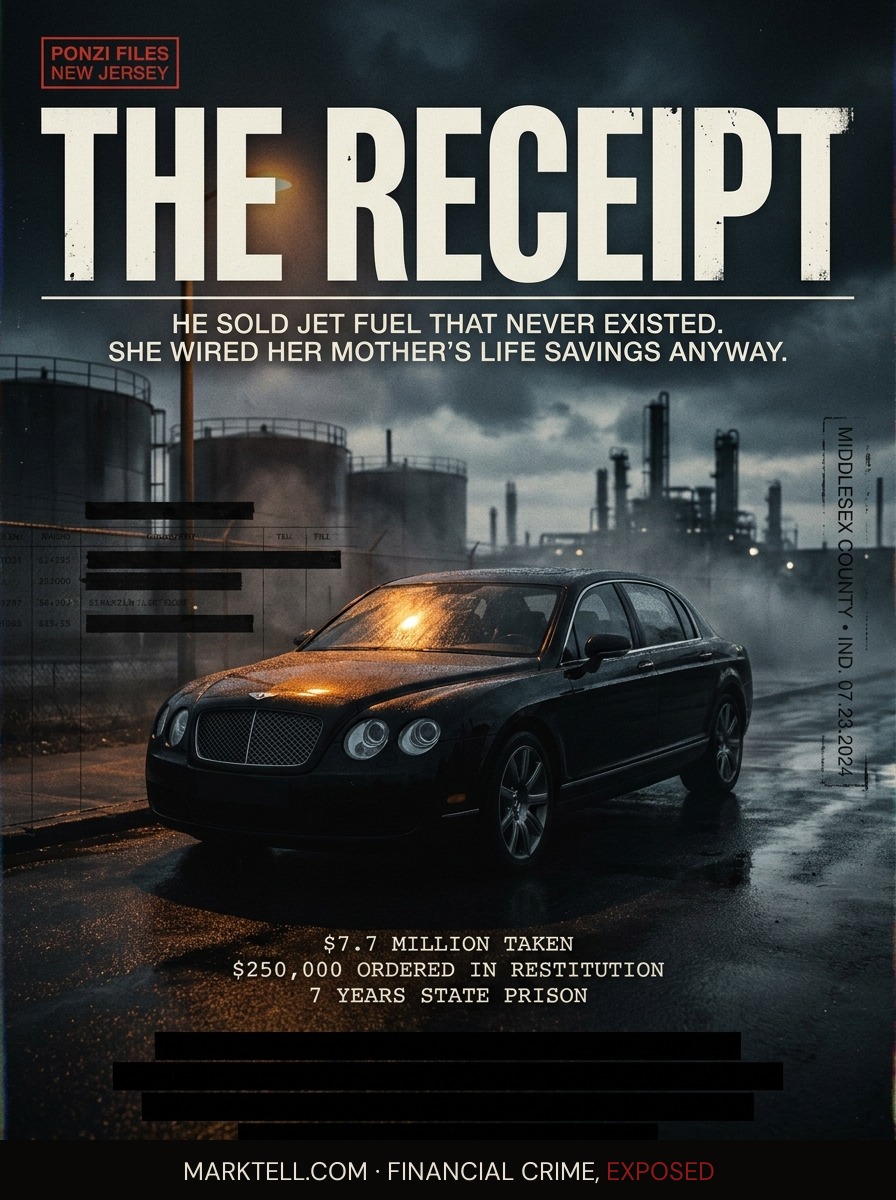
The fuel was the lie. The Bentley was the receipt.
Shahid Javed built two petroleum companies that sold no petroleum, staffed them with people who did not exist, and promised returns of fifty percent. On June 18, a New Jersey judge gave him seven years.
Marisol was fifty-eight when the call came. She was at her kitchen table in Edison, still in scrubs from a morning shift, eating a sandwich over a paper towel because she did not want to do dishes before her afternoon patients. The man on the phone said he worked for a fuel trading group in New Jersey. He had her number because a friend of a friend had mentioned she might be looking for something steady. Her mother had died eight months earlier and left her ninety thousand dollars. Marisol had been carrying that money around in a savings account that paid almost nothing, and she had been carrying the guilt of it too, because her mother had cleaned other people's houses to save it and Marisol did not want to be the person who let it disappear into nothing.
The man said his name. She wrote it on a yellow legal pad. She wrote the name of the company next to it. Prime Petroleum Group. The way he said it sounded like a place where adults worked.
Years later, after the indictment and the plea and the sentencing, Marisol would learn that the man on the phone had not existed. Not as he had described himself. The voice belonged to Shahid Javed, of Old Bridge, New Jersey, who was forty-one years old and who, according to the New Jersey Attorney General's office, had spent five years impersonating multiple fictitious employees of two fictitious companies in order to take money from people like her.
This is the story of a fuel company that did not sell fuel. It is the story of the people who wired money to it anyway, because the voice on the phone was patient and the paperwork looked correct and the returns, when they arrived, arrived on time.
I.
The machine started smaller than it ended. It almost always does.
According to the New Jersey Attorney General's office, Javed began in March 2018 by raising approximately $640,000 in what he called loans for a company named East Coast Energy Partners. He told lenders the money would be used to buy and sell jet fuel. There was no jet fuel. He spent the money on himself.
That is the first sentence of the chapter. A man borrows $640,000 against a fuel business that does not buy fuel. If the machine had stopped there, it would have been a fraud. But it did not stop there, because the people who got their early payments stayed quiet, and the people who did not get paid did not know whom to call, and the gap between what had happened and what anyone could prove was wide enough to drive a Bentley through.
So he built the next thing. Two New Jersey limited liability companies. Prime Petroleum Group LLC. Petro Traders Group LLC. The state's complaint describes them as fictitious. Not fictitious in the way that a holding company is a paper entity with real assets underneath. Fictitious in the way that a stage set is fictitious. A facade with no rooms behind it.
The pitch was specific. The companies, Javed told investors, generated returns by buying and selling fuel products and by holding ownership interests in a Texas oil refinery. The Texas refinery did not exist as he described it. The returns did not come from fuel.
The returns came from the next investor.
II.
Marisol wired twenty-five thousand dollars on the first round. She kept the receipt from her credit union in the same kitchen drawer where she kept her passport. The teller had stamped it. There was a date on it. She had asked the teller if everything looked right and the teller had said yes, the wire information was complete.
The wire information was complete. The destination was real. The destination was a bank account controlled by Shahid Javed.
The first quarterly statement arrived in the mail about three months later. It had a logo on it. The numbers showed her balance was higher than what she had put in. She read it twice. She put it in the drawer with the receipt.
She wired forty thousand more.
Picture it. A woman at a kitchen table in Edison, holding a piece of paper with a logo on it, doing the arithmetic of her mother's life. The arithmetic worked. That was the point. The arithmetic was designed to work on paper. The paper was the product. The fuel was the prop.
This is how a Ponzi scheme stays alive. Not by hiding. By performing. The statements arrive. The early payouts clear. The voice on the phone calls back when you leave a message. According to the state's filings, Javed paid out approximately $1 million in purported returns to earlier investors using funds from new investors. A million dollars is not generosity. A million dollars is the marketing budget. It is what the machine spends to recruit the next person.
III.
What the state's complaint describes is a particular kind of theater. Javed, prosecutors said, impersonated multiple fictitious employees from his fake companies. Different names. Different voices, presumably. Different roles. The investor who called to ask about a wire could be passed to "operations." The investor who wanted to talk about the refinery could be put through to someone who handled refinery questions. Every door in the building opened onto the same person.
Read that slowly. He was the receptionist. He was the trader. He was the operations manager. He was the closer. He was every voice in a company that had no employees because it had no business because it did not exist except as a structure to receive wires.
The fuel was the lie. Not a small lie. The whole product.
What he did with the money is what the record shows men in his position usually do with the money. A Bentley. A house. A boat. Personal creditors paid off. The pattern is so consistent across these cases that you could write it before you read the indictment. The investor money goes into a checking account. The checking account pays for the things the operator wanted before he had any money to buy them with. The operator never intended to buy fuel. He intended to buy a Bentley. The fuel was the story he had to tell to get to the Bentley.
That part may be the saddest. Not the car. The fact that the car was the goal and the company was the costume.
IV.
The indictment came down on July 23, 2024, in Middlesex County. Javed and a co-defendant were charged. The charges against the co-defendant remain pending, which means the second story in this case has not yet been told.
Javed pleaded guilty on April 15, 2026, before Superior Court Judge Ralph E. Amirata in Morris County. Two counts of second-degree securities fraud. One count of second-degree theft by deception. Second-degree, in New Jersey, is the band of charges that carries five to ten years.
On June 18, 2026, Judge Amirata sentenced him to seven years in state prison and ordered him to pay $250,000 in restitution.
Do the math. Total taken, per the New Jersey Attorney General's office: $7.7 million. Restitution ordered: $250,000.
That is not restitution. That is a gesture. The money is gone. It went into a Bentley and a house and a boat and the bank accounts of earlier investors who thought they were earning returns and were actually being used to advertise.
Attorney General Jennifer Davenport described the victims as "hardworking New Jerseyans who were simply looking for ways to invest their money wisely." Division of Criminal Justice Director Theresa L. Hilton said Javed "admitted his role in leading a complex scheme to defraud investors of millions of dollars to line his own pockets."
The official language is correct. It is also incomplete. The victims were not just looking to invest wisely. They were looking to do something with money that already had a meaning attached to it. An inheritance. A retirement. A daughter's college fund. The reason these schemes hurt the way they do is that the money was never just money.
V.
Marisol got her first sign in 2023. The statements stopped arriving on time. The man on the phone, when she could reach him, said the refinery was undergoing a review. He said the words "review" and "compliance" and "audit." He said them calmly. He said them the same way the teller at the credit union had said the wire information was complete.
She did not get the money back. She does not expect to.
She told her sister about it after the indictment was reported in 2024, and her sister asked her why she had not asked more questions, and Marisol did not have a clean answer because there was no clean answer. She had asked the questions a reasonable person asks. The answers had been the answers a reasonable person would accept. The machine had been designed by someone who knew what reasonable people sound like when they are trying to be careful.
She does not keep the statements in the drawer anymore. She does not keep the receipt from the credit union either. She does not need to look at them. She remembers the numbers.
What she lost was not the ninety thousand dollars, exactly. What she lost was the version of herself who believed she had been careful enough.
VI.
The fuel was the lie. The Bentley was the receipt.
Seven years is the sentence. Five years is how long the machine ran. Two companies that did not exist. One refinery in Texas that was not what he said it was. Roughly $7.7 million in. Roughly $1 million paid back to earlier investors as bait. A quarter million dollars ordered in restitution against losses that the state has not yet finished counting.
The co-defendant's case is still open. Somewhere in New Jersey, the next version of this machine is already being built under a different name, by someone who watched this one work for five years before it broke.
Marisol still works the morning shift. She still eats lunch over a paper towel. She does not answer calls from numbers she does not recognize.
That is what the machine cost her. Not the money. The phone.
- New Jersey Office of the Attorney General | June 18, 2026 | Press release on sentencing of Shahid Javed
- Insider NJ | June 19, 2026 | "Middlesex County Man Sentenced to Seven Years in State Prison for Running a $7.7 Million Securities Fraud Scheme Involving Fake Fuel Companies"
- New Jersey Superior Court, Morris County | April 15, 2026 | Guilty plea before Judge Ralph E. Amirata
- Middlesex County indictment | July 23, 2024 | State of New Jersey v. Shahid Javed and co-defendant
- Statements of NJ Attorney General Jennifer Davenport and DCJ Director Theresa L. Hilton | June 18, 2026
Editorial Notice
MarkTell is a true crime publication about financial fraud. Some scenes, dialogue, and sequential details are reconstructed from court filings, enforcement actions, news reports, and public records. Where the public record does not provide exact details, editorial reconstruction is used to convey the documented pattern of events. Names of private individuals may be changed to protect identity. All factual claims are sourced to public documents cited in the Evidence Trail above. MarkTell does not provide investment, legal, or financial advice. Nothing published here constitutes a recommendation to buy, sell, or avoid any investment. Allegations described in active cases have not been adjudicated and defendants are presumed innocent until proven guilty. Readers should conduct their own due diligence before making financial decisions.