The fraudster drowned. The trustee kept pulling on the thread.
Curtis Quigley drowned in the Okanagan before he could stand trial. A B.C. judge just ruled the trustee can move fast on the investors who came out ahead, because in a Ponzi scheme, coming out ahead means you were paid with someone else's money.
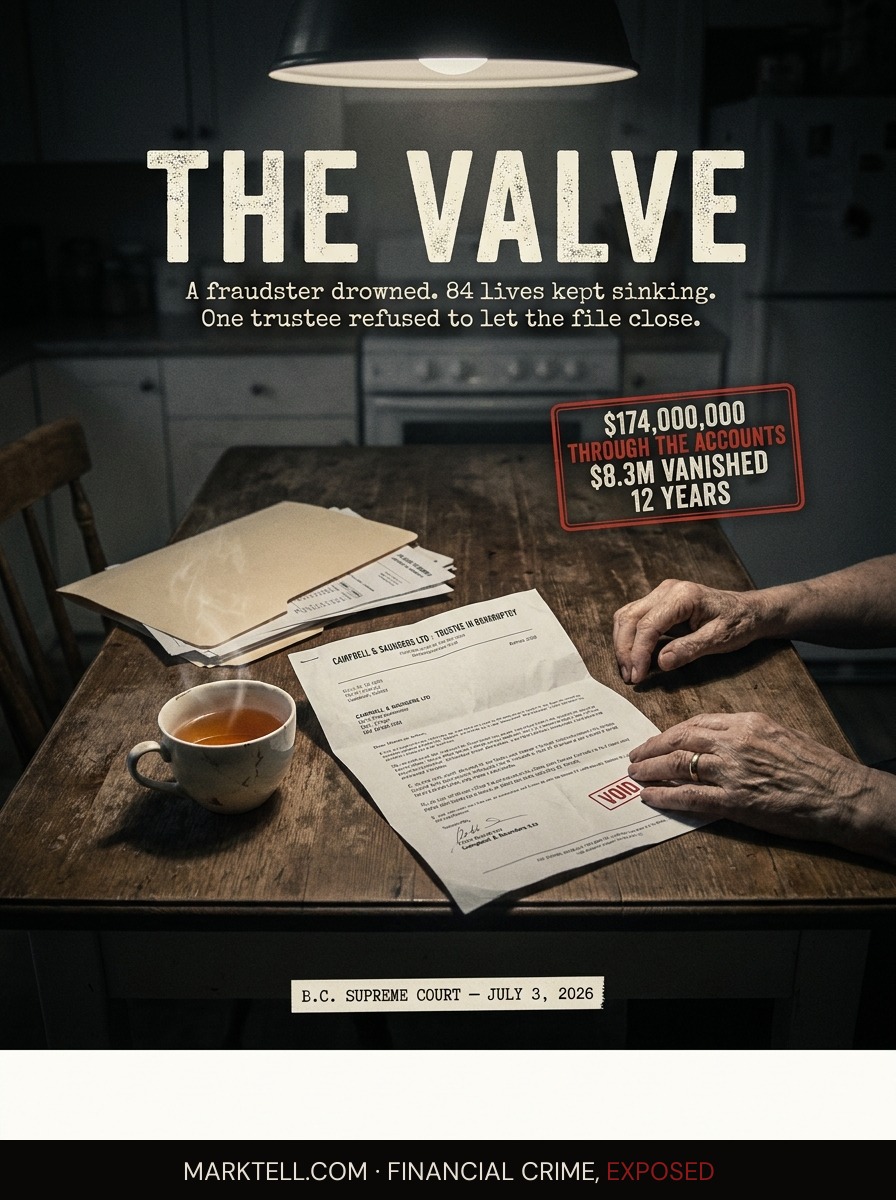
Marlene opened the letter at her kitchen table in Kelowna. It was from a company called Campbell Saunders Ltd. She had never heard of them. The letter said Curtis Quigley had filed for bankruptcy. It said she was one of his creditors. It said the trustee would be in touch.
She was 68. She had been retired from the dental office for two years. The $140,000 she had given Curtis had come from a line of credit on the house she and her husband had finished paying off in 2015. Her husband had died in 2018. The house was hers and the debt was hers and the money was gone.
She read the letter twice. She did not cry. She got up and put the kettle on.
That was June 2020. She has been waiting since then.
This is not a story about Curtis Quigley. Curtis Quigley is dead. He drowned near Okanagan Falls in June 2024, which is the kind of ending that closes a criminal file whether the file is ready to close or not. Fraud and money laundering charges against him were stayed. Charges against his partner Kathleen Treadgold were stayed too. Stayed is a word that sounds like paused. It usually means over.
This is a story about what happens after. About the machine that runs when the man who ran the machine is gone. About the trustee, and the court, and the 84 people like Marlene who need someone to keep pulling on the thread.
I.
The scheme was 12 years long. From 2008 to 2020. Real estate flipping in the Okanagan, sold as high-yield. Curtis was a Kelowna man with a boat and a motorcycle and a half-share in a house and a story about how much money there was to be made if you knew which properties to buy. Dozens of investors believed him. According to court documents connected to the trustee's application, $174 million moved through his accounts over those 12 years.
You should read that number twice.
$174 million.
The actual loss was $8.3 million. The other $165 million and change was churn. Money came in the front. Money went back out the back. The people who got paid back with a little extra told their friends. Their friends came in the front. And so on, for 12 years.
That is not a real estate fund. That is a valve.
A Ponzi scheme, and this is the part they do not tell you in the pitch, is not a hidden thing behind a real business. It is the business. The valve is the whole company. Curtis was not running a real estate fund with a fraud problem on the side. He was running a fraud, and the real estate story was the sticker on the outside of the valve.
II.
Marlene did not know she was in a valve. She thought she was in a fund. When Curtis paid her the first quarterly return of about 3 percent she thought the fund was working. When he paid her the second she thought the fund was reliable. She never took a payment above her principal because she was reinvesting. That decision, quiet and careful and the kind of thing a retired hygienist does with her husband's memory in the room, is why she is a net loser.
The people who took money out are net winners. Not because they were smart. Because they were early, or because they got nervous, or because they needed a new roof. In a Ponzi scheme the money that gets paid out is not profit. It is other people's principal, arriving late.
The trustee's job is to say that out loud in a courtroom and get a judge to agree.
On July 3, 2026, B.C. Supreme Court Justice Shelley Fitzpatrick agreed. She approved a summary process. That means the trustee does not have to sue each net winner in a separate lawsuit. That means the calculation of how much each net winner owes back can happen in a streamlined proceeding. That means Marlene may live to see some of her money.
The ruling rested on a principle that has been settled in Canadian and American bankruptcy law for a long time. Money paid out of a Ponzi scheme to a net winner is void. Not voidable. Void. The trustee can claw it back because the payment was, in the eyes of the court, never a legitimate return in the first place. It was principal that belonged to someone else, laundered through Curtis's checking account, and handed to whichever investor happened to be standing there when the valve turned.
III.
The math so far, per the trustee's filings.
$528,000 raised from Curtis's personal assets. The boat. The motorcycle. His half-interest in the Kelowna house. That is what a life looked like when they liquidated it.
$1.4 million recovered from 28 net winners who settled.
$2.5 million still being pursued from 12 more.
Nearly $780,000 being sought from Kathleen Treadgold as an alleged net winner and for her alleged role in the scheme. The allegations against her have not been adjudicated. The criminal charges were stayed. The civil claim is live.
Add it up. If the trustee collects everything currently sought, the pot for the 84 net losers is somewhere north of $5 million against $8.3 million in losses. That is not whole. It is not close to whole. It is more than the "nothing" Marlene was told to expect in June 2020.
Some of the net winners are fighting. According to the CBC's reporting on the ruling, some argued that the summary process stripped them of procedural rights. That is a real argument. It is also an argument that costs the net losers money every month it delays the recovery. The judge weighed both and chose speed.
Read that carefully. The people who took money out of a Ponzi scheme want more court time before they have to give it back. The people who lost everything need the court to move now, because some of them are 74 years old and cannot afford another six years.
IV.
Marlene is 74 now. She still lives in the house. The line of credit is still on it. The letter from Campbell Saunders sits in a folder in the top drawer of her kitchen desk, along with the original agreement she signed with Curtis and the quarterly statements he sent her for eight years. She kept everything. Fraud victims almost always do. The paper is the last piece of the thing they thought they had.
When she got word of the July 3 ruling she read it the same way she read the first letter. Once. Twice. Then she got up and put the kettle on.
That part may be the saddest.
V.
Here is what the case is worth beyond Marlene's money.
Curtis drowned. His death would, in most fraud cases, be the end of the recovery. Criminal charges gone. The main defendant unreachable. The public record about to close.
Instead a trustee filed an application. A judge read it. A court ruled that the death of a fraudster does not extinguish the estate's obligation to unwind the fraud. The valve turned one way for 12 years. The court has now authorized it to be turned the other way, as much as it can be turned, from what remains.
Every future Ponzi case in British Columbia will cite this ruling. That is worth something. It is not worth $8.3 million. But it is worth something.
VI.
The 12 remaining net winners will have a decision to make in the coming months. Settle, or litigate against a process the B.C. Supreme Court has already blessed. Their lawyers will run the math. Most of them will settle.
Marlene will wait. She has been waiting six years. She knows how to wait.
She was not stupid. She was not greedy. She trusted a man who spent 12 years making trust look like a business. The machine that ate her money is now being disassembled in a Vancouver courtroom, one net winner at a time, by a trustee she has never met and a judge she will never see.
The valve turned one way for a long time.
It is turning the other way now.
Slowly. But it is turning.
- CBC News | July 8-9, 2026 | "Process to claw back millions owed to victims of Kelowna fraudster expedited by B.C. Supreme Court"
- B.C. Supreme Court | July 3, 2026 | Ruling by Justice Shelley Fitzpatrick approving summary clawback process
- Campbell Saunders Ltd. | June 2020 onward | Court-appointed insolvency trustee filings in the Quigley estate
- Public record | June 2024 | Death of Curtis Gordon Quigley near Okanagan Falls; staying of criminal fraud and money laundering charges against Quigley and Kathleen Treadgold
Editorial Notice
MarkTell is a true crime publication about financial fraud. Some scenes, dialogue, and sequential details are reconstructed from court filings, enforcement actions, news reports, and public records. Where the public record does not provide exact details, editorial reconstruction is used to convey the documented pattern of events. Names of private individuals may be changed to protect identity. All factual claims are sourced to public documents cited in the Evidence Trail above. MarkTell does not provide investment, legal, or financial advice. Nothing published here constitutes a recommendation to buy, sell, or avoid any investment. Allegations described in active cases have not been adjudicated and defendants are presumed innocent until proven guilty. Readers should conduct their own due diligence before making financial decisions.