The four million users were ghosts. Now she wants a pardon.
A 28-year-old founder sold a bank the biggest fish in the student-finance pond. The fish was a spreadsheet. Now, with seven years to serve, she is knocking on the door of a presidential pardon.
Dana was forty-two and three cups of coffee into a Tuesday when the bounce report finished loading.
She managed college-segment retail at JPMorgan. She had spent the better part of a year building a marketing plan on top of a file the bank had paid one hundred seventy-five million dollars to acquire. The file was the user base of a startup called Frank. The pitch deck said 4.25 million students. The integration deck said 4.25 million students. The board memo said 4.25 million students.
The first real email blast went out to a sample of the list. Dana watched the dashboard.
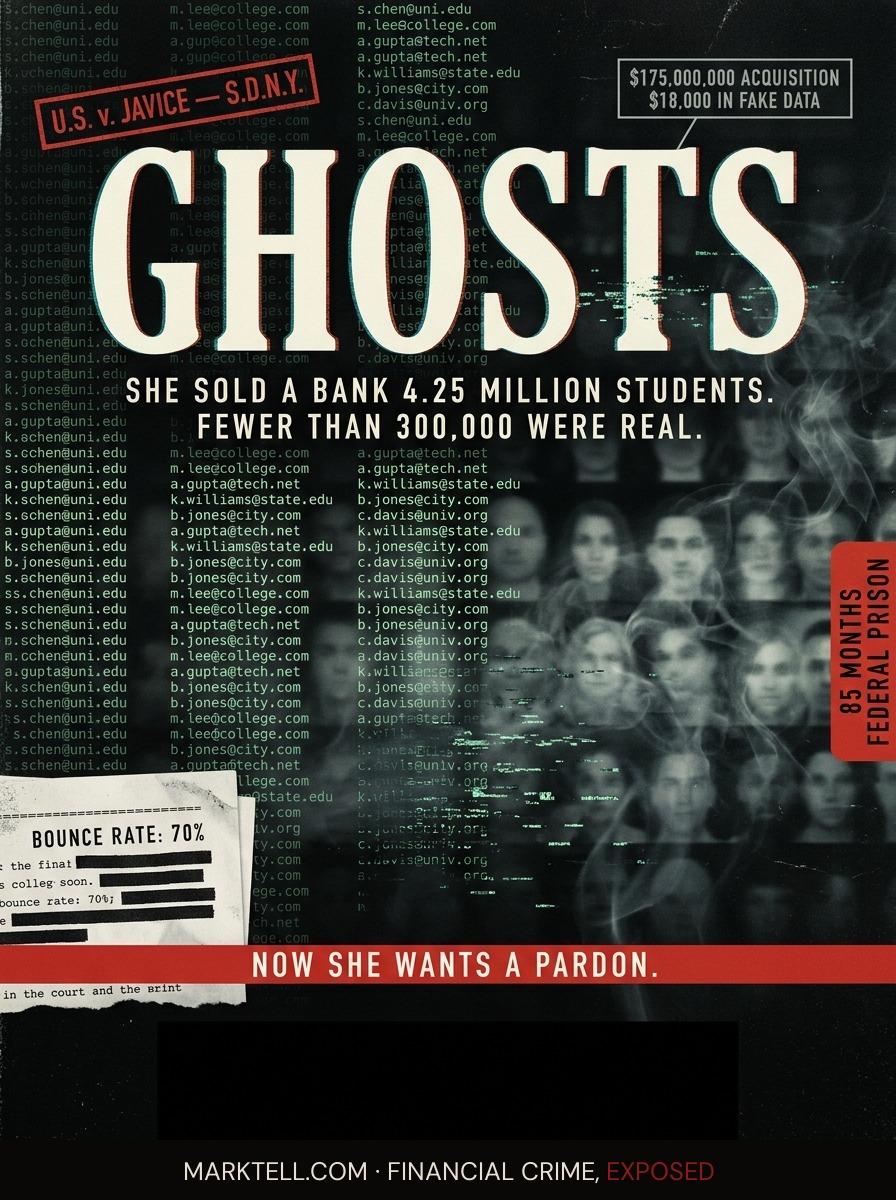
The bounce column climbed past ten percent. Then thirty. Then seventy.
A seventy percent bounce rate does not mean a bad list. A seventy percent bounce rate means the list is not a list. It is a spreadsheet wearing a costume.
Dana is not real. The bounce rate is. The Department of Justice put it on the record at trial. So did JPMorgan. So, eventually, did Jamie Dimon, who called the acquisition a "huge mistake" in front of a camera, which is the closest a bank CEO gets to saying the word taken.
This is a story about a spreadsheet that grew when people looked at it.
I.
Charlie Javice was twenty-eight when she sold Frank to JPMorgan in September 2021. She had been on the Forbes 30 Under 30 list. She had pitched Frank as the thing that would simplify the FAFSA, the federal financial aid form that every American family with a college-bound kid has to fill out and almost nobody understands. The product was real. The pitch was real. The founder was real.
The customer count was not.
According to the federal indictment, Frank had fewer than three hundred thousand actual users when Javice told JPMorgan it had over four million. That is not a rounding error. That is not optimism. That is a number that is wrong by a factor of more than fourteen.
JPMorgan, in due diligence, asked for the list. Javice, the government alleged at trial, cited student privacy concerns. This is the kind of objection that sounds responsible. It is also the kind of objection that buys time.
When the bank pressed, prosecutors said, Javice paid a data scientist eighteen thousand dollars to generate a synthetic dataset. Real-looking names. Real-looking emails. Real-looking ages and schools. Four million rows of people who did not exist.
Eighteen thousand dollars. Read that slowly.
That is the cost of fabricating a customer base that a global bank valued at one hundred seventy-five million.
II.
The acquisition closed. The money moved.
Javice personally collected over twenty-one million dollars from the sale of her equity. She was on track for another twenty million as a retention bonus. The retention bonus is the part that should make you stop. The retention bonus is the part where the fraud becomes a salary. The bank pays you to stay because the bank thinks you are valuable. The bank thinks you are valuable because of the four million users. The four million users are a file you bought for eighteen thousand dollars.
Picture it.
There is a moment, in every acquisition, when the wire hits. The seller's lawyers see the confirmation. The buyer's lawyers see the confirmation. The founder sees the confirmation. Everyone on the call is calm. Everyone on the call is professional. The founder is twenty-eight. The wire is for tens of millions of dollars. The list the wire was paid for does not exist.
Nobody outside that operation has seen the inside of those calls. Not really. We know what the indictment says, what the trial showed, what the verdict held. We can reconstruct the room. If we got a chair wrong, we got a chair wrong. The wire we got right.
III.
The mechanism here was not exotic. It was a spreadsheet.
Frank was supposed to be a platform. A platform has users. Users have email addresses. Email addresses can be tested. The whole edifice of the deal rested on a list that, when finally pressed, was generated by a contractor for the price of a used car.
JPMorgan's due diligence, according to subsequent reporting and the bank's own statements, relied on a third-party vendor to validate the user count. The vendor did not catch it. The synthetic data was good enough to clear the check.
That is the part nobody talks about. The synthetic data was good enough. Not because it was sophisticated. Because the check was looking for confirmation, not contradiction.
Due diligence at this scale is theater unless someone in the room is paid to be the adversary. Most of the time, no one is. The deal team wants the deal. The seller wants the deal. The third-party vendor wants the next engagement. The only person in the room who would want the deal to die is the person who is not in the room.
That is the machine. Not the spreadsheet. The room around the spreadsheet.
IV.
Dana sent the bounce report up the chain.
In the real version of this story, a JPMorgan employee whose name is not in the public record sent some version of that bounce report up some version of that chain. The bank started asking questions. The questions became internal investigations. The internal investigations became a referral. The referral became a federal case.
In March 2025, a jury in the Southern District of New York convicted Charlie Javice on four counts: conspiracy, wire fraud, bank fraud, and securities fraud. Her co-defendant Olivier Amar, Frank's chief growth officer, was convicted alongside her.
On September 29, 2025, Javice was sentenced to eighty-five months in federal prison. Seven years and one month. She was ordered to forfeit more than twenty-two million dollars. She and Amar were ordered, jointly, to pay two hundred eighty-seven and a half million dollars in restitution. More than one hundred million of that figure is the legal fees JPMorgan had to cover defending itself in connected litigation.
The math on the restitution alone is its own sentence. A twenty-eight-year-old founder built a company. The company was sold for one hundred seventy-five million. The fraud will cost her, on paper, two hundred eighty-seven and a half million. The fraud was not profitable. Not in the end.
But that is not what fraud is for. Fraud is for the moment the wire hits. Everything after is appeal.
V.
Which brings us to June 2026.
According to the Wall Street Journal, Charlie Javice has been seeking a pardon from President Trump. The reporting situates the request inside a broader clemency initiative reportedly tied to the nation's two hundred fiftieth anniversary. Javice is also pursuing an appeal of her conviction through the normal channels.
The political texture is its own paragraph. Marc Rowan, co-founder of Apollo Global Management and an early Frank investor, testified on Javice's behalf at trial. Rowan has been a donor in Republican political circles. JPMorgan, the victim institution, closed accounts associated with Trump's businesses in early 2021, an episode that produced its own lawsuit.
None of this means a pardon is coming. None of it means a pardon is not coming. The pardon power is, by design, not bound by the logic of the case. It is bound by the logic of the person holding the pen.
That is the part that should sit with you.
A jury heard the evidence. A judge weighed the sentence. The restitution order ran to nine figures. And the entire architecture of consequence can be unbuilt by a signature.
VI.
Here is what to take from this if you are sitting where Dana sat. Not at JPMorgan. At any desk where a number arrives in a deck and you are expected to build on top of it.
The number is not the evidence. The number is the claim.
A user count is testable. A revenue figure is testable. A customer list is testable. The cost of testing it is almost always lower than the cost of being wrong about it. The reason it does not get tested is not money. It is the social architecture of the room. Nobody wants to be the person who slowed the deal.
Be the person who slowed the deal.
The other thing to take from this is older and harder. The fraud does not end at the verdict. The fraud has a second act, and the second act is the appeal, the pardon application, the rehabilitation tour, the book deal, the podcast, the comeback. The machine that built the four million synthetic users is the same machine that builds the redemption arc. It is good at making things that did not happen look like they did.
Watch for it.
Dana, the one who is not real, went back to her desk after she sent the bounce report. She had eighteen months of work product built on a foundation that turned out to be a file someone bought for eighteen thousand dollars. She did not lose money. She lost something harder to name. She lost the version of her own work where the inputs were what they said they were.
That part may be the saddest. Not the loss to the bank. The bank is fine. The bank is always fine.
It is the people inside the bank who spent a year and a half building a marketing plan on top of four million ghosts.
VII.
The pardon application is one document on one desk in one building in Washington. Whether it moves is not a story anyone outside that room can tell yet.
But the spreadsheet is the story. The spreadsheet was always the story.
She sold a list that did not exist for one hundred seventy-five million dollars. She was caught because the list could not pass the simplest test you can run on a list: send it an email and see what comes back.
Seventy percent came back.
The rest is just paperwork.
- Wall Street Journal | June 2026 | "Exclusive | Charlie Javice Has Been Seeking a Pardon From Trump After Defrauding JPMorgan"
- U.S. Department of Justice, Southern District of New York | March 2025 | United States v. Javice, jury verdict
- U.S. Department of Justice, SDNY | September 29, 2025 | Sentencing of Charlie Javice (85 months)
- U.S. District Court SDNY | 2025 | Restitution and forfeiture orders, U.S. v. Javice and Amar
- Securities and Exchange Commission | ongoing | Civil enforcement action against Charlie Javice
- JPMorgan Chase & Co. | 2023 | Civil complaint against Charlie Javice and Olivier Amar
- Jamie Dimon public statements | 2023 | "Huge mistake" comments regarding Frank acquisition
- Forbes 30 Under 30 archive | pre-2021 | Charlie Javice profile
Editorial Notice
MarkTell is a true crime publication about financial fraud. Some scenes, dialogue, and sequential details are reconstructed from court filings, enforcement actions, news reports, and public records. Where the public record does not provide exact details, editorial reconstruction is used to convey the documented pattern of events. Names of private individuals may be changed to protect identity. All factual claims are sourced to public documents cited in the Evidence Trail above. MarkTell does not provide investment, legal, or financial advice. Nothing published here constitutes a recommendation to buy, sell, or avoid any investment. Allegations described in active cases have not been adjudicated and defendants are presumed innocent until proven guilty. Readers should conduct their own due diligence before making financial decisions.