The forged letter, the fake bond, the brother in Orlando: a Katy Ponzi closes
Christopher Knight Lopez ran a fraudulent investment shop out of Katy, Texas for nearly ten years, forging bank letters and selling access to $2 billion in Treasury bonds that did not exist. On May 7, 2026, a federal judge called it the worst white-collar crime he had seen from the bench.
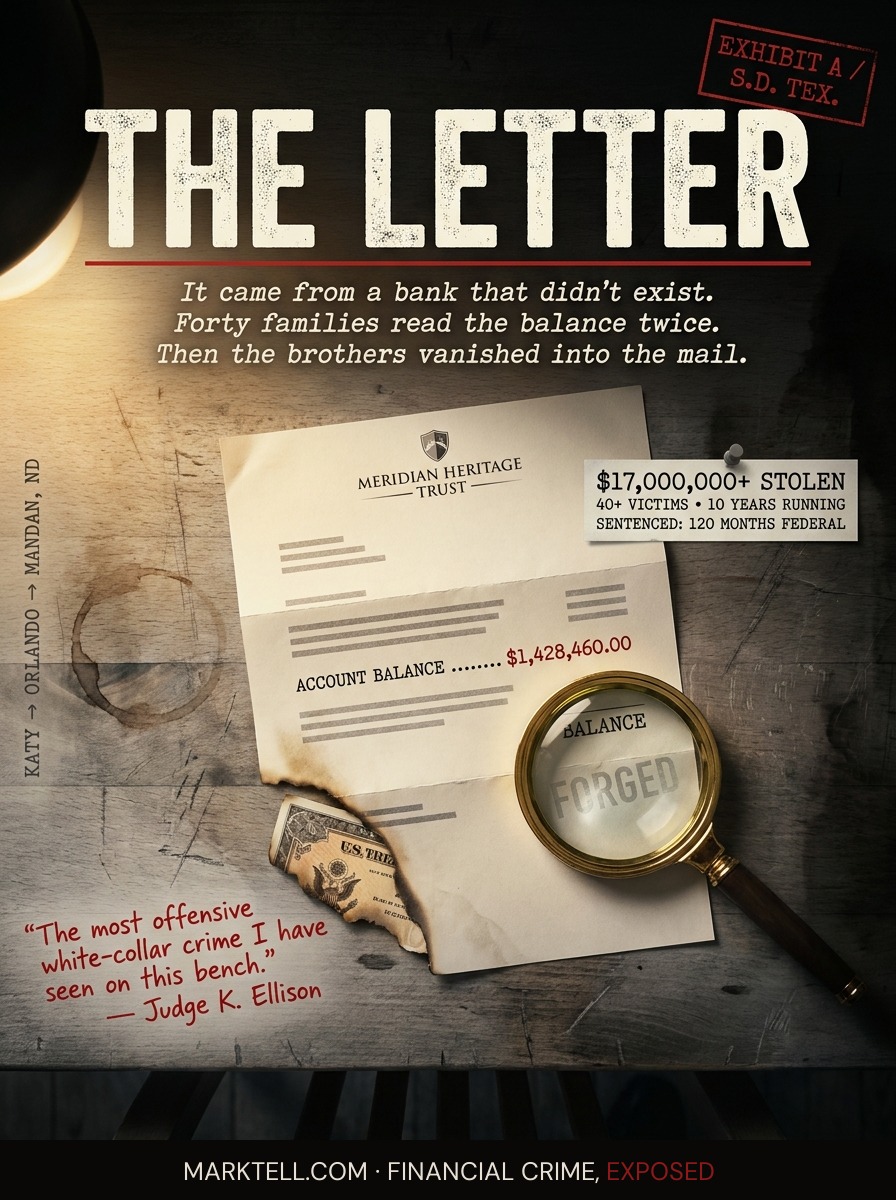
The letter looked like it came from a bank.
It had a letterhead. It had a signature. It had a number on it that was supposed to be the balance of an investment account, and the number was good. Better than good. The kind of number a person reads twice at a kitchen table in a Houston suburb because they want to make sure the comma is in the right place.
The letter was not from a bank. The account was not an account. The number was a number somebody had typed.
That is the story of Christopher Knight Lopez, who is forty years old and who lived in Katy, Texas, and who on Thursday, May 7, 2026, was sentenced in federal court in Houston to 120 months in prison. Ten years. Followed by three years of supervised release. He had pleaded guilty in February to conspiracy to commit wire fraud. The judge, Keith Ellison, said from the bench that this was the most offensive white-collar crime he had seen during his time on the bench.
Read that slowly. A federal judge has been on the bench long enough to see a lot of white-collar crime. He picked this one.
I.
The shop had names. It had several. Knight Nguyen Investments. Knight Advisory and Planning. Aevum Holdings. Exempt Management LLC. Ping An Financial Services Pte. The names sat on letterhead and on subscription documents and on the bottoms of emails. They sounded like they should mean something. A few of them sounded vaguely Asian-market, vaguely institutional, vaguely the kind of thing that would impress somebody who was not sure what they were looking at.
That was the point.
According to the U.S. Attorney's Office for the Southern District of Texas, the operation ran from May 2015 to January 2025. Almost ten years. More than forty victims. More than $17 million. The victims included senior citizens. They included people who handed over retirement savings. They included people who handed over money set aside for a child's college. They included local businesses. They were not, as a category, sophisticated investors with diversified portfolios and family offices. They were people who had a number in a savings account and were told they could do better.
The mechanism was old. It is the oldest mechanism in this category of crime. Money from new investors went out the door as "returns" to earlier investors. The rest of it, prosecutors said, went into the brothers' pockets.
II.
There were two brothers.
Christopher Knight Lopez ran the Katy end. Jayson Lopez, forty-three, ran the Orlando end. He is scheduled to be sentenced May 8, 2026, the day after his brother. He pleaded guilty to the same charge. A third defendant, Nadir Abdel Torres, forty-six, of Mandan, North Dakota, helped them obtain forged letters and forged bank statements. He pleaded guilty too. He is set for sentencing May 22.
The forgery is the part to sit with.
When an investor in a normal advisory relationship asks for proof of their balance, the advisor pulls a statement from a custodian. The custodian is a real bank or a real brokerage. The statement is generated by a system the advisor cannot edit. That is the architecture. It exists for the exact reason that someone like Christopher Lopez exists.
The Lopez operation, prosecutors say, did not pull statements from a custodian. It made them. Letters from banks that were not from banks. Account statements showing balances that were not balances. The forgery was not a one-time mistake under pressure. It was the product. The forgery was what the client was buying, even if the client did not know it.
A composite picture, drawn from the record. A retiree opens an envelope at the kitchen table. The letter inside has a familiar logo. There is a balance. The balance has grown since last quarter. She puts the letter back in the envelope. She puts the envelope in the top drawer of the kitchen desk where she keeps the financial documents. She does not call the bank. Why would she. The letter is from the bank.
The letter is not from the bank.
III.
There was also the Treasury bond piece. This is the part that should not work and did anyway.
Federal prosecutors say the brothers told clients they had access to $2 billion in U.S. Treasury bonds. The pitch was that they could use those bonds to finance the clients' businesses. The clients just needed to pay an advance fee.
The advance fee is the tell. In legitimate financing, the lender does not collect a large fee from the borrower before the money moves. In legitimate financing, the lender makes their money on the loan. The advance fee, charged against a loan that the lender has not yet committed to fund, is a structure that exists almost entirely to take the fee.
The fees were collected. The loans were never issued. There were, of course, no $2 billion in U.S. Treasury bonds.
This is the part that sounds, on the page, like it should not have caught anyone. Two brothers in Texas and Florida, claiming access to a sovereign-scale balance sheet. But the people who got the pitch were not bond traders. They were business owners who needed financing and who had been told by someone they trusted that there was a path. The brothers had letterhead. They had LLCs. They had a website. They had each other to confirm the story to anyone who asked.
That is how this kind of fraud works. Not because the lie is good. Because the room around the lie is built well enough that nobody walks out to check.
IV.
The record shows the machine was visible before it was caught.
In 2021, the Securities and Exchange Commission filed a civil complaint against Knight Nguyen Investments, naming Christopher and Jayson Lopez. The complaint alleged the firm had raised at least $3.7 million and had pushed investors into risky offerings while sending them fabricated statements. That number, $3.7 million, is what the SEC could see in 2021. The criminal case that closed this week, four years later, put the figure above $17 million across forty-plus victims.
The gap between those numbers is the gap between when the regulator first put a hand on the door and when the prosecutor finally walked through it.
The civil complaint did not stop the operation. According to the federal timeline, the scheme continued running until January 2025. That is almost four years of additional operating time after the SEC had said, in a public filing, that something was wrong here.
This is not a knock on the SEC. The SEC's complaint was the trail of breadcrumbs the FBI eventually followed. But it is worth saying clearly. A regulator's civil complaint is a public document. It is searchable. It does not, by itself, freeze a fraudster's bank accounts or force the office to close. The fraud kept running because the fraud could keep running. New clients did not know to look. Old clients were still getting their forged letters in the mail.
V.
Thirteen victims spoke at the sentencing hearing.
The court does not publish those statements in full, and a chapter like this one has no business reconstructing words it did not hear. What the record reflects is the count. Thirteen people stood up in a federal courtroom in Houston and told a judge what had happened to them. The judge listened. Then he said what he said about the worst white-collar crime he had seen.
Acting U.S. Attorney John G.E. Marck, in announcing the sentence, said the office would relentlessly pursue those who would financially prey on members of the community. That language is the language regulators and prosecutors use at every sentencing. It is true and it is also the boilerplate. The sentence is ten years. The money is $17 million plus. The victims are forty-plus. The brothers are two. The judge said this was the worst he had seen.
The forty victims do not get back what they put in by the sentence. They almost never do. Restitution orders in cases like this are paper. The money was spent. Some of it went to earlier investors as fake returns. Some of it went to personal use. There is rarely a vault to open at the end.
VI.
If you want to know what to look for, look at the letter.
Not the pitch. Not the website. Not the framed certificates on the wall in the conference room. Look at the document that says how much money you have and where it is.
A real custodial statement comes from the custodian. A real bank letter comes from a bank you can call at a number you found yourself, not a number printed on the letter. A real Treasury bond exists in a system that can be verified against public records. The forgery does not survive a phone call to a number the forger did not give you.
The brothers ran for ten years because almost nobody made that call.
That is the chapter. Two brothers. Five LLCs. Forty victims. One forgery desk. Ten years of operation, ten years of sentence, the symmetry of which is probably accidental and is probably also the only kind of symmetry the record will offer the people who lost the money.
The letter looked like it came from a bank.
It did not.
It never did.
- U.S. Attorney's Office, Southern District of Texas | May 7, 2026 | Press release announcing sentencing of Christopher Knight Lopez
- Houston Chronicle | May 7-8, 2026 | "Katy man who led $17 million Ponzi scheme sentenced to prison"
- U.S. District Court, Southern District of Texas | February 19, 2026 | Plea agreement, Christopher Knight Lopez, conspiracy to commit wire fraud
- U.S. District Court, Southern District of Texas | May 7, 2026 | Sentencing hearing, Judge Keith Ellison presiding
- Securities and Exchange Commission | 2021 | Civil complaint against Knight Nguyen Investments, Christopher Lopez, and Jayson Lopez
- Federal Bureau of Investigation | 2025-2026 | Investigation referenced in DOJ sentencing announcement
Editorial Notice
MarkTell is a true crime publication about financial fraud. Some scenes, dialogue, and sequential details are reconstructed from court filings, enforcement actions, news reports, and public records. Where the public record does not provide exact details, editorial reconstruction is used to convey the documented pattern of events. Names of private individuals may be changed to protect identity. All factual claims are sourced to public documents cited in the Evidence Trail above. MarkTell does not provide investment, legal, or financial advice. Nothing published here constitutes a recommendation to buy, sell, or avoid any investment. Allegations described in active cases have not been adjudicated and defendants are presumed innocent until proven guilty. Readers should conduct their own due diligence before making financial decisions.