The forged bank letter and the ten years it bought him
Christopher Knight Lopez ran a Houston investment shop for nearly ten years on forged bank letters and a fictional $2 billion in Treasury bonds. On May 7, 2026, a federal judge called it the most offensive white-collar crime he had seen.
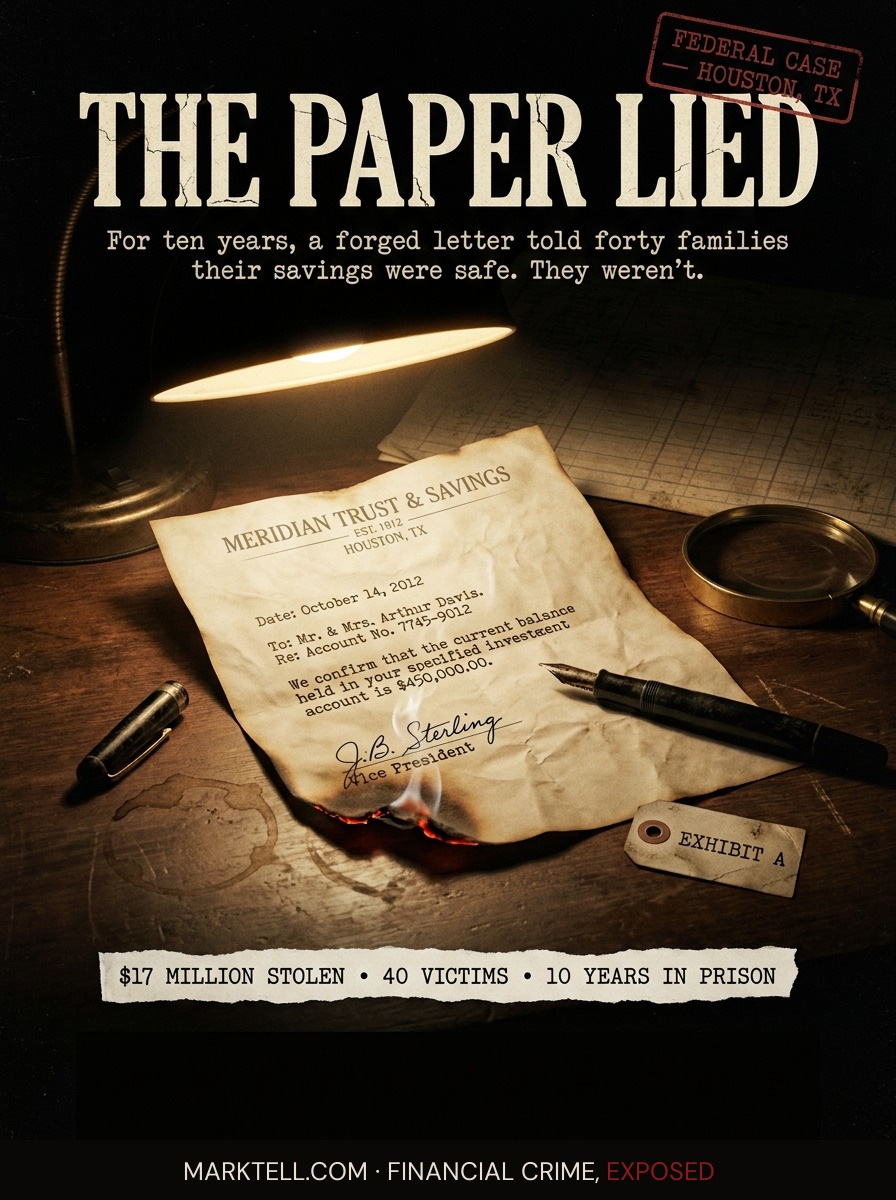
The letter looked right. That is where this story has to start, because that is where it always started for the people who lost the money. A piece of paper. A bank's name across the top. A signature line. A figure in the right-hand column that matched what you remembered putting in, plus a little more. The paper said your money was safe. The paper was the product.
The paper was forged.
On Thursday, May 7, 2026, in a federal courtroom in Houston, U.S. District Judge Keith Ellison sentenced Christopher Knight Lopez, forty, of Katy, Texas, to ten years in federal prison for conspiracy to commit wire fraud. Three years of supervised release after that. The judge said, on the record, that it was the most offensive white-collar crime he had seen during his time on the bench. Coming from a federal judge in Houston, that is not a small sentence to land in a transcript.
Lopez had pleaded guilty on February 19, 2026. The plea covered nearly ten years of conduct. From May 2015 to January 2025, according to the criminal information and the prosecution's filings, Lopez and his brother Jayson Lopez ran an investment business that defrauded more than forty people out of about $17 million.
Read that again. Forty people. Ten years. Seventeen million dollars.
The victims were not abstractions. The Department of Justice describes them as senior citizens, local businesses, and individuals who handed over retirement savings and college funds. Picture the demographics of Katy, Texas. Picture a couple in their seventies who had already worked the long shift of their lives and wanted someone competent to hold the rest of it for them. Picture a small business owner with a payroll to make. Those are the names on the victim list.
I.
The shop had a respectable face. Several of them.
Knight Nguyen Investments. Knight Advisory and Planning. Aevum Holdings Inc. Exempt Management LLC. Ping An Financial Services Pte. Five names. Five entities. One operation. When you are running a small fraud, one shingle is enough. When you are running something that needs to keep moving money between buckets while telling each client the bucket has their name on it, you need more than one shingle. You need a hallway of doors that all lead to the same room.
That hallway is what the brothers built. The SEC saw part of it first. In 2021, the Securities and Exchange Commission filed a civil complaint naming Christopher and Jayson Lopez and Knight Nguyen Investments, alleging they had raised at least $3.7 million from clients and pushed those clients into risky offerings tied to companies the brothers themselves controlled. The complaint alleged fabricated statements. That is the SEC's word. Fabricated.
A fabricated statement is the document that lets the fraud breathe. It is what the client looks at when she wonders if her money is still there. If the statement says yes, she does not call. If she does not call, the operator has another quarter to find someone new.
II.
Here is the mechanism, in plain English.
A Ponzi scheme is a closed loop. Money does not get invested. Money gets moved. New investors hand over funds. The operator takes some for himself. The rest gets sent back to earlier investors and labeled as "returns." Those earlier investors, seeing returns, tell their friends. The friends become the next round of new investors. The loop turns. The loop has to keep turning, because the moment new money slows, there is nothing to pay the old money with, and the loop collapses.
The Lopez operation, according to the federal filings, ran that loop. Client funds were misappropriated for personal use and used to pay purported returns to earlier investors. That is the language from the prosecution. Purported returns. Not returns. The word the government chose was purported. There was nothing under the returns. The returns were a paint color.
To keep the paint fresh, the brothers needed paper. According to court documents, they forged bank letters. They fabricated account statements. They produced documents that misrepresented the profitability and financial strength of the investments their clients believed they had made. A third defendant, Nadir Abdel Torres, forty-six, of Mandan, North Dakota, pleaded guilty to helping the brothers obtain forged documents. He is scheduled for sentencing on May 22, 2026.
Read what that means. There was a person whose role in the operation was the paperwork. A specialist. The forgery was not a one-time embarrassment. It was a function. It was a job description.
III.
The pitch had a second floor.
The brothers, according to the federal record, told prospective clients they had access to $2 billion in U.S. Treasury bonds. Two billion. They used that claim to solicit large advance fees for business financing they would then arrange. The financing was never provided.
Picture the conversation. A small business owner sits across from a man in a Houston office. The man explains that he has a relationship, a structure, a way to access two billion dollars in Treasury bonds. The owner does not understand exactly how that works, because nobody who does not work in institutional finance understands exactly how that works, and that is the point. The man asks for a fee, up front, to begin arranging financing. The owner writes the check.
There were no Treasury bonds. There was no financing. There was a man and an office and a story.
That is one of the oldest tools in the box. The advance fee is the trapdoor. You do not need to deliver anything. You only need the mark to believe that something the size of two billion dollars is sitting just on the other side of the wire transfer he is about to send. The size of the imaginary asset is what makes the small fee feel reasonable. Why would a man with access to two billion dollars run off with twenty-five thousand?
Because the two billion was never there. The twenty-five thousand was the entire transaction.
IV.
The fraud lasted ten years. That is the part that needs to sit in the room for a moment.
Ten years of quarterly statements going out to clients. Ten years of phone calls answered, dinners eaten, holiday emails sent. Ten years of a man in Katy, Texas, waking up and getting dressed and going to an office where the work of the day was making sure the loop kept turning.
The SEC's 2021 civil complaint should have ended it. It did not. The civil complaint named the brothers, named the firms, alleged the fabricated statements. And the operation kept running until January 2025. Almost four more years. Four more years of statements. Four more years of new investors handing over retirement money to a firm that had been publicly accused, on the SEC's own docket, of inventing the documents it was using to reassure them.
That gap is its own story. A civil complaint from a federal regulator is not a press release the average retiree reads. It is a PDF on a government website. The clients who were already inside the operation were getting their information from the operator, not from the SEC. The operator was the one telling them what the SEC complaint meant. He was, presumably, telling them it was nothing.
V.
What does the room look like, the morning after a sentencing like this?
A kitchen, somewhere in the Houston suburbs. A woman in her seventies opens a drawer where she kept a folder. The folder has statements in it going back years. Each statement has a number on it. Each number was a lie. The most recent statement, dated late 2024, shows a balance she will never see.
She is not stupid. She read the statements the way a person reads any document from an institution she has decided to trust. She looked at the letterhead. She looked at the totals. She filed it.
The machine was designed for that. The machine assumed she would not call the bank to verify that the bank had ever issued the letter. The machine assumed she would not cross-reference one quarter's statement against another to see whether the math told a coherent story. The machine assumed her trust, and her trust was, in fact, the only fuel it ran on.
The fuel ran out in January 2025. The federal investigators, with help from the SEC, walked through the paperwork. The brothers pleaded guilty. Christopher Knight Lopez was sentenced on Thursday. His brother Jayson, forty-three, of Orlando, Florida, is scheduled for sentencing on Friday, May 8, 2026. The day after this is published, in other words, the second brother will stand in front of the same kind of bench and answer for the same conduct.
VI.
Ten years is a long time for a fraud to run. It is also a short time, when you count the years against forty victims and seventeen million dollars and the kind of money that took a lifetime to save.
Judge Ellison gave Lopez ten years. The fraud lasted ten years. The math is uncomfortably clean.
That part may be the saddest. The forged bank letter, the one at the start of all of this, is still sitting in folders in kitchens across the Houston metro. It still looks right. The court has now said, on the record, that it was not. But the paper does not know that. The paper just sits there, in a drawer, looking like the truth.
The paper was the product. The product is what the buyers paid for. The product is what they got.
- U.S. Department of Justice, Southern District of Texas | May 7, 2026 | Press release on sentencing of Christopher Knight Lopez
- U.S. District Court, Southern District of Texas | February 19, 2026 | Plea agreement, United States v. Christopher Knight Lopez
- Securities and Exchange Commission | 2021 | Civil complaint against Knight Nguyen Investments, Christopher Lopez, and Jayson Lopez
- Citywire | May 8, 2026 | "Houston-area advisor sentenced for $17m Ponzi scheme"
Editorial Notice
MarkTell is a true crime publication about financial fraud. Some scenes, dialogue, and sequential details are reconstructed from court filings, enforcement actions, news reports, and public records. Where the public record does not provide exact details, editorial reconstruction is used to convey the documented pattern of events. Names of private individuals may be changed to protect identity. All factual claims are sourced to public documents cited in the Evidence Trail above. MarkTell does not provide investment, legal, or financial advice. Nothing published here constitutes a recommendation to buy, sell, or avoid any investment. Allegations described in active cases have not been adjudicated and defendants are presumed innocent until proven guilty. Readers should conduct their own due diligence before making financial decisions.