The finance director kept two sets of books and one of them paid for Florida
Jordan Khammar pleaded guilty in federal court in Brooklyn this week to a decade of wire fraud and money laundering. The machine that moved the money was the same machine he was hired to protect.
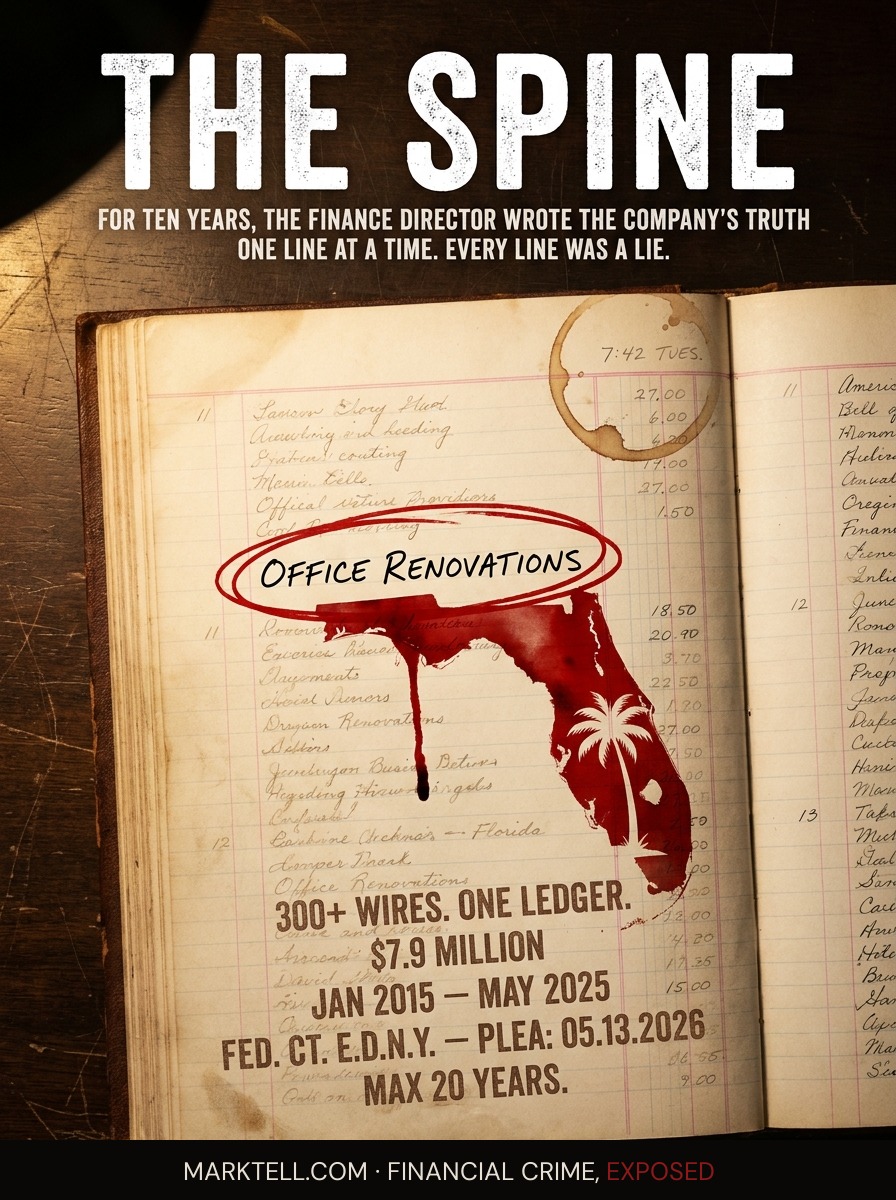
Marcy opened the ledger at 7:42 on a Tuesday morning. She had been at the company nineteen years. She knew the rhythm of its numbers the way a piano tuner knows a room.
The line in front of her said office renovations. The amount was a number that did not surprise her, because numbers at this company rarely surprised her. The Finance Director had initialed the entry the night before. She moved on.
She would not learn until almost a year later that the line was a wire. That the wire had gone to a Delaware shell. That the shell belonged to the man whose initials told her the line was clean.
This is a story about a ledger. A ledger is the book a company keeps to tell itself the truth about its own money. Every dollar that comes in, every dollar that goes out, every reclassification, every adjustment. The ledger is the spine. If the spine is bent, the body walks crooked and does not know it.
Jordan Khammar, 47, of Columbus, Ohio, pleaded guilty in federal court in Brooklyn on May 13, 2026, to wire fraud and money laundering. According to the plea, between January 2015 and May 2025, he initiated more than 300 fraudulent wire transactions out of his employer's bank account. He moved over $7.9 million. He hid it inside the ledger he was hired to protect.
He had been hired in 2006 as a financial consultant. He climbed. By the time the scheme began he was Finance Director of a multinational media and brand management firm. That title is the one that matters. Finance Director is the person who decides what an entry looks like before anyone else sees it. He had the keys to the banking system, the accounting system, the bookkeeping, and the payroll. He had, in short, the spine.
II.
The mechanism was not exotic. That is the part to sit with.
He wired money out of the company account to a company he controlled called Olive Tree Ventures, Inc. He then wired it from Olive Tree to other entities he controlled, including a media production company he ran on the side, Sideswipe Media, Inc.
In the ledger, the outgoing wires were dressed up. Credit card bills. Taxes. Office renovations. The kind of line item no one questions because no one has ever questioned it. According to the plea, he created more than 100 false entries in the company's general ledger to make the wires look like operating expense.
He also limited other employees' access to the financial systems. That part is its own sentence. The Finance Director, by virtue of his role, decides who gets to see what. He narrowed the room. He made sure the people who might have caught a pattern could not see the pattern.
This is the part the security industry calls insider threat, and the phrase is too soft. Insider threat sounds like a possibility. What Khammar admitted to was a decade.
III.
Picture the math.
Three hundred wires over ten years. That is, on average, one fraudulent transaction every twelve days. For ten years. Through two presidential administrations. Through a pandemic. Through annual audits, quarterly reviews, the routine internal motions that every multinational performs to assure itself that its money is still its money.
The money did not stay abstract. According to the plea and prosecutors' filings, Khammar used the funds to buy hundreds of thousands of dollars of real estate in Florida and Ohio. He paid more than $1.2 million in personal credit card bills. He paid himself $163,000 in payroll through another company he controlled. He withdrew $135,000 in cash. He bought furniture. He paid for travel. He paid for meals. He paid utilities.
Read that slowly. He used stolen money to pay utility bills. The lights in his house were on because the ledger at his job said office renovations.
IV.
The thing about a finance director's fraud is that no investor lost money in the way a retiree loses money in a Ponzi. The victim here is a company, and the company will, in the language of restitution, be made whole. The U.S. Attorney's Office for the Eastern District of New York has said Khammar faces a maximum of twenty years and restitution of at least $7.9 million, plus criminal forfeiture in the same amount.
But the company was not the only thing he stole from.
Think about Marcy again. Marcy is not her real name and Marcy is not one person. Marcy is every bookkeeper, every accounts payable clerk, every junior analyst who reconciled a line that had Khammar's blessing on it. For ten years, those people produced work product they believed was true. They closed books. They signed reports. They told auditors what they saw. They were, without knowing it, the downstream voices repeating the lie.
When the indictment came in September 2025, those people had to read it and understand that their own labor, the careful daily work of getting the numbers right, had been the instrument the fraud used to look correct.
That is what a manipulated ledger does. It does not only steal from the company. It steals the credibility of every person who worked inside it.
V.
The investigation was run by IRS-Criminal Investigation out of New York. The prosecution was handled by Assistant U.S. Attorneys Jonathan P. Lax and Dana Rehnquist, with Claire S. Kedeshian on asset forfeiture. The U.S. Attorney, Joseph Nocella, Jr., said in a statement that Khammar had "betrayed his employer's trust and abused his access to its financial systems for side projects and personal gain."
The phrasing is correct and it is also incomplete. The betrayal was structural. The access was the access the job required. He did not break in. He was given a key in 2006 and he used it for nineteen years, the last ten of them to take.
VI.
There is a particular kind of fraud that the security industry has spent a decade trying to detect with software, and this is the kind. It happens inside normal business processes. The wires were not unusual. The entries were not flagged. The activity looked, from any monitoring tool's perspective, like the company doing its own job. The fraud was not in the transactions. The fraud was in the labels.
That is why the ledger is the machine here. The wires were the symptom. The ledger was the disease. As long as the Finance Director controlled what the entries said, the entries said whatever he wanted.
Five reverse splits is a business model leaving fingerprints. One hundred false ledger entries is a confession written one line at a time, in the document the company trusted most.
VII.
Marcy is fine. She still has her job. The federal investigators talked to her, and to the people next to her, and the company is rebuilding its controls. The Finance Director's seat is empty. Somebody else will sit in it.
But on the morning she opened the indictment, the part that stayed with her was not the dollar figure. It was the list of entries. She recognized them. She had reconciled some of them. She had typed her own notes underneath them. She had, in the slow honest work of a Tuesday morning at 7:42, signed her name to the back of his lie.
The ledger told her the truth in the end. It just told her ten years late.
The man who controlled the book has now signed his own name to the truth, in a federal courtroom in Brooklyn, on the thirteenth of May. The book closes on his version of it. The next book is the one the sentencing judge will write.
- U.S. Attorney's Office, Eastern District of New York | May 13, 2026 | Press release announcing guilty plea of Jordan Khammar
- Regtechtimes | May 2026 | "Jordan Khammar pleads guilty to $7.9 million fraud and money laundering scheme"
- U.S. Department of Justice | September 23, 2025 | Indictment and arrest announcement, Jordan Khammar
- IRS-Criminal Investigation, New York Field Office | May 2026 | Statement of Special Agent in Charge Harry T. Chavis, Jr.
Editorial Notice
MarkTell is a true crime publication about financial fraud. Some scenes, dialogue, and sequential details are reconstructed from court filings, enforcement actions, news reports, and public records. Where the public record does not provide exact details, editorial reconstruction is used to convey the documented pattern of events. Names of private individuals may be changed to protect identity. All factual claims are sourced to public documents cited in the Evidence Trail above. MarkTell does not provide investment, legal, or financial advice. Nothing published here constitutes a recommendation to buy, sell, or avoid any investment. Allegations described in active cases have not been adjudicated and defendants are presumed innocent until proven guilty. Readers should conduct their own due diligence before making financial decisions.