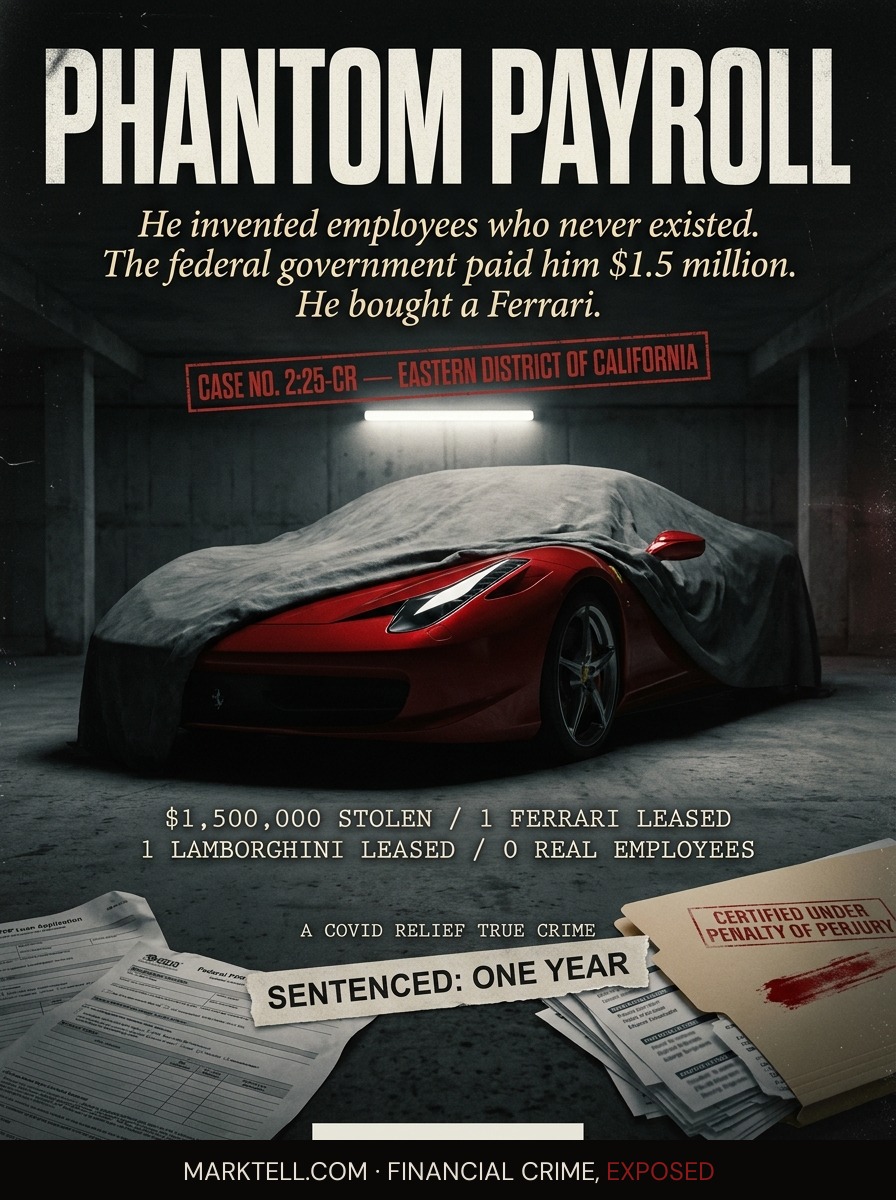
The Ferrari was leased with money meant for employees who never existed
Jedrek Upton walked into federal court in Sacramento with a Ferrari lease, a Lamborghini lease, and a $2.7 million property behind him. All of it, prosecutors said, was paid for with pandemic relief money meant for workers who did not exist.
Marisol found out about Jedrek Upton on her lunch break.
She was fifty-eight. She kept the books for a landscaping company in south Sacramento, six trucks and eleven full-time guys, and she still ate lunch at her desk because she had been eating lunch at her desk since 2003. She scrolled the Bee on her phone with one hand and a fork in the other. The headline said Placer County. It said lavish lifestyle. It said one-point-five million dollars.
Then it said Ferrari.
She put the fork down.
Marisol had spent eighteen months of her life on a PPP loan. Not getting one. Documenting one. The company had taken about ninety thousand dollars in the first round, in the spring of 2020, when nobody knew if the crews would still have jobs in June. She had been the one who pulled the payroll reports. She had been the one who calculated the full-time equivalents. She had been the one who kept the forgiveness folder in a plastic sleeve on the kitchen table for a year and a half, because she was terrified that a single missing pay stub would turn a grant into a debt.
The folder was still there. She could see it from the couch.
And on her phone, on a Tuesday in June, she was reading about a man in Lincoln who had allegedly walked the same program for a Ferrari.
I.
The federal complaint tells it straight.
Between January 2021 and May 2022, according to the U.S. Attorney's Office for the Eastern District of California, Jedrek Upton, forty-five, of Lincoln, submitted a series of applications for COVID-19 disaster relief on behalf of businesses he owned. The programs were the ones every small business in America learned the names of in 2020. Paycheck Protection Program. Economic Injury Disaster Loan. PPP and EIDL. Emergency aid, moved fast, backed by the Small Business Administration.
The programs were built on a promise. You said how many employees you had. You said what you would spend the money on. You certified it under penalty of perjury. The money moved. The paperwork came later.
Upton, prosecutors said, told the paperwork a story.
He inflated employee numbers on businesses that in some cases had no employees at all. He misrepresented how the funds would be used. He submitted falsified IRS documents to back up the numbers he was claiming. And when the time came to have the loans forgiven, which is to say converted from debt into a gift from the federal government, he certified that the money had gone to payroll and legitimate business expenses.
A significant portion was forgiven on those certifications.
The total, across the applications, came to nearly one and a half million dollars.
II.
Read the spending list slowly.
Personal credit card debt, paid off.
A Ferrari, leased.
A Lamborghini, leased.
A large down payment on a ten-acre property in Placer County, valued at roughly two point seven million dollars.
That is the record, as summarized by the Justice Department at sentencing.
None of those items are payroll.
None of them are rent for a business location. None of them are utilities for a shuttered storefront. None of them are the things the CARES Act was written to protect in the spring of 2020, when Congress was moving money out the door because a lot of small business owners were about to lose everything.
The program was a pipe. Money in one end. Relief out the other. The valves were the certifications. You signed, the valve opened, the money moved. The design assumption was that most Americans would not lie on a federal form during a national emergency.
Most did not.
Some did.
III.
Marisol kept scrolling.
The Bee said Judge John A. Mendez had sentenced Upton on June 30, 2026, in federal court in Sacramento. One year in prison. Three years of supervised release, twelve months of it home detention. Forfeiture of his interest in the property. Restitution of nearly one and a half million dollars back to the federal government.
He had pleaded guilty in November 2025 to one count of wire fraud and one count of money laundering.
She read the sentence again. One year.
She thought about the folder on the table.
She thought about the night in July 2020 when she had stayed up until one in the morning matching bank statements to payroll runs, because she had read that the SBA might audit, and she wanted every dollar traceable. She thought about the crew guys. Miguel, Junior, the two brothers whose last name she could never spell right on the first try. Real names. Real hours. Real checks.
Somewhere in Lincoln, according to the record, another set of names had been typed onto a federal form, and those names did not attach to human beings.
That part may be the saddest.
IV.
This case is not unusual. That is the thing to understand.
The Small Business Administration announced in February 2026 that it had suspended over one hundred and eleven thousand California borrowers suspected of about eight point six billion dollars in fraudulent activity across PPP and EIDL. The Justice Department's COVID-19 Fraud Enforcement Task Force has charged more than fifteen hundred defendants nationwide and seized over one point two billion dollars in relief funds since the pandemic began.
A week before Upton's sentencing, on June 23, 2026, a Sacramento man named Roosevelt Gulley was sentenced to four and a half years for a five-hundred-thousand-dollar COVID unemployment insurance fraud tied to identity theft. A month earlier, a Southern California medical company owner named Mehrdad Tabrizi pleaded guilty to stealing over a million in PPP and EIDL, part of it spent on a 2019 Porsche Turbo Cabriolet.
The pattern is not a Ferrari. The pattern is not a Lamborghini. The pattern is not a Porsche.
The pattern is the certification.
A form. A signature. A promise that the money would be used for something it was not going to be used for. That is where the fraud lives. Everything after that is just the receipt.
V.
Picture the pipe again.
The government opens the valve because a pandemic is killing small businesses. The rules say you certify. The rules say we will check the certifications later. The rules say we are trusting you because a nurse cannot wait ninety days for a bridge loan while her cleaning business dies.
Upton, according to his own guilty plea, put phantom employees on the intake side of the pipe.
The Ferrari came out the other end.
That is not a business plan. That is a translation. You feed a lie in and the pipe converts it into a car. You feed another lie in and it converts into a down payment on ten acres.
The pipe does not know. The pipe is not designed to know in real time. The pipe is designed to move fast and audit later.
Upton got audited later. IRS Criminal Investigation traced the falsified IRS documents back to the businesses that had no payroll. Assistant U.S. Attorneys Dhruv M. Sharma and Kevin C. Khasigian filed the charges. U.S. Attorney Eric Grant announced the sentence with a line about accountability for exploiting a national crisis.
The Ferrari was gone by then. The Lamborghini was gone. The property was forfeited.
The one point five million dollars is owed back on a payment schedule that will outlast the prison term by a decade.
VI.
Marisol finished her lunch cold.
She was not thinking about Upton, really. She was thinking about the small business owners she knew who had not applied for PPP because they were scared of the paperwork. The taqueria on Franklin that closed in October 2020 because the owner did not trust the forgiveness rules and did not want to end up owing the SBA money he could not repay. The hair salon on Freeport that took a small loan and paid every dollar back with interest because the owner could not sleep with a federal loan on her books.
Those people had read the same certification page Upton had read.
They read it as a promise they were making to the country.
He read it as a form field.
Some people got a Ferrari. Some people got a folder in a plastic sleeve on a kitchen table. The difference between them, on paper, was a single signature and a set of numbers that either matched real human beings or did not.
VII.
The sentence was one year.
Say it out loud. One year in federal prison for allegedly draining a national emergency program of one and a half million dollars and turning it into two exotic cars and a country estate.
That is not a comment on Judge Mendez. Federal sentencing is a math problem, and the math produced that number. Guilty plea. First offense. Cooperation. Restitution ordered.
It is a comment on the machine.
The machine that opened the valve fast in 2020 saved a lot of legitimate small businesses. It also created a category of person who saw an open valve and put a bucket under it. The math that convicts that person, years later, is not the same math that let them fill the bucket in the first place.
The bucket is what most Americans remember. The Ferrari in the driveway of the ten-acre property in Placer County. The Lamborghini next to it.
The valve is what nobody remembers, because a valve is not a story. It is a certification page on a website that most of us will never see again.
Marisol closed the app.
The folder was still on the table. She left it there.
She had filed honestly, and one year in federal prison was what a Ferrari cost. Those two facts were now living in the same country.
She went back to work.
- U.S. Attorney's Office, Eastern District of California | June 30, 2026 | Sentencing announcement, United States v. Jedrek Upton
- Sacramento Bee | June 30, 2026 | "Placer County man sentenced for using COVID relief loans for 'lavish lifestyle'"
- U.S. Department of Justice | COVID-19 Fraud Enforcement Task Force statistics, 2026 update
- U.S. Small Business Administration | February 6, 2026 | Announcement of suspension of 111,620 California borrowers
- U.S. Attorney's Office, Eastern District of California | June 23, 2026 | Sentencing of Roosevelt Gulley
- U.S. Attorney's Office | May 18, 2026 | Guilty plea of Mehrdad Tabrizi
Editorial Notice
MarkTell is a true crime publication about financial fraud. Some scenes, dialogue, and sequential details are reconstructed from court filings, enforcement actions, news reports, and public records. Where the public record does not provide exact details, editorial reconstruction is used to convey the documented pattern of events. Names of private individuals may be changed to protect identity. All factual claims are sourced to public documents cited in the Evidence Trail above. MarkTell does not provide investment, legal, or financial advice. Nothing published here constitutes a recommendation to buy, sell, or avoid any investment. Allegations described in active cases have not been adjudicated and defendants are presumed innocent until proven guilty. Readers should conduct their own due diligence before making financial decisions.