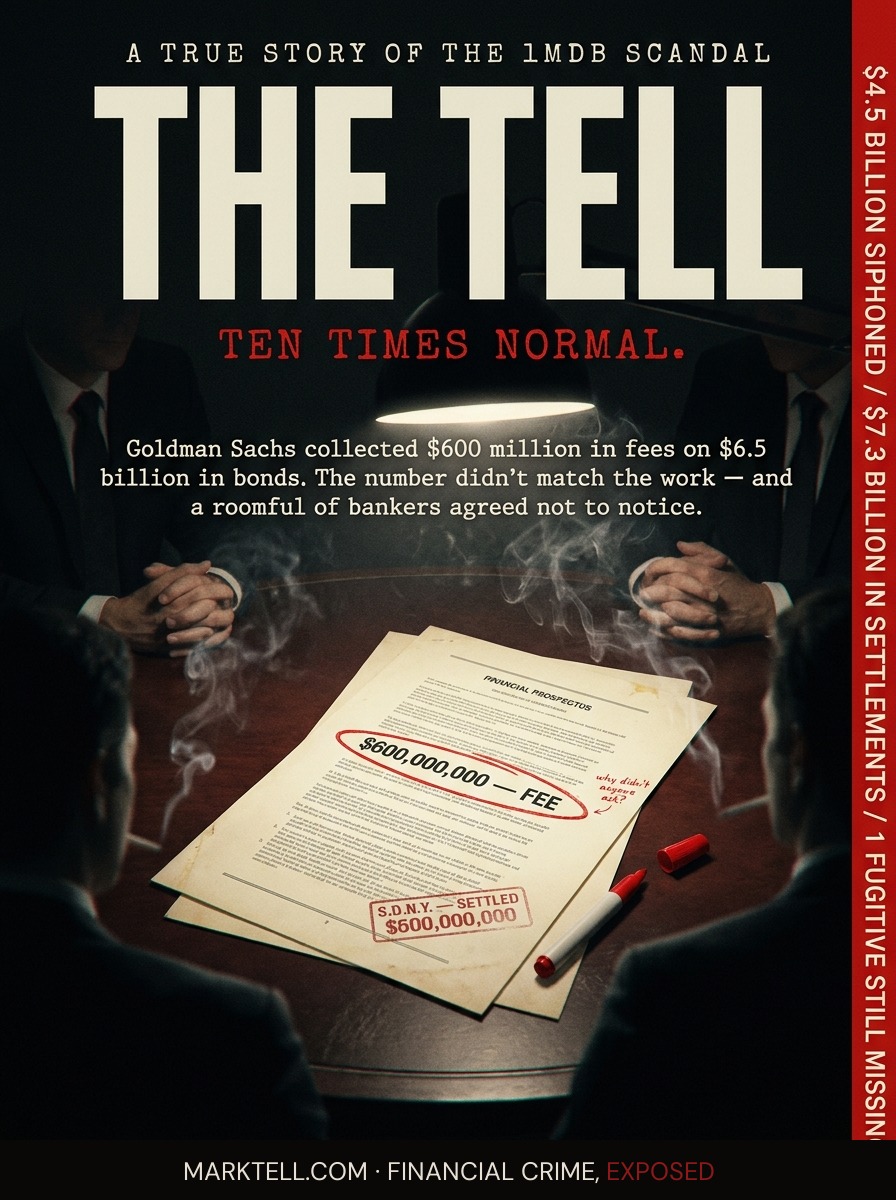
The fee was ten times normal. That was the tell everyone agreed not to see.
Eight years after the 1MDB scandal swallowed a Malaysian sovereign fund, Goldman Sachs has agreed to pay $500 million to settle a shareholder class action led by a Swedish pension fund. The fees on the bond deals were ten times what banks normally earned. Everyone in the room agreed not to say so.
Annika is fifty-eight. She works at a desk on the fourth floor of an office building in Stockholm where the windows do not open and the coffee machine is older than half the staff. Her title is unglamorous. Her job is to help oversee the pension money of millions of Swedish workers who will never know her name. The fund she works for is called AP7. It holds a sliver of almost every large company on earth, including, for years, Goldman Sachs.
On a December morning in 2018, she watched the Goldman line on her monitor do something she did not like. Not a crash. A slow leak. The kind of chart that looks like weather until you pull back and see it is a season.
She did not know yet that the leak had a name. The name was 1MDB.
I. THE FEE THAT DID NOT MATCH THE WORK
Here is the part the room agreed not to talk about.
Between 2012 and 2013, Goldman Sachs helped a Malaysian sovereign wealth fund called 1Malaysia Development Berhad sell $6.5 billion in bonds across three deals. For that work, Goldman collected an estimated $600 million in fees.
Read that slowly. Six hundred million dollars in fees on six and a half billion dollars in bonds. That is roughly ten percent. The normal fee for that kind of bond underwriting is closer to one percent. Federal prosecutors would later describe the fee as ten times what banks typically earn on bond issuances. They called it a total red flag.
A red flag is what a thing looks like before anyone says the word fraud.
If you are a senior person at a global investment bank and a deal comes through your desk paying ten times the normal rate, you have two choices. You can ask why. Or you can not ask why.
The shareholder complaint, filed in the Southern District of New York and led by Annika's pension fund, alleged that Goldman's leadership chose not to ask. The complaint alleged that the bank's executives, including then-CEO Lloyd Blankfein, told public investors the firm had robust internal compliance and risk controls while, behind the curtain, those controls were being waved past for the 1MDB deals. Goldman has denied this. The case was settled before a jury heard it.
But the fee sat there for years. Ten times normal. A number that did not match the work.
II. WHERE THE MONEY WENT
The bonds were sold. The fees were paid. Then the money that was supposed to develop Malaysia went somewhere else.
U.S. and Malaysian authorities have stated that approximately $4.5 billion was siphoned out of 1MDB. It went into real estate in Manhattan and Beverly Hills. It went into a yacht. It went into the production budget of a Hollywood film about a financial fraud, which is the kind of detail that would be cut from a novel for being too on the nose. It went, through a network of shell companies, into accounts controlled by associates of the Malaysian financier Jho Low and the inner circle of then-Prime Minister Najib Razak.
Two former Goldman bankers were at the center of the deals.
Tim Leissner, a managing director, pleaded guilty in 2018 to conspiring to launder money and violate the Foreign Corrupt Practices Act. He admitted in open court that he and others at Goldman had paid bribes and concealed Jho Low's role in the deals.
Roger Ng, a Goldman managing director in Malaysia, was convicted by a federal jury in 2022 on similar charges.
Goldman Sachs Malaysia, the bank's local unit, pleaded guilty in 2020. The parent bank entered a deferred prosecution agreement and paid roughly $2.9 billion to U.S. and other regulators. It paid an additional $3.9 billion to the Malaysian government in a separate settlement that year. In May 2024, a Brooklyn federal judge formally closed the U.S. criminal case after Goldman completed the three-year DPA.
This week, on May 20, 2026, lawyers walked into Manhattan federal court and filed papers in a different case. This one was not the government's. This one belonged to the shareholders.
III. THE PENSION FUND THAT NOTICED
You should understand who sued.
The lead plaintiff in the class action was Sjunde AP-Fonden, known as AP7. It is the default investment option for Sweden's national public pension system. Picture the most boring, most patient, most institutional money in the world. Not a hedge fund. Not an activist. A pension fund that holds Goldman shares because Goldman is in the index, and Sweden's retirees, by quiet default, own a piece of almost everything.
That is the fund that led the case. Annika's fund. The pension money of nurses and bus drivers and grocery clerks in Gothenburg and Malmö who never read a Goldman earnings call in their lives.
They argued, on behalf of a class of investors who bought Goldman stock between February 28, 2014, and December 17, 2018, that the bank had misled them about the size of the iceberg under the 1MDB business. When the iceberg surfaced, the stock fell. The complaint described the decline as precipitous. Shareholders said the loss was billions.
In April 2026, after a U.S. District Judge certified the class and cleared the way to a jury trial, Goldman and the plaintiffs announced an agreement in principle. The dollar number was not disclosed then. It was disclosed in the May 20 filing.
Five hundred million dollars.
It is one of the top twenty largest securities class action settlements ever recorded in the U.S. Second Circuit. It is also, by the math of this scandal, the smaller number. Goldman has now paid roughly $7.3 billion in 1MDB-related settlements when you stack the regulatory penalty, the Malaysian settlement, and this shareholder check on top of one another.
The bank denies wrongdoing in the shareholder case. A settlement is not a verdict. That is the legal posture, and it is the honest one.
But $500 million is a lot of denial.
IV. WHAT ANNIKA HOLDS NOW
Here is the part that may be the saddest.
The pension fund that led the case wins. The class wins. The lawyers will say, accurately, that the settlement is an outstanding result. Money will be distributed to shareholders who held Goldman stock during the class period. Some of it will flow back to AP7. Some of that, eventually, in fractions of fractions, will flow to the pensions of Swedish workers who do not know any of this happened.
Annika will not get a letter. She is not a plaintiff. She is a person who works at the fund that was the plaintiff. The check, when it clears, will be one more line in a quarterly report nobody outside the building reads.
The retiree in Malmö will not get a letter either. Her pension will go up by an amount so small it cannot be felt. That is what justice looks like when the harm is spread across millions of indirect owners. It is real. It is also invisible.
Meanwhile, $4.5 billion is still gone from a country that needed it. Jho Low is still a fugitive. The yacht has been seized. The film studio has been settled with. The Manhattan condos have changed hands. Najib Razak is in a Malaysian prison, his sentence reduced.
And the fee. The fee that was ten times normal. The fee that a roomful of senior people at one of the most sophisticated banks in the world looked at and did not ask the obvious question about.
That fee was the tell. Everyone in the room saw it. The shareholders, the ones whose money the bank was supposed to be working for, were the last to know.
That is the machine. Not the bribe. Not the yacht. Not Jho Low.
The machine is the room where the fee that did not match the work sat on the table, and nobody picked it up, because picking it up would have meant losing the deal.
Annika watches the chart. The chart, eight years on, has recovered. The bank is fine. The settlement will be paid out of a reserve that was already there. The stock did not move on the news.
That is the part you should remember. The number that bought peace was $500 million, and the market did not even flinch.
The fee was always the story. Everyone agreed not to read it.
- Reuters | May 22, 2026 | "Goldman Sachs to pay $500 million to settle shareholder lawsuit over 1MDB scandal"
- U.S. District Court, Southern District of New York | May 20, 2026 | Settlement filing, In re Goldman Sachs Group Inc. Securities Litigation
- U.S. Department of Justice | October 22, 2020 | Goldman Sachs deferred prosecution agreement and statement of facts, 1MDB matter
- U.S. Department of Justice | August 28, 2018 | Plea agreement of Tim Leissner
- U.S. District Court, Eastern District of New York | April 8, 2022 | Jury verdict, United States v. Roger Ng
- Government of Malaysia | July 2020 | Settlement announcement with Goldman Sachs ($3.9B)
- U.S. District Court, Eastern District of New York | May 2024 | Order closing U.S. criminal case against Goldman Sachs upon completion of DPA
- Sjunde AP-Fonden (AP7) | public fund disclosures, lead plaintiff filings
Editorial Notice
MarkTell is a true crime publication about financial fraud. Some scenes, dialogue, and sequential details are reconstructed from court filings, enforcement actions, news reports, and public records. Where the public record does not provide exact details, editorial reconstruction is used to convey the documented pattern of events. Names of private individuals may be changed to protect identity. All factual claims are sourced to public documents cited in the Evidence Trail above. MarkTell does not provide investment, legal, or financial advice. Nothing published here constitutes a recommendation to buy, sell, or avoid any investment. Allegations described in active cases have not been adjudicated and defendants are presumed innocent until proven guilty. Readers should conduct their own due diligence before making financial decisions.