The FBI warned her twice. She kept washing the money anyway.
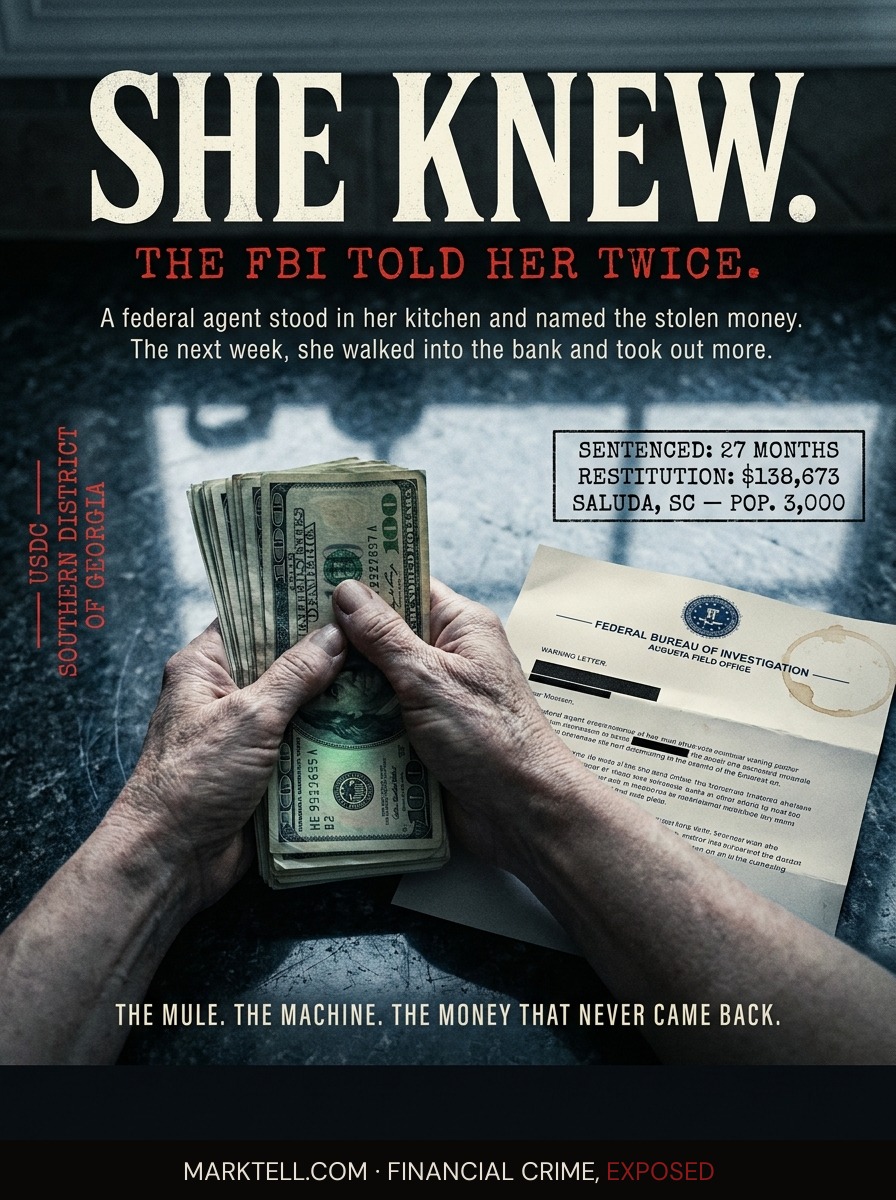
Laura Frantz of Saluda, South Carolina, was sentenced to federal prison this week for moving money stolen through business email compromise. The FBI says they warned her more than once. She kept the account open anyway.
Dana approved the wire at 4:11 on a Thursday afternoon.
She was fifty-four years old. She had been the controller at a construction supply company in a town she could walk across in twenty minutes. Nine years on the job. She knew the vendors by first name. She knew which ones called before sending an invoice and which ones just sent it. She knew the one she paid that afternoon. She had paid him for nine years.
The email came in at 3:47. It said the company had switched banks. The new routing number and account number were in the body of the email. There was a short, polite apology for the inconvenience. The signature block was the same signature block she had been reading since 2016. The font was the same. The phone number was the same. The only thing different was the bank.
She called the number at the bottom of the email to confirm. Someone picked up. Someone said yes, that's correct, thank you for checking.
She approved the wire. $73,400. The money left her company's account inside of ninety seconds.
That part is the composite. I am building Dana from the standard profile because the public record on this particular case does not name the victim companies. But the pattern is the pattern. The Federal Trade Commission and the FBI publish it every year. A controller. A vendor she trusted. An email that looked right. A wire that cleared before lunch the next day.
What is not composite is where the money landed.
II. The account in Saluda
The account that received money like Dana's belonged to a woman named Laura Frantz. She was sixty-two years old. She lived in Saluda, South Carolina, a town of about three thousand people roughly an hour northwest of Augusta.
She was not the one writing the emails. She was the next link in the chain. In the trade, she was a money mule. That is the person whose name is on the bank account. The person who walks into the branch. The person whose ID is on file. The person the wire actually hits.
A Business Email Compromise, or BEC, is a kind of fraud where someone impersonates a vendor or an executive in an email and convinces a company to wire money to an account the criminals control. The FBI has called BEC the most expensive form of cyber fraud in America by total dollars lost. The emails are cheap to send. The bank accounts on the receiving end are the bottleneck. Someone has to open them. Someone has to move the money. Someone has to convert the wire into cash or into a second wire that gets the money further away from the original victim.
That someone, between 2020 and 2023, was Laura Frantz.
According to the Department of Justice for the Southern District of Georgia, victim companies sent funds into bank accounts she controlled. She withdrew portions of the money. She used portions of it. The conduct went on for roughly three years.
III. The knock at the door
This is the part that separates this case from a thousand others.
Most mules will tell you they did not know. They will say they thought it was a romance. They will say they thought they were helping a boyfriend overseas. They will say they thought it was a job working from home. The script is well documented. Sometimes it is true. Sometimes it is the cover story.
In Frantz's case, the government says she was told.
The FBI warned her on more than one occasion, according to the DOJ release, that her actions were potentially criminal. The bureau is not in the habit of issuing those warnings casually. An agent showed up. An agent explained what the money was. An agent told her where it came from.
She kept the account open. She kept withdrawing.
Picture it. A federal agent in your kitchen explaining that the deposits hitting your bank account are stolen money. Wired in by companies who thought they were paying a vendor. Stripped out of a payroll account somewhere. And the next week, another deposit. And you walk into the branch and take it out.
That is not a misunderstanding. That is a choice.
I have sat in rooms where people made choices like that. Not for BEC. For other things. The thing the room teaches you is that money you can touch feels different from money you cannot. Once the cash is in your hand, the story you tell yourself about where it came from gets quieter. The FBI agent in the kitchen becomes a problem to manage. The bank teller becomes a friendly face. The next deposit becomes rent.
IV. The math
On June 15, 2026, in federal court in Augusta, U.S. District Judge J. Randal Hall sentenced Laura Frantz to 27 months in federal prison. Three years of supervised release after that. Restitution of $138,673.
That number is the surviving record of the money the government could trace through her accounts. It is not necessarily the total a BEC operation netted from companies who wired money. It is the number tied to Frantz.
Read it slowly. $138,673. That is a year and a half of Dana's salary. That is payroll for a small construction supply company for a month. That is a year of tuition. That is the number that ended in a federal courtroom this week.
The U.S. Attorney for the Southern District of Georgia, Margaret E. Heap, said in the announcement: "One cannot simply wash away the origins of illegally obtained money through financial schemes. This guilty plea demonstrates that those who attempt to conceal criminal proceeds will face the consequences."
Matt Ploskunak, the supervisory senior resident agent in the FBI's Augusta office, said this: "Anyone engaged in this type of criminal activity should realize they are not outside of the reach of law enforcement."
Note the language. Both quotes are aimed at the next Laura Frantz. Not at the next Dana.
V. What Dana lost
Dana lost the wire. The bank could not claw it back. The vendor she thought she was paying was paid eventually, out of a line of credit the company drew down to cover the hole. The owner did not fire her. He thanked her for calling the FBI quickly. He told her it could have happened to anyone.
She did not believe him.
She has trouble approving wires now. She prints the email. She walks down the hall to the desk of the person who supposedly sent it. She makes them say the routing number out loud. Some of her vendors think she has become difficult to work with. She knows. She does not care.
What she lost was not the $73,400. The company absorbed that. What she lost was the version of herself who picked up the phone and trusted the voice on the other end.
That part may be the part she does not get back.
VI. The machine
This is the part to remember.
The email that hit Dana's inbox was the front of the machine. The new routing number was the trapdoor. Laura Frantz, in Saluda, with the bank account and the cash withdrawals, was the drain. The cash that left the bank teller's window went somewhere. The DOJ release does not say where. In most BEC cases, it leaves the country.
Frantz is the part of the machine that got caught because she was the part standing in the open. Her name was on the account. Her ID was on file. Her ID was on the surveillance tape at the teller window. The FBI knew where she lived because they had been to her house.
The people who wrote the emails are almost certainly somewhere else. The Department of Justice has not announced charges against them in this filing.
The machine does not stop because Laura Frantz is going to prison. The machine recruits another sixty-two-year-old in another small town. The script the recruiter uses to convince her to open the account is the same script. The bank that opens the account is a different bank. The vendor email that hits the next Dana is a different email with a different signature block.
The pipe stays open. Only the segment of pipe with Frantz's name on it got shut.
VII. The renaming
The DOJ called it Money Laundering. Twenty-seven months. A restitution number. A guilty plea. A press release with two officials quoted.
That is the legal name. The practical name is this. A small company sent a wire to a vendor it had paid for nine years. The wire went to a woman in South Carolina who had been told by federal agents that the money was stolen. She took it out in cash anyway. Then she did it again. Then she did it for three years.
The controller still has the job. The vendor still has the contract. The woman in Saluda has 27 months.
The email that started it is still in someone's drafts folder, ready to be sent to the next controller, at the next company, on the next Thursday afternoon at 3:47.
Dana approved the wire at 4:11.
Somebody else is going to approve one tomorrow.
- U.S. Attorney's Office, Southern District of Georgia | June 15, 2026 | DOJ press release on sentencing of Laura Frantz
- The Augusta Press | June 2026 | "Former Augusta-area woman gets federal prison for laundering cyber fraud proceeds"
- FBI Internet Crime Complaint Center (IC3) | Annual reports | Business Email Compromise typology and loss totals
- Federal Trade Commission | Public guidance on money mule recruitment and BEC victim patterns
Editorial Notice
MarkTell is a true crime publication about financial fraud. Some scenes, dialogue, and sequential details are reconstructed from court filings, enforcement actions, news reports, and public records. Where the public record does not provide exact details, editorial reconstruction is used to convey the documented pattern of events. Names of private individuals may be changed to protect identity. All factual claims are sourced to public documents cited in the Evidence Trail above. MarkTell does not provide investment, legal, or financial advice. Nothing published here constitutes a recommendation to buy, sell, or avoid any investment. Allegations described in active cases have not been adjudicated and defendants are presumed innocent until proven guilty. Readers should conduct their own due diligence before making financial decisions.