The factory in Siun was the last room. The machine ran for a year inside it.
Xu Qing fled China in November 2024 after allegedly running a $245M Ponzi scheme. He spent seventeen months inside a factory in Ogun State before Nigerian police walked in. The arrest is a story about where machines go when they stop running.
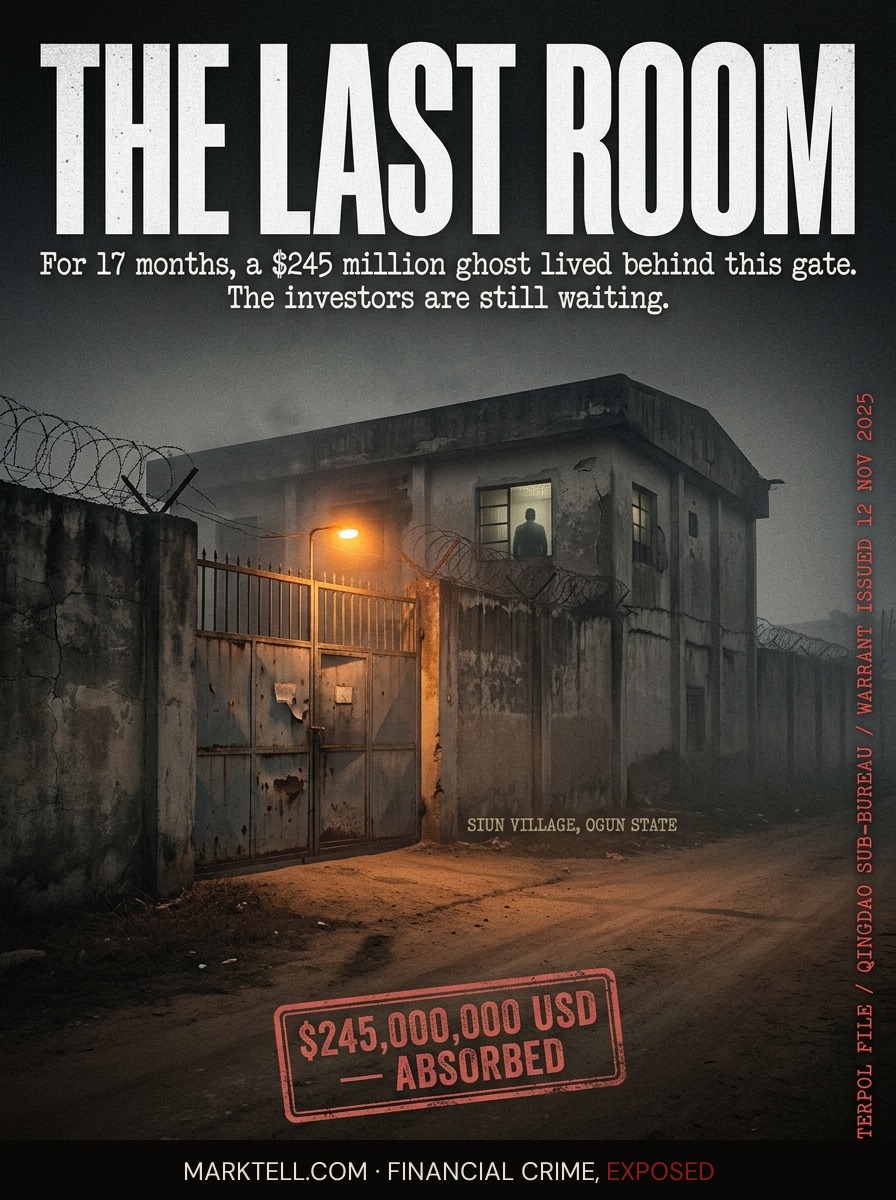
The factory sat off a road in Siun Village, in the Obafemi Owode Local Government Area of Ogun State, the kind of compound a driver passes without looking twice. Concrete walls. A gate. The sound of something running inside that could be machinery or could be a generator. From the road, it looked like every other small industrial building in that part of Nigeria.
For seventeen months, a man named Xu Qing lived somewhere on that property.
He had flown out of China on November 5, 2024. According to the Shinan Sub-Bureau of Qingdao Public Security, he was already wanted by then in connection with what Chinese law calls the illegal absorption of public deposits. The polite legal phrase. The plain English is that he is alleged to have run a Ponzi scheme. The number attached to it, repeated by the Nigeria Police Force when they announced the operation, is more than $245M USD.
A Ponzi scheme is the oldest machine in this category of crime. You collect money from new investors. You pay returns to old investors out of the new money. You call it a yield. You call it a fund. You call it whatever the regulator in your jurisdiction is least likely to look at first. The machine runs as long as the new money coming in exceeds the old money going out. When that ratio inverts, the machine stops, and the people holding the most recent statements are the ones holding nothing.
The Chinese complaint, as described in public statements by Nigerian authorities, alleges that ratio inverted around the time Xu Qing booked a flight.
He chose Nigeria. That itself is worth sitting with.
Nigeria has spent the past decade absorbing other people's financial fugitives the way some economies absorb capital. In December 2024, the Economic and Financial Crimes Commission raided a crypto-romance operation in Lagos and arrested 792 suspects, including Chinese and Filipino nationals. Before that, the country deported 42 Chinese and Philippine nationals convicted of cyber fraud and Ponzi schemes. The pattern is not new. The factory in Siun is the latest version of it.
Read the Inspector-General's statement carefully. IGP Olatunji Rilwan Disu, announcing the arrest on May 6, 2026, did two things. He framed the operation as a sign that Nigeria would not be a refuge for foreign fugitives. Then he turned and warned Nigerian employers to conduct background checks, including police verification, before engaging foreign nationals.
That second part is the tell. You do not issue that advisory unless you already know the answer to the question of how Xu Qing spent seventeen months inside an Ogun factory without being noticed.
Somebody hired him. Somebody rented him space. Somebody, somewhere in that compound, processed an introduction and decided not to ask the next question.
The arrest warrant was issued on November 12, 2025. INTERPOL NCB Abuja led the surveillance. The Nigerian Police Force walked in on April 24, 2026. He was repatriated four days later, on April 28, on a flight back to the People's Republic of China.
Picture that flight. A man who built, allegedly, a structure large enough to consume $245M USD of other people's savings. Sitting in a seat. Restrained, presumably. Looking out the window at a country he had used as a hiding place for a year and a half, returning to a country where the people who handed him their deposits are still waiting.
The investors are the part the press release does not linger on. The release lingers on the cooperation. The bilateral channels. The commitment to international law enforcement. The photograph of the handover. That is what gets the light.
The deposit slips get the shadows.
We do not know, from public sources, how many investors there were. We do not know the average ticket size. We do not know if any of them were warned by family or friends, the way investors in every Ponzi are warned and then ignore the warning, because the returns were arriving and the platform looked legitimate and the man at the top of the structure had answers for every question. Until he did not, and then he had a flight.
Here is what the structure of this case tells you, even before the Chinese court rules on anything.
A scheme that allegedly took $245M USD does not run out of one office. It runs out of a network. Sales agents. Bank accounts. Custodians. Promoters. Lawyers who structured the entity. Accountants who issued statements. Some of those people are still in China. Some of them, if the pattern holds, are not.
A fugitive who chose Nigeria did so because somebody told him Nigeria was a place where the question of who you used to be would not be asked twice. That somebody was right for seventeen months. Then it stopped being right, because INTERPOL Abuja decided to ask.
The factory is the machine in this story. Not the Ponzi structure in China. That machine has already done its work. The factory in Siun is the second machine. The one that absorbs the operator after the first machine has finished consuming the deposits. It is the place where a person becomes a different person, takes a different job, lives off the residue, and waits for the news cycle in his home country to move on.
The Nigerian arrest is what happens when the news cycle does not move on, when a foreign sub-bureau in Qingdao keeps the file open, and when an INTERPOL request crosses the right desk in Abuja.
It is also what happens once. Other factories, in other villages, are still running.
The IGP's advisory to employers was not advice. It was an admission. Somewhere in Ogun State, somewhere in Lagos, somewhere in a compound off a road that does not appear on any tourist map, another foreign national with a warrant in another country is filing paperwork under a name that is not his. The system that produced Xu Qing's seventeen months produced him as a category, not as an exception.
The Chinese investors will get a press release. They may, if Chinese asset recovery proceedings move efficiently, get a fraction of their deposits back. The amount will not match the amount on the original statements. It never does, in this kind of case. The machine ran. The residue is what is left after the machine ran.
Xu Qing is in custody now. The allegations against him have not been adjudicated. He is entitled to whatever process Chinese law provides, and that process will produce its own record, its own number, its own version of the story.
The factory in Siun is empty of him. It is not empty.
- Pulse Nigeria | May 7, 2026 | Nigeria police arrests Chinese fugitive hiding in Ogun factory over $245 million Ponzi scheme
- Nigeria Police Force public statement | May 6, 2026 | Announcement by DCP Anthony Okon Placid, Force Public Relations Officer
- Inspector-General of Police Olatunji Rilwan Disu | May 6, 2026 | Public advisory on foreign national background checks
- Shinan Sub-Bureau of Qingdao Public Security | November 12, 2025 | Arrest warrant for Xu Qing
- INTERPOL National Central Bureau Abuja | Surveillance and operational cooperation, April 2026
- EFCC Lagos crypto-romance enforcement action | December 2024 | Arrest of 792 suspects including Chinese and Filipino nationals
Editorial Notice
MarkTell is a true crime publication about financial fraud. Some scenes, dialogue, and sequential details are reconstructed from court filings, enforcement actions, news reports, and public records. Where the public record does not provide exact details, editorial reconstruction is used to convey the documented pattern of events. Names of private individuals may be changed to protect identity. All factual claims are sourced to public documents cited in the Evidence Trail above. MarkTell does not provide investment, legal, or financial advice. Nothing published here constitutes a recommendation to buy, sell, or avoid any investment. Allegations described in active cases have not been adjudicated and defendants are presumed innocent until proven guilty. Readers should conduct their own due diligence before making financial decisions.