The factory floor that wasn't ready when the guidance said it was
Between November 2025 and February 2026, Eos Energy told investors its automated battery production line was scaling toward a $150 million year. The line was running at more than triple acceptable downtime. A securities class action now asks who knew, and when.
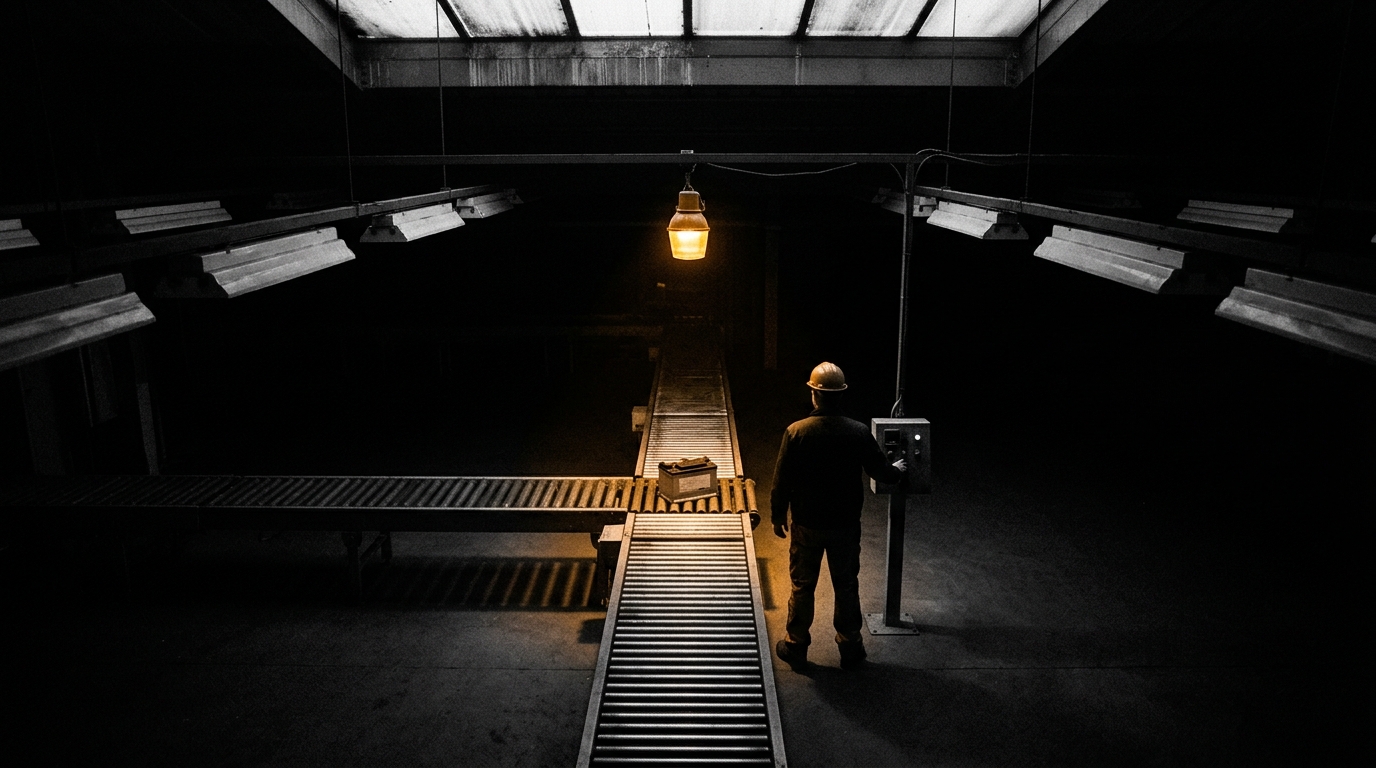
I. The Number That Was Not There
The earnings release went out after the close on February 26, 2026.
$114.2 million.
That was the full-year revenue number for Eos Energy Enterprises. The company that makes zinc-based battery storage systems. The company that had been telling investors, as recently as the fall of 2025, that full-year revenue would come in between $150 million and $160 million.
Do the subtraction. The shortfall was between $35.8 million and $45.8 million. More than a quarter of what the company had said it would earn, gone.
The next morning, February 27, 2026, EOSE shares opened and did not stop falling until they had lost 39.4 percent of their value in a single session. The stock closed at $6.74. It had been at $11.13 the day before. In one trading day, the company shed an estimated $1.4 billion in market capitalization. That is not a correction. That is not volatility. That is a floor giving way.
Somewhere, on a morning that was probably already cold, a person who owned Eos Energy shares opened a brokerage app and looked at a number they did not expect to see.
We do not know their name. What we know is the shape of their experience. They had read the guidance. They had seen the company talk about its automated production line at the Turtle Creek facility in Pennsylvania. They had been told a story about scale, about gigawatt-hours, about a company becoming the kind of company that could compete in the energy storage market that AI infrastructure was suddenly making urgent. They believed enough to hold the stock through November 2025. Through December. Through January and into February 2026.
They were still holding when the floor disappeared.
A securities class action, filed by multiple law firms including Hagens Berman and Robbins Geller Rudman and Dowd, alleges that the floor was already gone long before February 26. That people inside Eos Energy knew the automated line was not performing. That the guidance, when it was given and when it was affirmed, was not something the factory could support.
The complaint covers the period from November 5, 2025, to February 26, 2026. Anyone who bought or held EOSE shares during those months may be a member of the class. The lead plaintiff deadline is May 5, 2026.
None of this is adjudicated. Eos Energy has not been found liable. What has been disclosed, by the company's own officers, is more than enough to explain why the question is being asked.
II. What the Floor Was Supposed to Look Like
Eos Energy is not a shell. It is a real company, building real products, at a real facility.
That matters. It changes the shape of the story.
The Turtle Creek factory in Pennsylvania is where Eos intended to manufacture its zinc-based battery systems at scale. Zinc battery technology is positioned as an alternative to lithium-ion for large-scale energy storage. The kind of storage that utility companies and data center operators need to smooth out power delivery. The kind of demand that has been accelerating as AI infrastructure expands and the grid struggles to keep pace.
The company had been transitioning from manual to automated manufacturing. The goal was to reach 2 gigawatt-hours of annual production capacity by the end of 2025. A gigawatt-hour is a large unit of stored energy, enough to power tens of thousands of homes for an hour. For a manufacturer, it is a way of expressing volume. Eos was building toward a number that would make it a serious supplier.
The guidance, $150 million to $160 million for fiscal year 2025, was anchored to that production story. If the automated line worked, the volume would follow. If the volume followed, the revenue would follow. The guidance assumed the line worked.
The complaint alleges it did not.
According to the lawsuit, battery line downtime at Turtle Creek was running in the mid-30 percent range during the class period. The industry benchmark for acceptable downtime is approximately 10 percent. Mid-30 percent means the line was idle or producing unusable output for more than a third of its available time. More than triple the acceptable rate.
The complaint further alleges that the automated bipolar plate production, a key part of the manufacturing process, was failing to hit quality targets. Plates were coming off the line that did not meet specification. They had to be reworked. Rework takes time. Time is output. Lost output is lost revenue.
After the February 26 disclosure, the company's COO acknowledged publicly that failures in robotics, hardware, controls systems, maintenance scheduling, and spare parts availability had all contributed to the production problems.
Read that list again.
Robotics. Hardware. Controls. Maintenance schedules. Spare parts.
That is not one thing going wrong. That is a category of things going wrong. The question the lead plaintiff investigation is now centering on, according to Hagens Berman partner Reed Kathrein, is when management became aware that the automated line was not meeting its design intent.
Because if the line was failing in all those ways during the class period, while the guidance was being affirmed, then the guidance was not describing the factory that existed. It was describing the factory the company intended to have.
The person with the brokerage app did not know they were holding a gap between intention and reality. They thought they were holding a production story. They were holding the distance between what the floor was supposed to look like and what it actually looked like on any given shift.
III. What the Year Actually Produced
The full-year 2025 numbers are in the disclosure. They do not require interpretation.
Revenue: $114.2 million.
Gross loss: $143.8 million.
Net loss attributable to shareholders: $969.6 million.
Adjusted EBITDA loss: $219.1 million.
A gross loss means the company spent more to make its products than it received for selling them. $143.8 million more, on $114.2 million in revenue. That is not a margin problem. That is a structural problem. Every unit Eos shipped in 2025 cost more to build than the customer paid for it.
This is not new. In Q4 2024, Eos reported a gross profit margin of negative 558 percent. The company has been burning cash at a rate that requires continued capital infusion to survive. That context existed before the class period began. It is part of the floor the guidance was standing on.
None of this means the company was a fraud. It means the company was not yet a business in the traditional sense. It was a development-stage manufacturer trying to reach the scale at which it could produce profitably. That story is legitimate. Many real companies have lived inside that story and eventually crossed to the other side of it.
The allegation in the lawsuit is narrower and more specific than "the company was failing." The allegation is that statements made during the class period about the company's ability to meet its guidance were materially false and misleading because the people making those statements had access to the factory floor data and chose not to reflect what that data showed.
CEO Joe Mastrangelo, after the February 26 disclosure, stated that "2025 was a structural turning point for Eos" and acknowledged disappointment in not meeting revenue expectations. The company simultaneously issued 2026 guidance of $300 million to $400 million.
The complaint does not say the company's future is hopeless. It says the class period statements about 2025 were not honest about what was happening in real time on the Turtle Creek floor.
Whether that distinction holds up in court is a question that has not been answered. The case is active. The complaint is an allegation. Eos Energy has not been found to have done anything wrong.
What has been found, in the public record, is a 25 percent revenue miss, a list of production failures acknowledged by the company's own COO, and a stock price that lost more than a third of its value in a single day when investors learned what the factory had actually been doing.
IV. The Shape of the Machine
I have spent a long time watching how production stories are told to investors.
The architecture is almost always the same. The company identifies a real market need. The need is genuine. The technology has promise. The management team can speak fluently about scale, capacity, deployment timelines, and total addressable markets. The guidance number is the number that makes the investment thesis work. It is the number that connects the story to something measurable.
The guidance is not a lie at the moment it is given. At least, not always. Sometimes it is an aspiration dressed in the grammar of a forecast. The manufacturing line is going to perform like this. The output is going to grow like this. The revenue will follow. The guidance is the story the company tells itself about who it is becoming.
The problem is what happens when reality diverges from the story and the guidance does not move.
When a line is running at 35 percent downtime and the guidance is still affirming $150 to $160 million, something has to be true. Either the people setting the guidance do not know about the downtime. Or they know about the downtime and believe they can recover. Or they know about the downtime and do not reflect it in the guidance because reflecting it would be a different kind of problem.
The lawsuit is asking which one of those was true at Eos Energy during the class period.
That is the right question.
It is the question that matters not just for the shareholders who lost money on February 27. It is the question that matters for anyone who has ever read a guidance range and believed it described something the company had actually measured.
Guidance is not a promise. Most investors know this technically. But the guidance number is also the only external anchor a retail investor has when evaluating whether a stock is worth holding. If the guidance is set or affirmed without the operational data to support it, the anchor is not anchoring anything. It is floating. It just does not look like it is floating from the outside.
That is what the complaint alleges happened between November 2025 and February 2026. The anchor was floating. The factory was telling a different story than the guidance was. And the person with the brokerage app had no way to see the factory.
V. What Comes Next
The lead plaintiff deadline is May 5, 2026. Six days from today.
That deadline is procedural. It is the date by which the investor who lost the most money during the class period can apply to represent the class in court. It does not mean the case ends on May 5. It means the class leadership gets established by May 5. The litigation will continue long after that.
Eos Energy is scheduled to release Q1 2026 results on May 13, 2026. The company has already announced preliminary Q1 revenue of $56 to $57 million and says it completed factory acceptance testing for a second production line. The 2026 guidance is $300 to $400 million.
If the Q1 numbers hold, and if the second line performs, Eos will argue that the operational problems were real but temporary, that the team fixed them, and that the story is continuing. That argument may be entirely true.
It does not resolve the class period question. The question is not whether Eos Energy can eventually produce at scale. The question is whether investors were told the truth about what the factory floor looked like between November 5, 2025, and February 26, 2026, while they were deciding whether to buy, hold, or sell.
Analyst consensus as of this writing is a rating of reduce, with price targets from JPMorgan and Roth Capital at $6 per share.
The stock closed at $6.74 on the day the floor fell through.
The person with the brokerage app has not recovered what they lost. They may never recover all of it. The class action does not guarantee recovery. Class actions settle or go to trial, and outcomes vary widely. Many class members receive cents on the dollar.
What the class action does, if it proceeds, is put the question formally on the record. When did the people running this company know the guidance was not achievable? What did they say to investors while they knew it?
The factory floor is the evidence. Not the press releases. Not the conference calls. Not the CEO's statement about structural turning points.
The floor. The robots. The downtime logs. The rework rates. The spare parts orders, or the absence of them.
That is where the truth of this story lives. Whether the court can get to it is a different question.
The investors who held through the class period already know what the floor cost them.
They found out the way they always find out.
After the close, in a filing, in a number that was not the number they had been given.
$114.2 million.
That is the sentence the factory wrote.
- Eos Energy Enterprises, Inc. | February 26, 2026 | FY2025 earnings disclosure / press release
- Hagens Berman | April 2026 | EOSE class action announcement / deadline alert / PR Newswire
- Robbins Geller Rudman and Dowd LLP | April 2026 | EOSE class action announcement
- Pomerantz LLP | April 2026 | EOSE class action announcement
- The Rosen Law Firm | April 2026 | EOSE class action announcement
- Bleichmar Fonti and Auld LLP | April 2026 | EOSE class action announcement
- Glancy Prongay and Murray LLP | April 2026 | EOSE class action announcement
- Levi and Korsinsky LLP | April 2026 | EOSE class action announcement
- Eos Energy Enterprises, Inc. | April 2026 | Preliminary Q1 2026 revenue announcement
- Eos Energy Enterprises, Inc. | prior periods | Q4 2024 financial results (gross margin -558%, EBITDA -$154.55M)
- NASDAQ market data | February 26-27, 2026 | EOSE closing price and intraday trading record
- Analyst consensus data | April 2026 | JPMorgan and Roth Capital price targets, consensus rating
- CEO Joe Mastrangelo | February 26, 2026 | public statement on FY2025 results
- COO public acknowledgment | February 2026 | production failures statement (robotics, hardware, controls, maintenance, spare parts)
- Reed Kathrein, Hagens Berman | April 2026 | public statement on investigation focus
Editorial Notice
MarkTell is a true crime publication about financial fraud. Some scenes, dialogue, and sequential details are reconstructed from court filings, enforcement actions, news reports, and public records. Where the public record does not provide exact details, editorial reconstruction is used to convey the documented pattern of events. Names of private individuals may be changed to protect identity. All factual claims are sourced to public documents cited in the Evidence Trail above. MarkTell does not provide investment, legal, or financial advice. Nothing published here constitutes a recommendation to buy, sell, or avoid any investment. Allegations described in active cases have not been adjudicated and defendants are presumed innocent until proven guilty. Readers should conduct their own due diligence before making financial decisions.