The escrow account was the trapdoor. The masks were never coming.
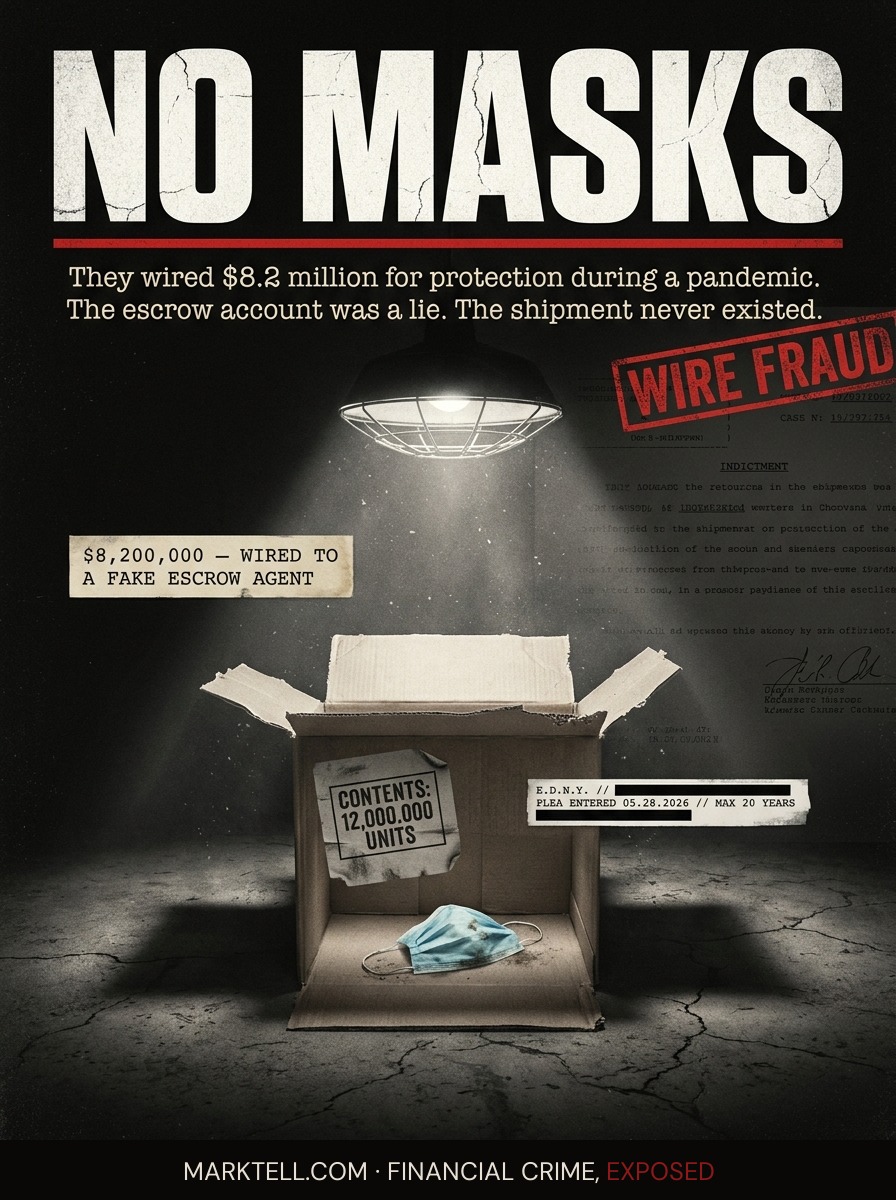
In the spring of 2020, a Montreal company wired $8.2 million to a purported escrow account for face masks Quebec and Alberta were desperate to receive. Six years later, an Orchard Park business owner has admitted the escrow account was the door the money walked through, not the lock that held it.
Marc was at his kitchen table in Montreal when the wire confirmation came back. It was a Tuesday in the spring of 2020. His daughter was doing fractions at the other end of the table. The office had been closed for two weeks. The hospitals in Quebec were rationing surgical masks by the box, not by the case.
The number on his screen was $8.2 million. The recipient was listed as a third-party escrow agent. The contract said 12 million face masks would ship from a supplier in upstate New York. The escrow account, he had been told, was the protection. The money would not move until the masks did.
He closed the laptop. He told his daughter she could have ten more minutes of the iPad. Somewhere in his chest there was the specific calm that comes from having done the careful thing in a careless time.
The escrow account was not an escrow account.
That is the sentence the federal government has now put into the record. On May 28, 2026, Julie Dotton, a business owner from Orchard Park, New York, pleaded guilty to wire fraud in the Eastern District of New York. According to the Department of Justice announcement, Dotton misrepresented her ability to source personal protective equipment to a Canadian company between March and October of 2020. She entered into a contract through an entity she controlled. The Canadian company wired $8.2 million to what it believed was a third-party escrow agent. Instead, the funds moved to a bank account controlled by a co-defendant, Jonathan Cannon of Miller Place, New York, who then disbursed the money to various third parties for their benefit.
No masks were procured. No masks were shipped. There were, according to the DOJ, months of excuses.
The Canadian company was Busrel Inc., a Montreal-based official provider of PPE to the provinces of Quebec and Alberta during the early stages of the pandemic. That detail matters. Busrel was not a speculator. It was a supplier to the hospitals that were rationing.
I.
To understand the machine, you have to understand the room it was built in.
In March of 2020, the global market for surgical masks broke. Demand went vertical. Supply chains that had run on six-week lead times started quoting eight months. Buyers who had never wired money to strangers in upstate New York started wiring money to strangers in upstate New York. The ordinary protections, the references, the audited financials, the site visits, were not available. The factories were closed. The borders were closing. The hospitals were calling.
Into that room walked a category of seller that had not existed two months earlier. People who said they could source masks. Sometimes they could. Sometimes they could not. The ones who could not had two choices. Tell the buyer no, or take the money and figure it out later.
The structure that protected buyers in normal times was the escrow account. A neutral third party holds the money. The seller ships. The buyer inspects. The escrow releases. This is how international trade in commodities has worked for a hundred years. It is the lock on the door.
The DOJ's account describes what happens when the lock is the door. Busrel wired $8.2 million to an account it believed was held by a neutral third-party escrow agent. The account was, according to the government, controlled by Cannon. The money did not sit in escrow waiting for masks. It moved.
II.
Marc, in the version of this story the record permits, spent the next several months sending emails.
The first emails were polite. Shipping updates. Estimated arrival. The supplier, Dotton's entity, had explanations. Customs. Air freight delays. A factory in flux. These were not implausible explanations in the summer of 2020. Every legitimate buyer was hearing some version of them. That was the genius of the timing. The chaos of real supply chains was the cover story.
The middle emails were firmer. Where are the masks. Where is the tracking. When can we expect delivery.
The last emails were demands. Deliver the masks or refund the money.
The DOJ filings describe what happened next as months of excuses. Read that slowly. Months. Not weeks. The buyer was not in the room when the wire cleared. The buyer was on email. The seller was the only voice that could tell the buyer what the seller was doing with the money. The seller, according to the government, was telling the buyer the masks were coming.
The masks were not coming.
III.
This is the part of the chapter where the legal vocabulary matters.
Wire fraud is a federal charge built on a simple structure. A scheme to defraud. The use of an interstate or international wire to carry it out. The wire from a Canadian bank to a New York account that the DOJ describes is the wire that turned a commercial dispute into a federal case. Without the wire, this is breach of contract. With the wire, it is twenty years.
Dotton pleaded guilty to that charge on May 28, 2026. According to the DOJ announcement, she faces a maximum of twenty years' imprisonment, restitution of at least $8.2 million, and $8.2 million in criminal forfeiture. Sentencing has not been scheduled in the materials available. The forfeiture and restitution numbers match the wire amount, which is the government's way of saying it intends to claw back the full sum.
Cannon was charged with wire fraud in May 2024 and released on a $500,000 bond. His case, as of the record I can see, remains pending. Allegation is not adjudication. His name appears here because the DOJ has put it in the public filings as the person whose account received the funds and whose hands disbursed them. What a jury or a plea will eventually say about him is a future document.
IV.
The thing to notice is the shape.
This was not a complicated scheme. There was no fake audit. There was no fund administrator. There was no quarterly statement designed to deceive. There was a contract for masks, a wire to a "third-party escrow agent," and a recipient account controlled by the wrong person. The lie was inside the word escrow. Everything downstream of that word was inevitable.
The same shape ran across the American economy in 2020. The FBI and the DOJ have described pandemic-era PPE fraud as one of the largest categories of advance-fee schemes in recent memory. Buyers wired money for masks, gowns, ventilators, test kits, and gloves. Some buyers received counterfeit goods. Some received nothing. Federal authorities have publicly estimated that American businesses alone lost roughly $100 million to PPE scammers during the early pandemic. The Busrel matter is one case inside that estimate.
The Canadian buyer's loss was $8.2 million ($8.2M USD, same currency). For a regional PPE distributor supplying provincial health systems, that is not a rounding error. That is payroll. That is the next purchase order. That is the inventory the hospitals were waiting on.
V.
Marc, if he were a real person rather than the composite the record permits, would have spent the summer of 2020 telling his executives the masks were delayed. Then telling them the masks were further delayed. Then telling them the supplier had stopped responding. Then telling them the money was gone.
He would have done all of this while the hospitals he supplied were still rationing.
That part may be the saddest. The advance-fee fraud takes money. The pandemic advance-fee fraud took money that was supposed to stand between a nurse and the air she was breathing. The DOJ's announcements during this period have used a phrase repeatedly: there is no free pass for COVID-19 fraud. They mean it as a warning. It reads, in 2026, as an accounting.
Six years is a long time to wait for the word guilty. The case was charged in 2024. The plea came in 2026. The masks were needed in 2020.
The escrow account was the door. The masks were never on the other side of it.
- U.S. Department of Justice, Eastern District of New York | May 28, 2026 | Press release announcing Julie Dotton guilty plea to wire fraud
- U.S. Department of Justice, Eastern District of New York | May 2, 2024 | Announcement of arrests and wire fraud charges against Julie Dotton and Jonathan Cannon
- Syracuse.com | May 2026 | "Upstate NY business owner admits to $8.2 million fraud scheme involving Covid masks"
- FBI New York Field Office | 2024-2026 | Public statements by Assistant Director in Charge James C. Barnacle, Jr.
- U.S. Attorney's Office, EDNY | 2024 | Statements by U.S. Attorney Breon Peace regarding initial arrests
- U.S. Attorney's Office, EDNY | 2026 | Statements by U.S. Attorney Joseph Nocella, Jr. regarding guilty plea
- Busrel Inc. | Public record | Identified as victim Montreal-based PPE supplier to Quebec and Alberta
Editorial Notice
MarkTell is a true crime publication about financial fraud. Some scenes, dialogue, and sequential details are reconstructed from court filings, enforcement actions, news reports, and public records. Where the public record does not provide exact details, editorial reconstruction is used to convey the documented pattern of events. Names of private individuals may be changed to protect identity. All factual claims are sourced to public documents cited in the Evidence Trail above. MarkTell does not provide investment, legal, or financial advice. Nothing published here constitutes a recommendation to buy, sell, or avoid any investment. Allegations described in active cases have not been adjudicated and defendants are presumed innocent until proven guilty. Readers should conduct their own due diligence before making financial decisions.