The escrow account had a judge's name on it. That was the point.
Federal prosecutors say a former Brooklyn judge and a 37-year-old investor turned a judicial title into a wire-fraud instrument. The investors thought they were buying a UCC auction position. There was no auction.
I.
Marc wired the money on a Wednesday.
Fifty-eight years old. A strip-mall office in Paramus with one window that faced the parking lot and a paper ledger he kept open next to the laptop because his father, who used to drive a delivery truck for a hardware supplier in Newark, had told him once that a screen was a feeling and paper was a fact.
The deal was a UCC auction. A Uniform Commercial Code auction, for the reader who has not had one pitched to them, is what happens when a borrower defaults on collateral and the lender holds a public sale of that collateral to recover the loan. In commercial real estate, it can be a way to take control of an asset for less than its market value. It is a real instrument. Real auctions happen. That is what made the pitch land.
The escrow account was held by a sitting Justice of the New York Supreme Court.
Marc read the account name twice. Edward Harold King. Kings County. He had not met the man. He did not need to. The title did the work.
He sent the wire at 10:47 in the morning. He wrote the amount in the paper ledger in pencil. He underlined it.
The wire cleared.
He exhaled.
A judge cannot steal from an escrow.
II.
The federal complaint, filed in May 2026, tells a different story about that escrow account.
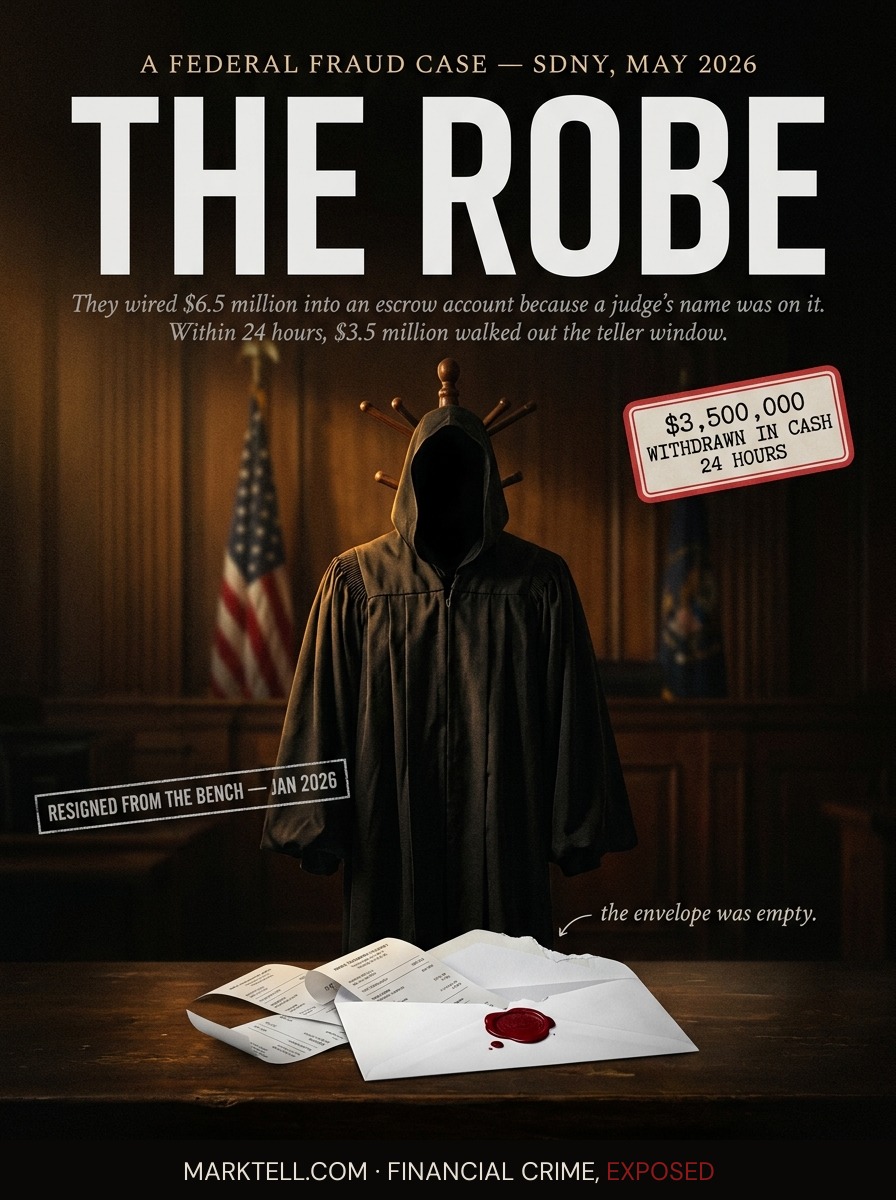
According to prosecutors, on February 26, 2025, investors wired approximately $6.5M into an escrow account controlled by former Justice Edward Harold King. Within twenty-four hours of the funds landing, the complaint alleges, two things happened.
About $3.5M was withdrawn at a teller window.
About $850K was transferred to a bank account belonging to Sam Sprei, the 37-year-old investor named alongside King in the indictment.
Read that slowly.
Three and a half million dollars, in cash or cashier's instruments, walked out of a bank through the standard customer-facing window. Not a wire to a vendor. Not a payment on a property. A withdrawal. The kind of transaction a teller files a currency transaction report for and a compliance officer eyeballs the next morning.
The complaint alleges the UCC auction the investors believed they were funding did not exist. No bankruptcy. No collateral sale. No filing in any docket the investors could have checked if they had thought to check, which they did not, because the account was in a judge's name.
That is the machine.
Not the wire. Not the withdrawal. The robe.
III.
Sam Sprei has been described in past civil filings as a younger associate of Chaim Miller, a Brooklyn investor with a long paper trail of his own. Sprei's name has appeared in real estate matters, in political fundraising circles, in the kind of overlapping ledgers that produce a reputation in a specific zip code and almost nowhere else. He is 37. He moves in rooms where deals are introduced by first name.
Edward Harold King sat on the Kings County Supreme Court bench. He resigned in January 2026 amid separate escrow allegations that prefigured the federal case. The resignation was the first visible tremor. The indictment in May was the structure becoming visible.
The pitch, as the government describes it, relied on a simple piece of behavioral math. An investor who would not wire $6.5M into a private escrow held by a 37-year-old promoter will wire $6.5M into an escrow held by a sitting judge. The judge does not need to say anything. The judge does not need to be in the room. The name on the account is the closing argument.
The Department of Justice put it this way: "Fraud that hides behind a veneer of legitimacy, especially the authority of a judge, strikes at the heart of public trust."
That is a true sentence. It is also a polite sentence. The blunter version is that the title was the instrument. The man in the robe was the lock pick.
IV.
In May 2025, three months after the wire, about $1.5M was returned to the investors.
This is the part of the pattern that experienced fraud investigators recognize immediately. A partial return is not a refund. It is a quiet move. It buys time. It mutes the loudest investor. It postpones the phone call to the FBI by a quarter or two, which is sometimes all a structure needs.
Marc did not get a full refund. Nobody in the complaint did. The remaining $5M, give or take, is not accounted for in the public filings available as of this writing. It went somewhere. Money always goes somewhere. The trail exists. The question, as always, is whether anyone is going to be allowed the time and the subpoena power to follow it through the bank records, the title companies, the second-tier accounts, and the cash that walked out the teller window in a city where $3.5M in withdrawals is unusual enough to leave a record but not unusual enough to stop.
Back in Paramus, Marc opened the docket search for the UCC auction he had funded.
There was no docket.
He searched the borrower's name. Nothing. He searched the property address he had been given over the phone. Nothing. He called the number on the deal sheet. It rang.
He sat at the desk with the paper ledger open and the laptop showing a search bar with no results, and he understood, in the slow way these things are understood, that the account name had been the whole product. The deal had been a label on an envelope. The envelope had been empty.
He did not call anyone for an hour. He just sat there.
V.
Sprei and King were arrested and charged with wire fraud conspiracy in May 2026. If convicted, each faces up to twenty years.
Allegation is not adjudication. Both men are presumed innocent. The complaint is a charging document, not a verdict. The defense has not yet been heard in full.
But the chronology in the public record is its own argument.
The wire on February 26, 2025.
The withdrawals within 24 hours.
The partial return in May 2025.
The resignation from the bench in January 2026.
The federal charges in May 2026.
That is a sequence. It is the sequence a fraud investigator sees in case after case, with different wallpaper. A trusted role. A pooled fund. A fast withdrawal. A partial refund. A quiet exit from the institution. A late indictment.
The wallpaper this time was a black robe.
VI.
Marc still keeps the paper ledger. He still writes amounts in pencil. He still underlines them.
He has stopped underlining the account names.
That is the small private thing the case took from him. Not the money, which he can absorb, slowly, over a few bad years. The reflex. The instinct that said a title on a bank account meant something. His father's instinct, the one about paper and screens, did not protect him. The instinct that protected him for thirty years was the wrong one for this room.
The escrow account had a judge's name on it.
That was the point.
- NJ.com | May 13, 2026 | "Former judge, developer charged with $6.5M real estate fraud in N.J."
- U.S. Department of Justice | May 2026 | Wire fraud conspiracy complaint, United States v. Sprei and King
- New York State court records | January 2026 | Resignation of Justice Edward Harold King, Kings County Supreme Court
- Federal complaint allegations re: February 26, 2025 wire of approximately $6.5M into King-controlled escrow account; subsequent $3.5M teller-window withdrawal and $850K transfer to Sprei account; approximately $1.5M returned to investors in May 2025
Editorial Notice
MarkTell is a true crime publication about financial fraud. Some scenes, dialogue, and sequential details are reconstructed from court filings, enforcement actions, news reports, and public records. Where the public record does not provide exact details, editorial reconstruction is used to convey the documented pattern of events. Names of private individuals may be changed to protect identity. All factual claims are sourced to public documents cited in the Evidence Trail above. MarkTell does not provide investment, legal, or financial advice. Nothing published here constitutes a recommendation to buy, sell, or avoid any investment. Allegations described in active cases have not been adjudicated and defendants are presumed innocent until proven guilty. Readers should conduct their own due diligence before making financial decisions.