The Eight Percent Fund paid eight percent. Until the day it paid nothing.
For three decades, Miles Burton Marshall did taxes for his neighbors in Hamilton, New York, and sold them shares in something he called the Eight Percent Fund. On June 11, 2026, a judge entered $85 million in judgments against him for 988 people who thought they had savings.
Marjorie kept the folder in the top drawer of the kitchen desk, behind the coupons and the warranty for the dishwasher. Tax returns going back to 1998. A few birthday cards from grandchildren she had not seen in a while. And the quarterly statements from the Eight Percent Fund, one for every quarter she had been an investor, stacked by year and held together with a binder clip.
She was seventy-one. She had worked the front office at the elementary school in Madison County for thirty-one years before she retired. Her husband had been gone six years. The Eight Percent Fund was supposed to be the part of her life that did not require thinking about.
The man who ran it did her taxes.
His name was Miles Burton Marshall. He had an office on a side street in Hamilton, the village in Madison County where Colgate sits on the hill and the rest of the town sits below. He was a tax preparer and an insurance agent. He had a license on the wall. He had been there since before her husband died, and before that too. People in Hamilton brought him their shoeboxes in February and March, and he gave them back a return and a number, and the number was usually fine.
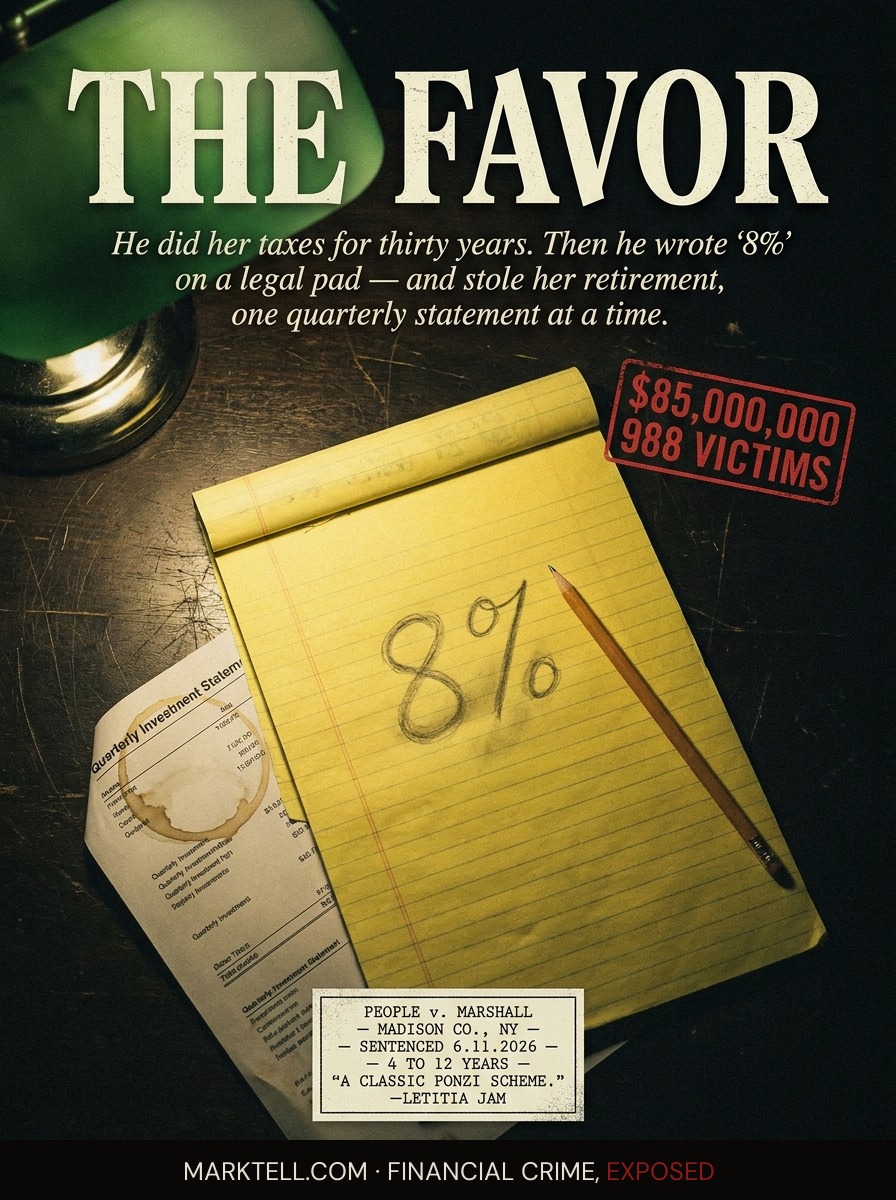
At some point, and Marjorie cannot now remember exactly when, Marshall began to mention, while sliding a return across the desk, that he also ran a fund. A small thing. Real estate. Eight percent a year. He wrote the number on a legal pad with a pencil, in case she wanted to look at it later. He always wrote it down. The pencil was a detail she remembered.
She wrote her first check in 2014. She wrote her last one in 2022.
On June 11, 2026, in a courtroom in Wampsville, Judge Rhonda Youngs sentenced Marshall, age seventy-four, to four to twelve years in state prison. The same morning, judgments totaling approximately $85 million were entered in favor of 988 people. The New York Attorney General's office, which brought the case, described it the way you describe these things when you are trying to be plain. "A classic Ponzi scheme." That is what Letitia James called it. That is what it was.
I.
A Ponzi scheme is a particular kind of machine. Here is what it does. New money comes in the front door. It does not get invested in anything. It gets handed to the people who put money in the front door earlier, who are told it is their interest, or their dividend, or their share of the profits. As long as more money comes in the front door than goes out the back, the machine looks like a fund. The statements look real. The eight percent shows up. The investor sees the number on the page and thinks, the man does what he says.
The machine has only one rule. It cannot stop eating.
When new money slows, the back door starts to drag. The checks go out late. The phone calls start. The operator pulls money from somewhere else, his other business, his own pocket, his next client, until there is no somewhere else. Then the machine stops, and everyone who was inside it at the moment it stopped finds out together that there was never a fund. There was a desk. There was a man. There was a pad of paper.
According to the Attorney General's office, Marshall ran this machine for three decades. He told his clients the money was going into real estate. It was going into restaurants and vacations and shopping, and into the older checks that had to keep clearing for the newer checks to be written. He stole more than $50 million in principal from 988 people. The interest he had promised them, the eight percent compounded across years, brought the total he owed them to roughly $85 million by the end.
II.
Picture the office.
A side street in a village of fewer than four thousand people. A waiting area with two chairs and a coffee table with last year's magazines. A desk with a green-shaded lamp. A framed insurance license. A computer that does the returns, and next to it a yellow legal pad where Marshall, when the conversation turned, would write the number 8 and a percent sign.
This is the part that matters. He was not a stranger. He was not a cold call. He was not a voice on the phone selling palladium to dentists, which is a different machine I know something about. He was the man you brought your shoebox to in March. He knew your dependents. He knew your deductions. He knew which of your kids was in college and which one was not speaking to you. He had watched your finances the way a doctor watches a chart, for years, and he had your trust the way doctors get trust, by being there and by not laughing when you asked the obvious question.
When a man like that mentions, while handing you a return, that he also runs a fund, you do not hear a sales pitch. You hear a favor.
Read that slowly. The fraud lived in the favor.
III.
Marjorie wrote a check for $40,000 in 2014. It was not all of her savings, but it was a piece of them that mattered. Marshall slid a one-page agreement across the desk. She signed it. She got a receipt. A few months later a statement arrived in her mailbox, on letterhead, with a number on it that was slightly larger than the number she had given him. The math worked out to eight percent annualized.
The next year, the same. The year after that, the same.
By 2019 she had added another $25,000. By 2022 she had added more. The statements kept arriving. The eight percent kept showing up. When she asked, once, what the fund was actually invested in, Marshall said real estate, and named a couple of properties she had driven past. She did not ask again. There was no reason to. The statements were arriving. The math was working. The man was the man who did her taxes.
This is the part I want you to sit with, because it is the part the machine is built on. The statement was a piece of paper. Marshall printed it himself. The number on it was not a record of anything. It was a promise written in the shape of a fact. And it arrived four times a year, on schedule, for almost a decade, into a kitchen on a quiet street in Madison County, where a woman who had worked the front office of an elementary school for thirty-one years kept it in a folder behind the dishwasher warranty.
The press release calls these people victims. They were. But before they were victims, they were neighbors, and that is the renaming that matters. This was not a fund. It was a neighbor-trust engine. The eight percent was the byproduct. The machinery was the relationship.
IV.
The machine became visible in March 2023.
Marshall filed for bankruptcy. The petition listed assets of less than $22 million against liabilities of more than $90 million owed to 988 creditors. Read those two numbers next to each other. Twenty-two against ninety. That gap is not a shortfall. That gap is the proof. There had never been a fund earning eight percent on real estate. There had been a pad of paper, and a man, and three decades of new checks paying old promises.
The Office of the United States Trustees got involved. The Village of Hamilton Police Department got involved. The Madison County Real Property Tax Services Department, which would know what real estate Marshall actually owned, got involved. The New York State Attorney General's Criminal Enforcement and Financial Crimes Bureau took the case. Assistant Attorneys General Andrew Tarkowski and Eleanor Biggers worked it, with Sean Bunny assisting.
On April 28, 2026, Marshall pleaded guilty. Grand Larceny in the Second Degree. Securities Fraud under New York's Martin Act, which is the state's old and powerful anti-fraud statute, the one that does not require proof of intent in the way federal securities law does. Scheme to Defraud in the First Degree.
On June 11, 2026, he was sentenced. Four to twelve years. Judgments entered for 988 people. The Attorney General's press release went out the same day.
V.
I want to tell you about the part of this that the press release does not get to.
Some of these 988 people are in their seventies and eighties. Some of them put their entire retirement into the Eight Percent Fund over the course of a decade or two, a check at a time, the way you put money into a savings account that pays slightly better than the bank. Some of them are now back at work. The New York Attorney General's office said so directly. Back at work in their seventies because the man who did their taxes spent their retirement on restaurants.
That part may be the saddest. Not the theft. The going back.
The bankruptcy estate will pay something, eventually, to some of them. It will not pay $85 million. It will not even pay $50 million. It will pay a fraction, distributed across 988 claims, after the trustee's fees and the lawyers and the years. For most of them, the judgment they received this week is a piece of paper that says what they were owed by a man who does not have it.
Marjorie's $40,000, and the $25,000, and the rest. They are not coming back. Not really. Not in time to matter to a woman who is seventy-one.
VI.
I have been in rooms where the pitch was the product. I sold platinum to people who picked up the phone in the 1980s. I sold timeshare contracts at hour five of the presentation, when nobody reads. I sold small-cap shares in a blimp company that did not make blimps. I know what the rooms look like. I know what the closers say after the customer hangs up.
Marshall's office was not one of those rooms. That is what makes this case the one I want you to read carefully.
He was not running a boiler room. He was running a tax practice. The fund was a sideline, mentioned across the desk, written on a legal pad. The pitch was not a pitch. It was a recommendation from the man who already knew your Social Security number. The closing technique was not urgency or scarcity. It was twenty years of being on time with your returns.
This is the machine that is hardest to see, because it does not look like a machine. It looks like a favor from a neighbor. It looks like the eight percent the bank will not pay you, offered by the man you already trust with everything else.
The Eight Percent Fund paid eight percent for thirty years.
Until the morning in March 2023 when the petition was filed, and the arithmetic finally caught up to the language, and 988 people in Madison County learned together that the statements they had been keeping in their kitchen drawers were never records of anything. They were the receipt for the favor.
- New York State Office of the Attorney General | June 11, 2026 | Press release on the sentencing of Miles Burton Marshall
- Yonkers Times | June 11, 2026 | "NY Tax Preparer Who Stole More than $50 Million Sentenced"
- Madison County Court | April 28, 2026 | Guilty plea, People v. Marshall (Grand Larceny 2nd, Martin Act Securities Fraud, Scheme to Defraud 1st)
- Madison County Court | June 11, 2026 | Sentencing, Judge Rhonda Youngs presiding
- U.S. Bankruptcy Court | March 2023 | Marshall Chapter petition listing assets under $22M against liabilities over $90M to 988 creditors
Editorial Notice
MarkTell is a true crime publication about financial fraud. Some scenes, dialogue, and sequential details are reconstructed from court filings, enforcement actions, news reports, and public records. Where the public record does not provide exact details, editorial reconstruction is used to convey the documented pattern of events. Names of private individuals may be changed to protect identity. All factual claims are sourced to public documents cited in the Evidence Trail above. MarkTell does not provide investment, legal, or financial advice. Nothing published here constitutes a recommendation to buy, sell, or avoid any investment. Allegations described in active cases have not been adjudicated and defendants are presumed innocent until proven guilty. Readers should conduct their own due diligence before making financial decisions.