The down payment was the product. The pool was the prop.
Tracy Davenport sold the dream of an inground pool to more than fifty Kentucky families. What she was actually selling was the down payment itself, and a federal judge just put a number on it.
Marcy stood at the kitchen island on a Saturday in the spring of 2022 and signed her name on a contract that was supposed to end a ten-year argument with her own backyard.
She was forty-four. A school nurse. Two kids who had spent every July of their lives at other people's pools. The backyard was a flat patch of Kentucky grass with a fence around it. She had refinanced the house the month before, pulled equity she had built across fifteen years of mortgage payments, and turned it into a number she could write on a check.
The check was the down payment. About half of the project total. The contractor had explained that pool work was front-loaded. Permits. Equipment. The excavator. The liner. You had to commit early, she was told, because the season was short and the crews were booked.
Marcy committed.
She wrote the check. She handed it across the island. The woman who took it had a binder of finished projects, photographs of decking and blue water and children jumping. The binder was real. The photographs were real. The pools in them existed somewhere in Kentucky.
Hers would not.
I.
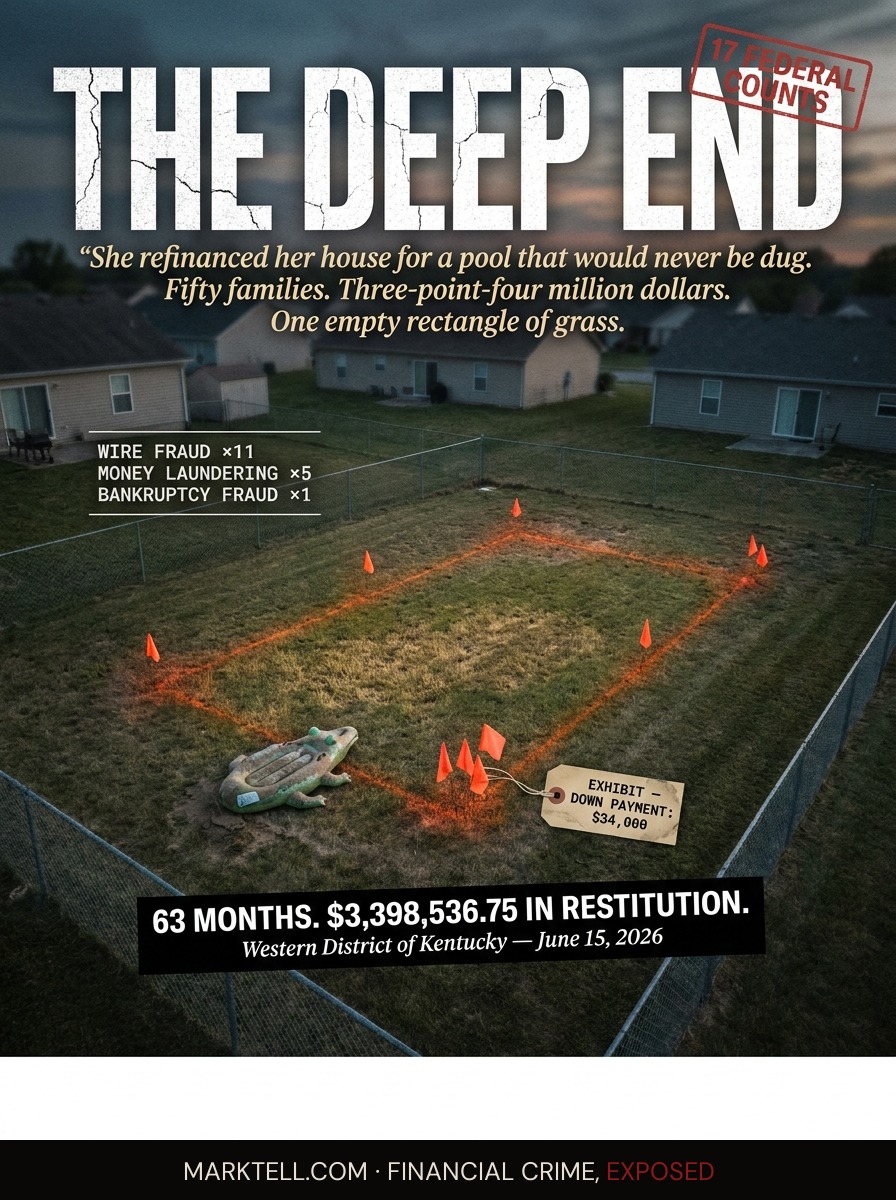
The contractor's name was Tracy Davenport. She is fifty-one. She lives in Louisville. On June 15, 2026, a federal judge in the Western District of Kentucky sentenced her to sixty-three months in federal prison and ordered her to pay $3,398,536.75 in restitution to more than fifty customers who had signed contracts and written checks between May 2021 and December 2022.
The charges, all adjudicated: eleven counts of wire fraud. One count of bankruptcy fraud. Five counts of money laundering.
Read that line again. Seventeen federal counts. One business.
The wire fraud counts are the deposits. Each one is a customer writing a check or sending a transfer for a pool that was not going to be built. The money laundering counts are what happened to the money after it arrived. The bankruptcy count is the door she tried to close behind her.
U.S. Attorney Kyle Bumgarner, announcing the sentence, said Davenport "repeatedly lied to victims all the while knowing she had stolen their money." The FBI's Olivia Olson called her a "ruthless business owner who intentionally defrauded customers." Those are prosecutors talking after they won. The court record is what makes them sayable.
II. The funnel.
A residential inground pool is one of the most expensive things a middle-class American family will ever buy that is not a house or a car. The industry estimates put a typical project north of fifty thousand dollars. The restitution math in this case puts the average loss per household at roughly sixty-eight thousand.
That is not a luxury number. That is a refinance number. That is a HELOC number. That is the number you reach by pulling equity out of the only asset most families own.
The machine here is simple. It has a name in contractor fraud literature, where it shows up over and over in different states under different company names. The down payment funnel. The pipe is open at the top. Customers pour money in. The pipe is closed at the bottom. Nothing comes out.
The funnel works because of how the pool industry is built. Permits cost money up front. Equipment costs money up front. The contractor's argument that she needs half the project cost before the dig is a true argument when the contractor is honest. The same sentence is the predator's first sentence when she is not.
You cannot tell which is which from the binder. The binder is the same.
What you can tell, sometimes, is the order of operations. An honest contractor pulls permits before she pulls money. A predator pulls money and then explains why the permits are taking longer than expected.
Marcy did not know to ask about that.
III. The wait.
The excavator was supposed to come in May.
It did not come in May. The reason given was rain. Then it was supposed to come in June. The reason given was a supplier backlog. Then July. By August the reasons had stopped being given because the phone had stopped being answered consistently.
In Marcy's backyard there were survey flags. Small orange plastic teeth in the grass, marking the rectangle where the pool would be. The flags faded. The kids stopped asking when the pool was coming. They started asking it the way they asked about Santa, with the suspicion that the answer was a lie that adults agreed to tell each other.
The HELOC statement came every month. The principal did not move. The interest did.
This is what financial fraud looks like from inside a family's life. Not a dramatic phone call. Not a moment of revelation. Just the slow conversion of a planned future into a debt that has to be paid for a thing that does not exist.
IV. The wall.
According to the indictment and the conviction record, Davenport used customer funds for purposes other than the construction the contracts described. The money laundering counts indicate the funds moved through accounts in ways designed to make their origin harder to trace.
Then she filed for bankruptcy.
This is the part that earned the separate count. Bankruptcy fraud, as a federal charge, is what happens when someone uses the bankruptcy code not as a refuge from debts they could not pay but as a wall between themselves and money they took. The court found that this is what happened here.
Picture what bankruptcy looks like to a customer who is owed a pool. You wrote a check eight months ago. You watched the excavator not arrive. You called your lawyer. Your lawyer told you that you had to get in line behind every other creditor. The line is long. The pool is not coming. Your money is not coming back through the company.
The company has been processed. The processor is still on the other side.
Marcy got a letter from a trustee. She filed a claim. She understood, eventually, that the claim was a number on a list, and the list would be paid from whatever the bankruptcy estate could recover, which was almost nothing.
That was when she stopped looking at the flags in the backyard. She did not pull them up. She just stopped looking.
V. The room.
The sentencing happened in a federal courtroom in Louisville on a Monday in the middle of June. Davenport got sixty-three months. Five years and three months. She will serve federal time, with three years of supervised release on the other side.
The restitution number is $3,398,536.75. Look at the cents. Federal restitution is calculated from the records. The cents are there because somewhere in the trial exhibits there are checks and wires and bank statements that add up to exactly that figure. The cents are the receipts.
Will the victims see the $3.4M? They will see some of it. Federal restitution is collected from whatever the defendant earns or owns, often for the rest of her life. It rarely closes the gap. The legal system is excellent at naming the wrong. It is poor at making the wronged whole.
Marcy will get a check eventually. It will not pay off the HELOC.
VI. The pattern.
This is not a Louisville story. This is a national story that happened to be prosecuted in Louisville this week.
Pool deposit fraud has been documented in Florida, where a contractor was recently convicted of taking nearly three million dollars from more than 150 homeowners. In Minnesota, a contractor pleaded guilty last September to a similar scheme that cost a dozen families over a million. The pattern is consistent. Take large deposits. Front-load the money. Stop returning calls. File bankruptcy when the calls become subpoenas.
The pool industry is, in most states, lightly regulated at the residential level. Licensing exists. Bonding exists. Enforcement is uneven. The same machine can be built in different states under different LLC names by different people, and the customer in the kitchen with the binder has very little public information available to tell her which contractor she is talking to.
The pandemic made the demand worse. Families stuck at home decided the backyard was the project. Demand surged. Supply did not. The gap between the two is the room the predator lives in.
This is the part where pattern recognition matters more than any single conviction. Davenport will go to federal prison. Another contractor, in another state, with another company name, is signing a contract right now at a kitchen island that looks like Marcy's.
VII. The flags.
The thing about a hole that was never dug is that it is invisible.
Marcy's backyard looks the way it did before. Grass. Fence. A flat rectangle where a pool was supposed to be. The survey flags are gone now. She pulled them in the fall of 2023, when she finally accepted that the rectangle was going to stay grass.
The HELOC is still on the books. The kids are older. They go to other people's pools.
When the sentencing news came across her phone this week, she read it standing in the same kitchen where she had signed the contract. The island was the same. The light was the same. The story had a number now. Sixty-three months. Three point four million. More than fifty households.
She was one of the more than fifty.
That was not the part that hurt.
The part that hurt was that she had been the one who held the pen.
The contract had said pool. The product had been the check.
- U.S. Attorney's Office, Western District of Kentucky | June 15, 2026 | sentencing announcement, U.S. v. Tracy Davenport
- WHAS11 | June 17, 2026 | "Louisville woman sentenced, ordered to pay $3.4M in swimming pool fraud scheme"
- FBI Louisville Field Office | June 15, 2026 | statement of Special Agent in Charge Olivia Olson
- IRS Criminal Investigation, Detroit Field Office | June 15, 2026 | statement of Acting SAC Bobby Kuszynski
- Federal indictment and judgment, U.S. District Court, Western District of Kentucky | counts: 11 wire fraud, 1 bankruptcy fraud, 5 money laundering
- Industry pattern reporting on residential pool deposit fraud schemes in Florida and Minnesota (2023-2025)
Editorial Notice
MarkTell is a true crime publication about financial fraud. Some scenes, dialogue, and sequential details are reconstructed from court filings, enforcement actions, news reports, and public records. Where the public record does not provide exact details, editorial reconstruction is used to convey the documented pattern of events. Names of private individuals may be changed to protect identity. All factual claims are sourced to public documents cited in the Evidence Trail above. MarkTell does not provide investment, legal, or financial advice. Nothing published here constitutes a recommendation to buy, sell, or avoid any investment. Allegations described in active cases have not been adjudicated and defendants are presumed innocent until proven guilty. Readers should conduct their own due diligence before making financial decisions.