The director's salary was forty thousand. The deluxe wrestling package was not.
Murielle Misczak ran the books at a German-language daycare in Brooklyn and rerouted tuition checks into accounts she controlled. She pleaded guilty this week. The receipts read like a fever dream.
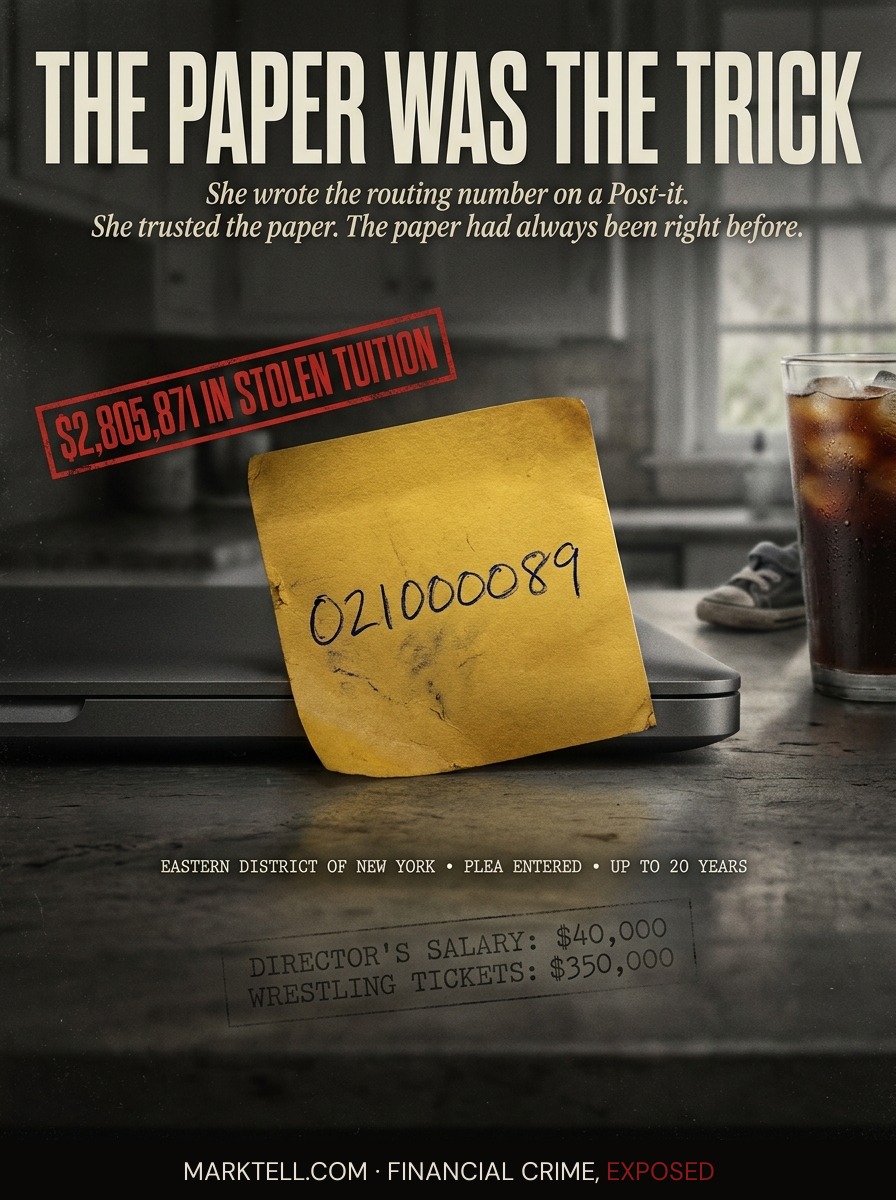
Hannah wrote the routing number on a yellow Post-it stuck to the side of her laptop. Her son was four. The preschool was German-immersion, two blocks from the F train, and the waitlist had been eighteen months long. The number on the Post-it had come in an email from the director. The email said something about a new processing account. Hannah did not read it carefully. She had a meeting in nine minutes and a kid in the next room asking where his shoes were.
She typed the number into her bank's transfer screen. She wrote KinderHaus in the memo line. She hit send.
That is the moment. That is where this story lives. Not in the courtroom in Brooklyn where Murielle Misczak entered her plea on Wednesday. In a kitchen in Park Slope, on a Tuesday morning, with a Post-it and a routing number and a mother who trusted the paper because the paper had always been right before.
The tuition at KinderHaus Brooklyn runs up to $4,450 a month. That is $48,000 a year. For a four-year-old. The school serves about a hundred kids. The math on a hundred families paying close to fifty thousand dollars a year is the math that makes this story possible. There was a river of money flowing through that daycare, and Murielle Misczak was the person who stood at the bend in the river.
She had been there since 2013. Hired as a program coordinator. Promoted to director in 2020. By 2025 her salary was $40,000.
Read that again.
Forty thousand dollars a year, running a school that processed several million in annual tuition. That is the gap the machine lives in. Not because every underpaid administrator steals. Most do not. But the structural fact of putting one person in charge of the money and paying her less than the families pay for a single child's seat is a fact worth holding up to the light.
According to the charging documents filed in the Eastern District of New York, between January 2022 and October 2025, Misczak rerouted tuition payments into accounts she controlled, then moved that money into her personal bank accounts. The total prosecutors put on the plea is over $2.75 million. The restitution figure ordered by the court is $2,805,871.
Here is where the money went, according to prosecutors:
Over $350,000 on professional wrestling tickets. Deluxe packages. The kind where her three children met the wrestlers backstage.
Over $600,000 on travel and entertainment.
Over $150,000 on ride-sharing.
Over $150,000 on food delivery.
Hundreds of thousands more on luxury goods.
Picture the receipts. Picture the WWE deluxe meet-and-greet photograph. Three children, a wrestler in trunks and boots, a backdrop with logos on it. Picture the Uber history. Picture the DoorDash order from a Tuesday in 2023, a salad and a cold brew, paid for by a parent in Park Slope who thought she was paying a teacher.
The mechanism was not exotic. It was a trick as old as bookkeeping. The director controlled the channel between the parent and the institution. She gave the parents new account numbers. The parents paid. The money landed somewhere the school did not see. Then, to keep the books looking the way the books were supposed to look, prosecutors say she went into the daycare's accounting system and deleted and altered the records.
That is the part that matters. Not the wrestling tickets. The wrestling tickets are the headline. The deletions are the machine.
The fraud was not discovered by an auditor. There was no auditor. The fraud was discovered in October 2025 by Simona D'Souza, the founder of KinderHaus, who started looking at numbers and found that numbers were missing. Misczak was terminated in December 2025. The civil suit followed. The arrest came in March 2026. The guilty plea came on Wednesday.
Hannah did not learn any of this from the school. She learned it from a parent group chat. Somebody posted a link to a wrestling news site. The headline was about the WWE tickets. Hannah read it standing in her kitchen, the kid asking for juice, and she felt the floor move a little.
She went back through her bank statements. She found the transfers. She found the Post-it, still stuck to the side of her laptop, the routing number in her own handwriting. She had written it down herself. She had sent the money herself. The trick had not been technical. The trick had been a piece of paper and a busy morning and a person she had no reason to distrust.
This is what the daycare embezzlement looks like from the parent's chair. It does not look like a heist. It looks like a logistics email on a Tuesday.
The prosecutors handling the case are Shannon Jones and Sophia Suarez, working under U.S. Attorney Joseph Nocella Jr. The FBI's New York Field Office, under Assistant Director James Barnacle Jr., ran the investigation. Misczak's attorney, Lowell Sidney, told reporters after the plea that his client was "accepting responsibility for what she's done." She faces up to twenty years. She will not get twenty years. She will likely get a fraction of that. The restitution order will likely be paid back at pennies on the dollar, if at all, because the money is gone. The money was spent. The money went to ringside.
Hannah's son is starting kindergarten in September. He does not know any of this. He knows the names of the wrestlers because the older kids at the daycare knew them. He thought knowing the names of the wrestlers was a thing kids at his school did.
That part may be the saddest.
The wider pattern is worth a sentence. The Department of Justice has been working through a wave of daycare-related fraud cases in the past eighteen months, most of them tied to federal nutrition and child-care reimbursement programs in Minnesota. The Misczak case is different in kind. There was no federal money involved. There were just parents. Parents who wrote checks. Parents who got the routing number in an email and did not call to verify because nobody calls to verify a routing number from the school their kid has gone to for two years.
The lesson is not that Hannah should have called. The lesson is that the school should have built a system where the director could not be the only person who saw the river.
There was no second signature. There was no outside bookkeeper. There was a director, a laptop, and access to the accounting software. That is not a fraud scheme. That is the absence of a control. The fraud scheme is just what fills the absence.
Hannah peeled the Post-it off her laptop the night she read the news. She held it for a second. Then she threw it away.
The routing number is in evidence now. Somewhere in a folder in the Eastern District of New York, in the case file marked United States v. Misczak, there is a list of accounts. Hannah's transfer is on it. So are about a hundred others. Each one a parent at a kitchen counter, on a Tuesday, sending a number to a number, believing the paper.
The paper was the trick. The paper was always the trick.
She made forty thousand a year. The wrestling tickets cost three hundred and fifty thousand. The gap between those two numbers is the entire chapter.
- U.S. Attorney's Office, Eastern District of New York | June 11, 2026 | Press release on guilty plea of Murielle Misczak
- United States v. Misczak | Eastern District of New York | charging documents and plea filing, June 2026
- KinderHaus Brooklyn v. Misczak | New York State Supreme Court, Kings County | civil complaint filed late 2025
- FBI New York Field Office | June 11, 2026 | statement from Assistant Director James C. Barnacle Jr.
- Fightful | June 11-12, 2026 | initial news coverage of guilty plea and WWE-related expenditures
- DOJ press materials on related daycare fraud cases | 2026 | Minnesota CCAP and nutrition program prosecutions (contextual only)
Editorial Notice
MarkTell is a true crime publication about financial fraud. Some scenes, dialogue, and sequential details are reconstructed from court filings, enforcement actions, news reports, and public records. Where the public record does not provide exact details, editorial reconstruction is used to convey the documented pattern of events. Names of private individuals may be changed to protect identity. All factual claims are sourced to public documents cited in the Evidence Trail above. MarkTell does not provide investment, legal, or financial advice. Nothing published here constitutes a recommendation to buy, sell, or avoid any investment. Allegations described in active cases have not been adjudicated and defendants are presumed innocent until proven guilty. Readers should conduct their own due diligence before making financial decisions.