The diagnosis was the product. The child was the billing code.
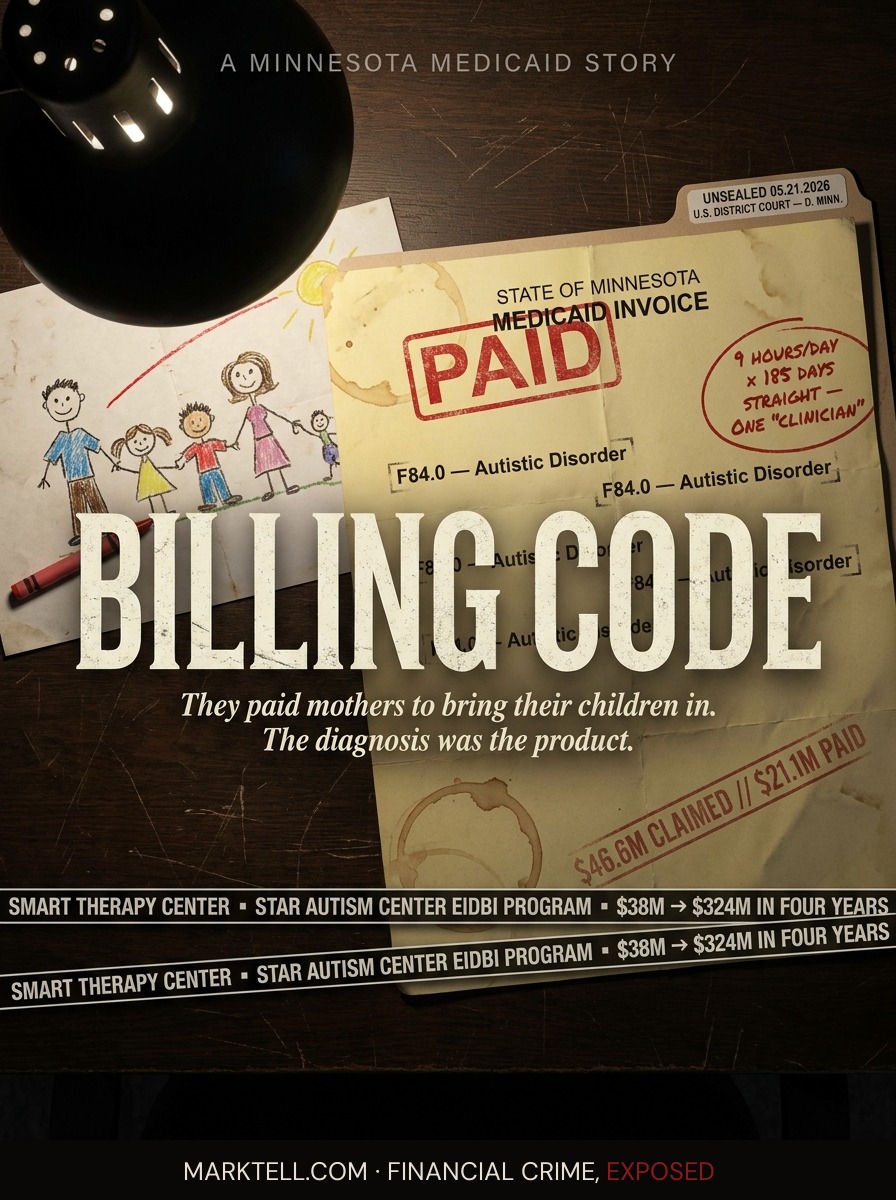
Federal prosecutors say two Minneapolis-area autism therapy centers turned a Medicaid program for autistic children into a billing engine, with one owner allegedly invoicing nine hours a day for 185 straight days. The grand jury indictments unsealed this week add two more names to a case that has already produced two guilty pleas.
Amina is thirty-four. She lives in a second-floor apartment off Lowry Avenue with her son Yusuf, who is three, who does not sleep through the night, who flaps his hands when the bus goes by and will not look at her when she calls his name.
A woman from down the hall told her about the center.
The woman said they help with kids like Yusuf. The woman said they would do the paperwork. The woman said there was money in it. Not a lot. Enough.
Amina took the bus to an office in a strip mall and sat in a waiting room with a television playing cartoons and a coffee maker that was not plugged in. A man with a clipboard asked her some questions. He asked them quickly. He wrote her answers down before she finished giving them. He told her Yusuf qualified. He told her the state would pay for therapy. He told her she would get a little something for bringing him in.
When she left, there was an envelope.
This is the part of the story the indictments describe. Not in those words. The indictments use the word "kickbacks." The indictments use the phrase "recruiting clients." The indictments say the businesses paid parents to enroll children whether or not the children had autism.
The indictments call this fraud against the Early Intensive Developmental and Behavioral Intervention program. EIDBI. A Medicaid-funded service for children under twenty-one with autism spectrum disorder. The program is designed to pay for hours of one-on-one therapy that, done correctly, can change a child's life.
Done incorrectly, it is a code on an invoice.
I.
The numbers in this case are not the biggest part of it. They are just the part you can count.
According to the federal charging documents, Smart Therapy Center in Minneapolis and Star Autism Center in St. Cloud submitted $46.6 million in claims to Minnesota's EIDBI program. They were reimbursed $21.1 million. Smart Therapy collected nearly $14 million between 2020 and late 2024. Star Autism, which opened in August 2020, collected around $6 million in roughly the same window.
Asha Farhan Hassan, the CEO of Smart Therapy, pleaded guilty to wire fraud in December 2025. She admitted to stealing the Medicaid money. She also admitted to taking another $465,000 from federal child nutrition programs through the same business.
Abdinajib Hassan Yussuf, the CEO of Star Autism Center, pleaded guilty to one count of wire fraud in March 2026.
On Thursday, May 21, 2026, a grand jury indictment was unsealed charging two more people, Shamso A. Hassan and Hanaan M. Yusuf, who prosecutors say were part owners of both centers. Those charges are allegations. The two have not been convicted.
The U.S. Attorney's Office, the FBI, the Department of Health and Human Services Office of Inspector General, and the Minnesota Attorney General's Medicaid Fraud Control Unit have all been part of the work.
That is what is on the page. The page is the easy part.
II.
Here is the harder part.
In 2020, Minnesota spent $38.1 million on EIDBI for the year. By 2024, the state was spending $324.9 million. The number of provider agencies went from around 150 to over 500.
Read that again.
A program for autistic children grew its annual cost by more than eight times in four years. The number of agencies billing it more than tripled. Nobody who watches state Medicaid spending sat in a chair somewhere in St. Paul and said, out loud, "this is what successful early intervention looks like." That is not what successful early intervention looks like. That is what a billing channel looks like when somebody has figured out how to open the valve.
The valve was the diagnosis.
To bill EIDBI, a child needs an autism diagnosis. Federal prosecutors allege the centers solved that by qualifying children who did not have autism. They allege the centers paid parents to bring those children in. They allege the centers then billed for hours of therapy that were never delivered, or were delivered by people with no training, or in schedules that did not exist in any version of reality.
The specific allegation that stops a reader is this one, from the charging documents: one owner billed for nine hours a day, for 185 straight days.
Picture it. Nine hours of one-on-one autism therapy. No weekends off. No holidays. No sick days. No travel days. 185 days in a row. By one person.
That is not a clinician. That is a spreadsheet.
III.
Amina did not know any of this when she walked into the office on Lowry.
She knew her son was struggling. She knew the rent was due. She knew the woman down the hall had said it was fine.
She brought Yusuf back twice a week for a few months. Sometimes there were other kids in the waiting room. Sometimes there was nobody. Sometimes a young woman would take Yusuf into a back room for an hour and bring him back out with a sticker on his shirt. Sometimes nobody took him anywhere and they just sat there until somebody waved at them from a desk.
She got another envelope. Then another.
When she asked once what kind of therapy they were doing, somebody told her it was the kind that helps with focus. Nobody used the word autism with her again after the intake. She had not asked them to.
This is how the machine recruits. Not with a lie the parent has to swallow. With a story the parent does not have to ask too many questions about. The check is the closing technique. The check is at hour five. The check makes the contract feel like a favor instead of a transaction.
The contract, in this case, was Yusuf's medical record.
That record now says he was diagnosed with autism spectrum disorder in the fall of 2023. That record will follow him to school. That record will follow him to every doctor he sees as an adult. The state, eventually, may correct it. May. The damage of a false diagnosis is not the kind of damage you fix by sending a letter.
IV.
This case did not appear out of nowhere. It came out of the Feeding Our Future case, the $250 million federal child nutrition fraud out of Minnesota that has produced dozens of convictions since 2022. Federal investigators have said that at least a dozen defendants from Feeding Our Future also owned or worked at autism centers.
The same hands moved from one program to another. The food program tightened up. The autism program was wide open.
That is the part to sit with.
Not the criminals. The criminals are predictable. They will find a program. They will find another program. They will find a third. The pattern in the record is that when one government valve gets shut, the same operators walk twenty feet down the hall and find another valve that is still open.
Minnesota has tried to close this one. In 2025, the legislature passed anti-fraud measures and created an Office of Inspector General. By late 2025, the state paused payments in fourteen Medicaid programs, including autism therapy, to audit who was actually doing the work. In June 2025, the state designated autism services as "high risk," which meant unannounced site visits and pre-approval reviews on claims.
This created a second problem.
Legitimate autism centers, the ones with real clinicians and real waiting lists and real children, started waiting ninety days for payments. Some could not make payroll. Some cut hours. Children who actually needed therapy started losing it because the state was now trying to figure out which of the five hundred agencies were real.
That part may be the saddest. The machine ran for four years. The kids who needed help paid for it on both ends.
V.
In April 2026, a federal audit found up to $600 million in potentially improper Medicaid payments for autism services across four other states. Indiana. Wisconsin. Maine. Colorado. CMS called on all fifty states to re-evaluate their providers.
Read that again too.
This is not a Minnesota story. Minnesota is the place where the investigators got there first. The same billing engine, with the same fuel, is sitting in the rest of the country waiting for somebody to look.
The fuel is a diagnosis. The fuel is a child. The fuel is the trust a parent places in a person with a clipboard who tells them the state has money for kids like theirs.
VI.
I worked phone rooms for years. Metals. Timeshares. Subscriptions. The product was never the product. The product was always the close. You learned which words made the customer pick up the pen. You learned which words made them hang up. You learned that the truth and the close were two different machines that sometimes used the same words.
The autism center is a phone room with a waiting room attached.
The pitch is the envelope.
The mark is the parent.
The product is the child's name on a billing form.
VII.
Amina stopped going to the center in the spring of 2025. She does not remember exactly why. She thinks it was because Yusuf seemed about the same, and the woman down the hall had moved, and the envelopes had started showing up less often.
She got a letter in early 2026 from the Minnesota Department of Human Services. The letter said her son's provider was under review. The letter said she might be contacted by investigators. The letter said her son's eligibility for services was being re-evaluated.
She put the letter on the kitchen counter. She put the envelope of intake paperwork next to it. She sat down at the table.
Yusuf was in the other room flapping his hands at the window.
She has not decided yet what she will tell the investigators. She has not decided yet whether the woman down the hall will be a name she gives them. She has not decided yet what happens when somebody asks her, out loud, whether she knew.
The thing she keeps coming back to is that nobody ever told her she was doing anything wrong. They told her she was helping her son. They told her the state wanted to help. They handed her the envelope and they said thank you for coming in.
That is the machine. That is how it eats.
A program written for children who needed it became a program written around children who could be billed for. Two of the people who ran two of the centers have pleaded guilty. Two more have been indicted. There are five more centers that were raided on May 1. There are forty-nine other states.
The diagnosis was the product. The child was the billing code. The parent was the pen at hour five.
- U.S. Department of Justice, District of Minnesota | December 2025 | Plea agreement, Asha Farhan Hassan
- U.S. Department of Justice, District of Minnesota | March 2026 | Plea agreement, Abdinajib Hassan Yussuf
- U.S. Department of Justice, District of Minnesota | May 21, 2026 | Grand jury indictment, Shamso A. Hassan and Hanaan M. Yusuf
- The New York Times / DealBook | May 21, 2026 | "2 Minnesota Autism Therapy Providers to Be Charged in $46 Million Medicaid Fraud Case"
- Minnesota Department of Human Services | 2024-2025 | EIDBI program expenditure data and provider counts
- Minnesota Office of the Legislative Auditor | 2025 | Anti-fraud legislative measures and OIG creation
- HHS Office of Inspector General | April 25, 2026 | Audit findings on improper Medicaid autism service payments in Indiana, Wisconsin, Maine, Colorado
- Centers for Medicare and Medicaid Services | April 2026 | Notice to all 50 states regarding provider re-evaluation
- Federal Bureau of Investigation, Minneapolis Field Office | May 1, 2026 | Coordinated raids on five additional autism service centers
Editorial Notice
MarkTell is a true crime publication about financial fraud. Some scenes, dialogue, and sequential details are reconstructed from court filings, enforcement actions, news reports, and public records. Where the public record does not provide exact details, editorial reconstruction is used to convey the documented pattern of events. Names of private individuals may be changed to protect identity. All factual claims are sourced to public documents cited in the Evidence Trail above. MarkTell does not provide investment, legal, or financial advice. Nothing published here constitutes a recommendation to buy, sell, or avoid any investment. Allegations described in active cases have not been adjudicated and defendants are presumed innocent until proven guilty. Readers should conduct their own due diligence before making financial decisions.