The diagnosis was Parkinson's. The prescription was the paperwork.
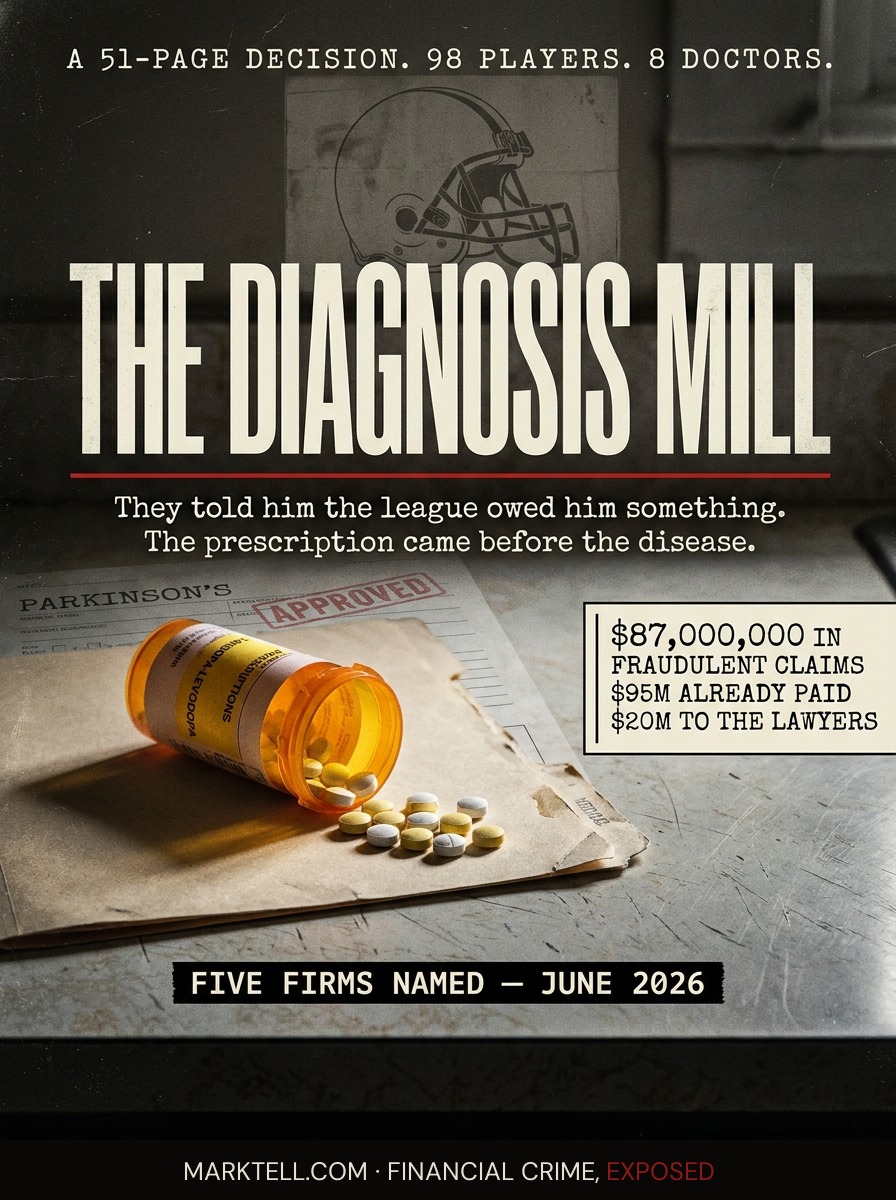
A 51-page decision from two Special Masters accuses five law firms of routing retired NFL players to unapproved doctors, harvesting Parkinson's diagnoses, and pulling tens of millions from a settlement built to last 65 years. The diagnosis was the product. The player was the inventory.
Reggie keeps the binder on the kitchen counter, next to the coffee maker, because that is where he stands every morning and that is when he remembers things. He is fifty-eight. He played seven seasons on the offensive line in the late eighties for a team that does not exist under that name anymore. Last Thanksgiving he could not remember his youngest grandson's name in the moment it mattered, and his daughter pretended not to notice, and that is when the binder started.
The binder has medical forms. It has a card from a paralegal. It has a printed map to a strip mall in a town an hour from his house, where a doctor he had never heard of saw him for forty minutes and wrote down a word that changes a man's life.
Parkinson's.
He had not gone looking for that word. The word came looking for him. A guy he played with had called. Said there was a settlement. Said there was a firm that knew how to walk you through it. Said the firm would set up the appointment, drive you if you needed, handle the paperwork. Said guys like them, with the headaches and the forgetting and the hands that did not always do what the brain told them, were owed something.
Reggie said yes on the phone. That part took maybe four minutes.
II. THE PIPE
The NFL concussion settlement was finalized in 2015 out of a class action brought by nearly five thousand former players starting in 2011. It was designed to last sixty-five years. It is uncapped, meaning the league pays what the qualifying diagnoses say it owes. To date the program has paid out more than $1.5 billion.
The payouts are tiered by diagnosis. Up to $1.5 million for early dementia. Up to $3.5 million for Parkinson's. Up to $5 million for ALS.
That is the pipe. A long pipe, sixty-five years long, with money in it, and a list of medical conditions that open the valve.
Now picture what a pipe like that looks like to a certain kind of operator. Not a player. Not a doctor. A firm.
III. THE DIAGNOSIS MILL
On Monday, June 8, 2026, two court-appointed Special Masters, David Hoffman and Jo-Ann Verrier, released a 51-page decision in the matter of the settlement program. The decision was made public on June 10. It accuses five law firms of an "organized scheme" to defraud the program.
The firms named: Douglas Grossinger, Attorney at Law. Feder Law, LLC. Pro Athlete Law Firm, P.A. Syme Law, PLLC. And Reppert Oates and Vytell, LLC, the firm associated with Bart Oates, the former NFL center turned attorney, who was named in the report.
The mechanism the decision describes is specific. According to the audit, the firms recruited retired players. They directed them to a set of doctors who were not on the program's approved-physician list. Those doctors diagnosed the players with Parkinson's. The doctors also prescribed medication that suppresses the symptoms of Parkinson's.
That last part is the move.
Here is why. The settlement program has anti-fraud safeguards. One of them is that the program's approved physicians do their own evaluations. But approved physicians can take into account a prior diagnosis and a prior prescription when they assess a player. If you walk in with a Parkinson's diagnosis already on paper and a bottle of carbidopa-levodopa already in your medicine cabinet, the approved physician has a thumb on the scale before he ever looks at you. The symptom-suppressing drug means the physical exam may not show the disease in the way it would otherwise. The prior diagnosis means the medical record looks settled.
The decision alleges the firms knew this. The decision alleges the doctors knew this. The decision alleges that together they ran a process designed to manufacture qualifying claims.
Read that slowly. The diagnosis was not a finding. The diagnosis was a product.
IV. THE NUMBERS
98 players are named in the audit's count of allegedly fraudulent claims.
$87 million in fraudulent claims total, by the decision's accounting.
57 of those claims were approved before the scheme was caught. Those approved claims paid out more than $95 million.
The law firms' share of that, in contingency fees, is estimated at about $20 million.
37 additional claims were pending. The decision recommends they be denied.
Eight specific doctors are flagged. Claims evaluated by them are recommended for denial as well.
That is the math. Read it once more. $87 million in claims. $95 million already out the door. $20 million to the lawyers off the top.
V. THE STRIP MALL
Reggie remembers the waiting room had a fish tank.
He remembers a paralegal he had met once drove him. He remembers the clipboard. He remembers the doctor was friendly and did not take very long. He remembers being handed a prescription on the way out and being told to fill it. He remembers being told the firm would handle the rest.
He filled the prescription. He took the pills. He did not feel different. He thought maybe that was how it was supposed to feel.
A check came later. Not to him directly. To the firm. The firm took its share. He got the rest. It was a number he had not seen in one piece in twenty years.
He did not ask the questions you are asking. He was a man who had been told for a long time that the league owed him something, and now someone was finally handing him something, and he took it.
The mark is not stupid. The mark is the reader. The machine was built to do exactly what it did to Reggie.
VI. WHAT THE RECORD ALREADY KNEW
This is not the first time the settlement program has been a crime scene. In 2021, the program ended the practice of "race-norming," which had assumed Black former players started from a lower cognitive baseline and made it harder for them to qualify for awards. Also in 2021, a Florida law firm was caught influencing doctors and forging records.
In September 2017, Judge Anita Brody, who oversees the settlement, expressed concerns from the bench about "deceptive practices" by claims service providers, lawyers, and lenders circling the fund.
Christopher Seeger, co-lead counsel for the players, has investigated and raised concerns about predatory practices before.
The pipe has been leaking for years. What changed this week is that two Special Masters put names on the leak.
VII. WHAT THE FIRMS ARE NOT YET
They are not, today, convicted of anything. The Special Masters' decision is a civil finding inside the settlement program. The Special Masters have the authority to refer their findings to federal authorities. They have not done that publicly yet. No criminal charges have been filed against any of the named firms or any of the named individuals.
This matters. Allegation is not adjudication. The five firms named have not had their day in a criminal court. Bart Oates has not had his day in a criminal court.
What has happened is this. A 51-page decision inside the program that controls the money has concluded, in writing, that an organized scheme existed. The decision recommends denying the 37 pending claims. It mandates a complete overhaul of the Parkinson's diagnostic process within the program. The NFL said it was "pleased" with the decision and hopes it will "deter future misconduct."
The league is the defendant in the original case. The league is also, now, the beneficiary of the finding. Sit with that for a second.
VIII. THE COST THAT IS NOT $87 MILLION
Reggie's binder is on the counter. He has not opened it in a few weeks. He saw his name was not in the news but he also saw a list of firms and one of them was the firm he used and his daughter showed it to him on her phone and he asked her to read it twice.
He still has the headaches. He still cannot always remember the grandson's name.
He does not know yet if his claim is in the 57 or the 37 or the rest. He does not know yet if his diagnosis was real or if the doctor in the strip mall handed it to him the way the firm handed him the paralegal and the map and the pen.
That is the part the audit does not measure. There is a man in Houston with a binder, and there are men like him in Tampa and Phoenix and Atlanta and a hundred other towns, and they do not know which of their diagnoses were findings and which were products. The machine that allegedly used them did not tell them. The doctors who allegedly diagnosed them did not tell them. The firms that allegedly drove them to the waiting rooms did not tell them.
For every actual sick player in the queue, the queue got longer this week. Every approved physician inside the program now reads every prior Parkinson's diagnosis with one eyebrow up. Every legitimate claim now sits behind the residue of the alleged scheme.
The diagnosis mill, if it ran the way the Special Masters say it ran, did not just take $95 million out of a sixty-five-year pipe. It put a question mark next to every sick player who is going to walk into an exam room for the next decade.
IX. THE PEN AT HOUR FIVE
I have sat in the rooms where contracts get signed. I have watched men with shaking hands sign documents they did not read because by the time the pen comes out the room has done its job. The room had the friendly voice. The room had the social proof, the guy from the team. The room had the authority figure in a white coat. The room had the firm with the letterhead. By the time Reggie was in that waiting room with the clipboard, the close had already happened on the phone with his old teammate.
That is not how good medicine works. It is how a sale works.
The Special Masters' decision is what happens when, every once in a while, somebody opens up the back of the machine and the wires are visible. Not down. Out in the open. For a minute.
The machine will be rebuilt. Different firms. Different doctors. Same diagnosis tier, or a different one, depending on which payout opens which valve. Sixty-five years is a long pipe. The operators have time.
Reggie does not. None of the men with the binders do.
The diagnosis was the product. The player was the inventory. The pipe was the point.
- The New York Times (DealBook) | June 10, 2026 | "How 5 law firms allegedly defrauded the NFL concussion settlement program"
- Special Masters David A. Hoffman and Jo-Ann M. Verrier | June 2026 | 51-page decision in NFL concussion settlement matter (made public June 10, 2026)
- U.S. District Court for the Eastern District of Pennsylvania | Judge Anita B. Brody | NFL Concussion Settlement docket; September 2017 remarks regarding "deceptive practices"
- NFL Concussion Settlement Program | public payout data; over $1.5B paid to date; 65-year settlement term; payout tiers (up to $1.5M early dementia, up to $3.5M Parkinson's, up to $5M ALS)
- Prior reporting on 2021 race-norming policy change and 2021 Florida law firm misconduct findings in the settlement program
- NFL public statement | June 2026 | League response to Special Masters' decision
Editorial Notice
MarkTell is a true crime publication about financial fraud. Some scenes, dialogue, and sequential details are reconstructed from court filings, enforcement actions, news reports, and public records. Where the public record does not provide exact details, editorial reconstruction is used to convey the documented pattern of events. Names of private individuals may be changed to protect identity. All factual claims are sourced to public documents cited in the Evidence Trail above. MarkTell does not provide investment, legal, or financial advice. Nothing published here constitutes a recommendation to buy, sell, or avoid any investment. Allegations described in active cases have not been adjudicated and defendants are presumed innocent until proven guilty. Readers should conduct their own due diligence before making financial decisions.