The detective who knew the paperwork was the lock and the key
John Bolden wore a shield by day and ran a tax prep franchise on the side. Federal prosecutors say he used the second job to feed the first one's friends, family, and clients into a pandemic relief program he knew nobody was watching.
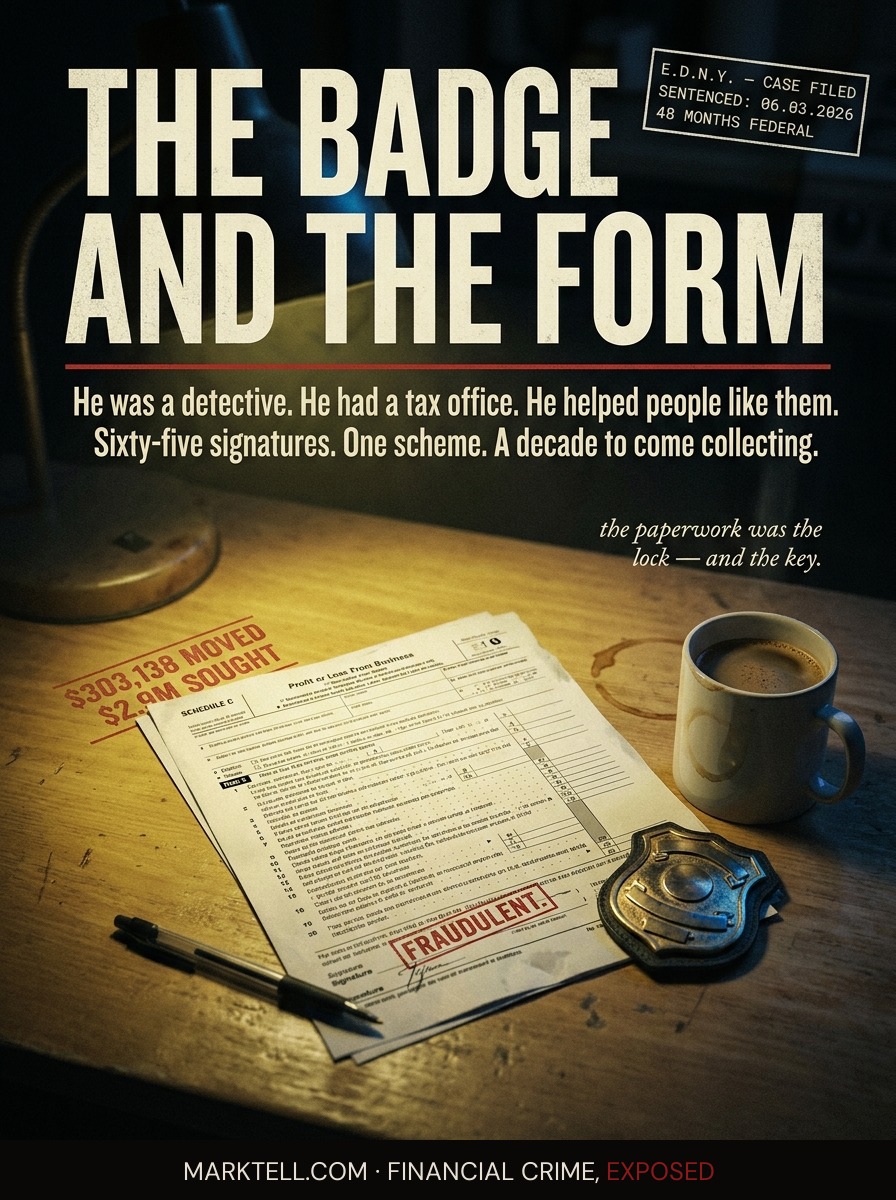
Marisol was fifty-two and tired in a specific way. Twelve-hour shifts changing bedsheets in a private home in Forest Hills. A grown son who had moved back in. A church friend who one Sunday in early 2021 leaned over the pew and said she knew a man who could help her get the COVID money. He was a detective. He had a tax office. He helped people like them.
That sentence is the whole story. He was a detective. He had a tax office. He helped people like them.
The paperwork arrived a few weeks later. Marisol sat at her kitchen table on a Tuesday night, a cup of instant coffee going cold next to a printed form she had never seen before. Schedule C. Profit or loss from business. The form listed a business she did not own and gross income she had never earned. The man on the phone had told her to sign where the tabs were. The money would come in a few weeks. The government wanted to help.
She signed.
She is a composite. The detective is not.
I.
The man on the phone was John Bolden. Forty-eight years old. Valley Stream. A sworn NYPD detective at the time, with ownership in a tax-preparation franchise on the side. The Department of Justice would later describe what he did between May 2020 and October 2022 in the flat language federal prosecutors use when they want a jury to be able to follow along.
He submitted online loan applications. The applications contained false and fraudulent information. He used his tax-prep franchise to generate fictitious IRS Form Schedule C documents. The Schedule Cs described employment, gross income, and net income that did not exist. He did this for himself. He did it for his co-defendants. He did it for more than sixty-five other individuals, including clients, family members, and NYPD co-workers.
The scheme sought to take nearly $3 million from the Paycheck Protection Program. It succeeded in moving at least $303,138 in PPP funds to borrowers who did not qualify for them. That is the figure the court ordered Bolden to repay in restitution. The court also ordered him to forfeit $112,002. Those are the numbers from the sentencing on June 3, 2026, in the United States District Court for the Eastern District of New York, before Judge Diane Gujarati.
Forty-eight months. Two years of supervised release after that.
Read those numbers slowly. He sought three million dollars. He moved three hundred thousand. He is going to prison for four years. The math of federal fraud sentencing is its own quiet language.
II.
The Paycheck Protection Program was built in a panic. Congress passed it in the spring of 2020. The premise was simple. Small businesses were dying. Workers were being sent home. The federal government would loan money to keep payrolls running, and if the money was used the way the rules said, the loans would be forgiven.
To get a PPP loan as a self-employed person, you needed to show one document above all others. A Schedule C. The form that says how much you earned from your own business in the prior year. The form Marisol had never filed in her life.
The vetting was minimal. That was the design. Speed was the point. The Government Accountability Office and the Small Business Administration's own Inspector General would later estimate that as much as $200 billion in PPP funds went to fraud. Seventeen percent of roughly $790 billion in loans.
Picture that. One in six dollars.
Inside that gap, a particular kind of operator went to work. The operator who already had access to people's tax documents. The operator who already knew how to fill out a Schedule C. The operator who could sit across a desk from a client and explain that this was just paperwork, that the government wanted them to have this money, that everybody was doing it.
The Department of Justice's COVID-19 Fraud Enforcement Task Force has now charged more than 3,500 defendants and recovered more than $1.4 billion. Bolden is one of those defendants. He is not the smallest. He is not the largest. He is the type.
III.
Here is what made him different. The badge.
In the courtroom, the prosecutors made the point in plain English. He was a sworn law enforcement officer. He brazenly took advantage of a COVID relief program. He used his position and his side business to help dozens of people, including NYPD co-workers, fraudulently obtain federal funds.
In the room where the documents were signed, the badge was the lock and the key. A client who walked into a tax-prep office to file an honest return walked out signed up for something else entirely, because the man who prepared the form was a detective. Detectives know what is legal. Detectives do not commit crimes in front of their own clients. Detectives are the people you call when you have been the victim of a crime.
That is what the badge did. It made the room feel safe.
Marisol did not know what a Schedule C was. She did not know what a PPP loan was. She knew her friend at church trusted this man, and her friend at church had received money from the government, and the man on the phone had a badge and a tax office and a calm voice. She signed where the tabs were.
She is now on the hook in ways that will take years to untangle. The PPP and Bank Fraud Enforcement Harmonization Act of 2022 extended the statute of limitations on PPP fraud to ten years. The lookback period is not closing. It is opening.
IV.
Bolden did not work alone. The indictment names co-defendants. The case is a small machine with visible parts.
Anthony Carreira, forty-three. Staten Island. Another former NYPD detective. He knowingly submitted false documentation for PPP funds. He was sentenced in March 2026 to time served.
Christian McKenzie, forty-eight. Wheatley Heights. Bolden's cousin. He fraudulently obtained a PPP loan himself, and according to the prosecution, he referred other applicants to Bolden in exchange for a share of the proceeds. He is scheduled to be sentenced on July 14, 2026.
That is the structure. A detective with access to a tax-prep franchise. Another detective willing to submit a fraudulent application. A cousin functioning as a referral channel, sending bodies through the door.
This is the part that should not be missed. The scheme did not need sophistication. It did not need shell companies in the Caymans or wire transfers through Cyprus or a fake hedge fund. It needed three things. Access to people who needed money. Access to a form. A reason for those people to trust the man holding the form.
The badge supplied the third thing. The franchise supplied the second. The pandemic supplied the first.
V.
The Eastern District of New York handled the prosecution. United States Attorney Joseph Nocella Jr. led the office. Assistant United States Attorneys Andrew D. Grubin and Eric Silverberg ran the case. The FBI investigated, alongside the Suffolk County Police Department, the SBA Office of Inspector General, the Federal Reserve's Office of Inspector General, the U.S. Department of Education Office of Inspector General, and the NYPD's Internal Affairs Bureau.
That is a long list of agencies for a scheme that moved $303,000. Read that list again. Six investigative bodies. One detective. One franchise. One paperwork machine.
The lesson is in the list. The PPP fraud cases are not being prosecuted because the dollar amounts shock the conscience. They are being prosecuted because the model scales. Bolden's scheme is one of thousands. The same template was running in tax-prep storefronts and back offices across the country for two years. The federal government is now walking backward through every one of those applications, document by document, signature by signature.
The ten-year statute of limitations means somebody who signed a Schedule C in May 2020 can still be looking at a federal subpoena in 2030.
VI.
Marisol got her money. Several thousand dollars. She paid her rent. She bought groceries. She gave some of it to her son. The money was gone in a season.
The letter came later. Not to her, not yet. To others like her. A formal envelope from a federal agency she could not place on a map. A demand for repayment. A reference number. A phone number that connects to a queue.
That is the cost the news stories do not measure. Bolden goes to prison for four years and pays $415,000 in restitution and forfeiture. The people whose names are on the loan applications carry the paper. Some of them did not know what they were signing. Some of them did. The federal government does not have to sort that out gently. It can come back for the money any time in the next decade.
The detective is going to a federal prison. The marks are going to keep checking the mailbox.
VII.
Bolden's guilty plea was on February 18, 2026. The sentencing was on June 3, 2026. The judge was Diane Gujarati. The sentence was 48 months in federal prison, restitution of $303,138, forfeiture of $112,002, and two years of supervised release. Those are the adjudicated facts.
Here is what is not in the sentencing memo. The badge that made it possible was issued by the City of New York. The franchise that generated the paperwork was a legitimate business. The clients who signed were not invented. They are real people, with real names, on real loan applications that the federal government can revisit until 2030 and beyond.
Marisol sits at her kitchen table in June 2026 and reads the news about a detective in Valley Stream going to prison. She does not recognize the name. The man who helped her did business as someone else. She is not sure if the man in the headline is the man on her paperwork. She tells herself it is probably not.
That part may be the saddest. She still does not know.
The machine was not the detective. The machine was the form, the franchise, the badge, and the panic. Take any one of those four away and the scheme does not run. Put them all back together under a new name in the next emergency and it runs again.
The detective got four years. The form is still on the IRS website.
- U.S. Attorney's Office, Eastern District of New York | June 3, 2026 | Sentencing announcement, United States v. Bolden
- U.S. Department of Justice | February 18, 2026 | Guilty plea, John Bolden
- LI Press | June 2026 | "Former NYPD detective and Valley Stream native sentenced for Paycheck Protection Program fraud scheme"
- DOJ COVID-19 Fraud Enforcement Task Force | ongoing | Aggregate enforcement statistics
- SBA Office of Inspector General | various | PPP fraud estimates
- PPP and Bank Fraud Enforcement Harmonization Act of 2022 | 2022 | Public Law extending statute of limitations
- U.S. Attorney's Office, District of South Carolina | May 28, 2026 | Settlement announcement (industry context)
Editorial Notice
MarkTell is a true crime publication about financial fraud. Some scenes, dialogue, and sequential details are reconstructed from court filings, enforcement actions, news reports, and public records. Where the public record does not provide exact details, editorial reconstruction is used to convey the documented pattern of events. Names of private individuals may be changed to protect identity. All factual claims are sourced to public documents cited in the Evidence Trail above. MarkTell does not provide investment, legal, or financial advice. Nothing published here constitutes a recommendation to buy, sell, or avoid any investment. Allegations described in active cases have not been adjudicated and defendants are presumed innocent until proven guilty. Readers should conduct their own due diligence before making financial decisions.