The delivery man at the door was the last private moment of his life
A federal indictment unsealed in the Northern District of California alleges three Tennessee men ran a violent home-invasion route through four California cities, targeting cryptocurrency holders and forcing one victim to transfer roughly $6.5 million in digital assets. The case is part of a global pattern security researchers now call wrench attacks.
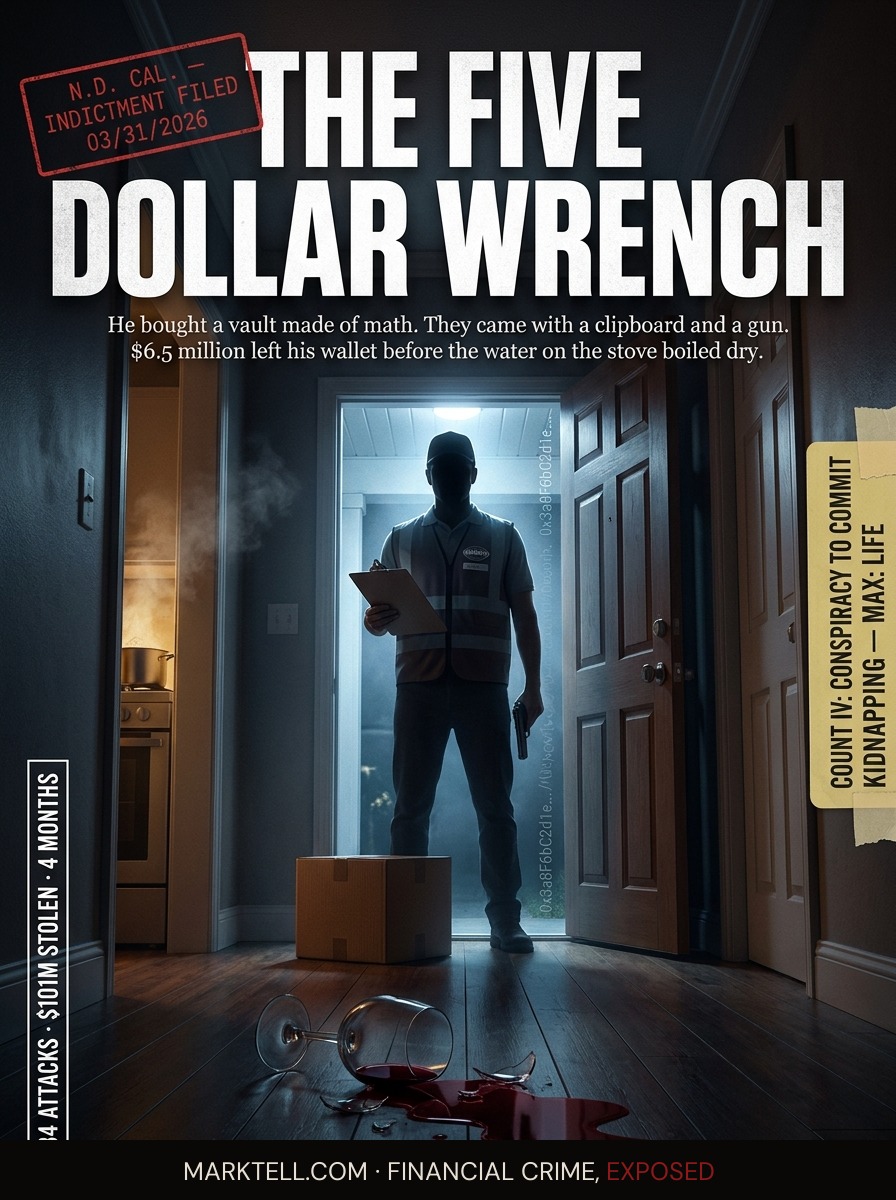
Daniel was making pasta when the doorbell rang.
He was thirty-eight. He worked from home most days, ran a backend team at a midsize company, and had spent the afternoon arguing with a junior engineer about logging frameworks. The water was almost at a boil. He had a glass of red wine open on the counter. The kitchen smelled like garlic and butter.
The doorbell rang again. Then a knock.
Through the peephole he saw a man in a delivery vest holding a clipboard and a brown box. No truck visible at the curb, but his street curved and the truck could have been just out of frame. The man on the porch looked bored, which is the look delivery workers wear.
Daniel opened the door.
What happened next, in the version of this story the U.S. Attorney's Office for the Northern District of California laid out on March 31, 2026, is the shape of a crime category that did not have a clean name five years ago. Security researchers now call it the wrench attack. The phrase comes from an old internet joke about cryptography. You can build an unbreakable encryption scheme, the joke goes, but the attacker does not need to break it. He just needs a five-dollar wrench and your kneecap.
The federal grand jury indictment names three men from Tennessee. Elijah Armstrong, twenty-one. Nino Chindavanh, twenty-one. Jayden Rucker, twenty-five. The charges include conspiracy to commit Hobbs Act robbery, conspiracy to commit kidnapping, attempted Hobbs Act robbery, and attempted kidnapping. The indictment alleges the three men targeted at least four cryptocurrency holders across San Francisco, San Jose, Sunnyvale, and Los Angeles between November 22 and December 31, 2025. In one incident, prosecutors allege, a victim was forced at gunpoint to transfer approximately $6.5 million in cryptocurrency to a wallet controlled by the co-conspirators.
These are allegations. Trial has not happened. The defendants are presumed innocent. Read that sentence twice. The legal system depends on it and so does this story.
I.
What the indictment describes is not a hack. There is no exploit, no smart-contract vulnerability, no compromised seed-phrase generator. The cryptography held. The blockchain did exactly what it was designed to do, which was to execute an irreversible transfer the moment the private key was used to sign it.
The attack is on the body that holds the key.
This is the part of the technology the marketing decks left out. A hardware wallet is a small device, smaller than a car key, that stores the private key offline. It is the safest place to keep crypto, because the key never touches the internet. It is also the worst place to keep crypto, because the key never touches the internet. There is no bank that can freeze the account. There is no customer service line that can reverse the transaction. There is no fraud department.
The thing you bought to get away from banks does not have the things banks have.
I built lending protocols for four years. I told people in Discord servers that self-custody was sovereignty. I meant it. I still mean parts of it. But sovereignty over your own keys means the attacker who wants your money has to go through you, the person, not through a vault made of legal process. The vault is your front door. The vault is whether you opened it.
II.
CertiK, the blockchain security firm, counted 34 verified physical attacks on cryptocurrency holders globally in the first four months of 2026. That is a 41 percent increase over the same window in 2025. The estimated losses across those 34 incidents reach roughly $101 million. France logged 41 crypto-linked kidnappings in the first three and a half months of the year. In April, French authorities charged 88 individuals across overlapping cases.
The numbers are doing something specific.
They are telling you the people running this play have figured out that the math works. A delivery vest costs eleven dollars. Zip ties cost less. The expected value of forcing one wealthy crypto holder to transfer his holdings is higher than the expected value of robbing a hundred convenience stores. The crime has scaled the way the asset class scaled.
The indictment in the California case alleges the crew used firearms, duct tape, and zip ties. It alleges they posed as delivery workers to get inside. That last detail is the one that should not leave you. Almost everyone reading this opens the door for a delivery worker every week. The pose is invisible because the pose is ordinary.
III.
Back to the hallway.
Daniel is on the floor. His phone is in his pocket and then it is not. The hardware wallet is in a safe in the second-bedroom closet. He gave them the code to the safe because a man with a gun asked him for it. The wallet is on the kitchen counter now, next to the wine glass, next to the pot of water that is still boiling because nobody turned the stove off.
They want him to sign a transaction. They have already opened a wallet on his laptop. They have already typed in the destination address. They want him to approve.
He approves.
This is the moment the architecture I helped build for years stops being elegant. The transaction broadcasts. It propagates across nodes. It is confirmed in a block. It is, by design, final. There is no rollback. There is no fraud department. There is, in the language of the protocol, no party with standing to reverse it.
Approximately $6.5 million leaves Daniel's wallet and enters a wallet the indictment says was controlled by the co-conspirators. From there, the FBI and IRS-CI are still tracing the flow. That investigation is ongoing. The court documents do not yet say how much, if any, has been recovered.
The water on the stove eventually boils dry. A neighbor will hear something later. That part is reconstruction. The wire is not.
IV.
Here is the ugly question.
How did they pick him.
The indictment does not say. The investigators are not going to say, at least not yet, because the answer probably implicates a data source they want to keep watching. But the industry has a short list of plausible vectors and none of them are comforting.
A leak from an exchange that held identifying information tied to wallet addresses. A public on-chain footprint that anyone with chain-analysis tools can read. A social media post showing off a gain, a profile picture in front of a recognizable house, a podcast appearance where the holder talked about their portfolio. A friend who talked to the wrong person at a bar. A property record cross-referenced with a Twitter handle.
The wrench attack does not require a hack. It requires a list.
If you are a high-value crypto holder, the list exists. The only variable is whether your name is on it yet.
V.
The mechanism here is simple enough to fit on an index card.
Identify a target with significant on-chain holdings. Locate the target's physical address. Approach the door in a costume the target opens for without thinking. Apply force until the target signs a transaction. Move the funds through mixers and exchanges before the chain analysts catch up.
The press release talks about sophistication. U.S. Attorney Craig H. Missakian called the scheme sophisticated, brazen, violent, and dangerous in his public statement. The sophistication is not technical. The sophistication is operational. It is in the route across four cities. It is in the costume. It is in the speed of the laundering. The technology being attacked is not the cryptography. The technology being attacked is the assumption that your house is not part of your security model.
VI.
Daniel sleeps in the living room now.
That is the part I cannot verify because Daniel is a composite, built from the four unnamed victims the indictment describes and the documented method of entry the prosecutors cited. But the shape of what survivors of these attacks describe in court filings and victim impact statements is consistent enough to render: the closet door stays open, the safe stays empty on purpose, the doorbell gets disabled, the deliveries get rerouted to a locker three miles away.
The money is one loss. The house is another.
The thing crypto was supposed to free him from was the bank. The thing it could not free him from was the front door.
VII.
If convicted on all counts, each defendant faces a maximum of twenty years per conspiracy to commit Hobbs Act robbery count, twenty years per attempted Hobbs Act robbery count, twenty years per attempted kidnapping count, and life in prison per conspiracy to commit kidnapping count. The case is being prosecuted by Assistant U.S. Attorneys Galen A. Phillips and Nicholas M. Parker, with investigation by the FBI, IRS-CI, and the San Francisco Police Department.
The trial date has not been set as of this writing. The defendants remain in federal custody.
The 2025 Minnesota case, where two brothers were federally charged in an $8 million crypto kidnapping in September, is the closest American precedent. The Evan Tangeman case, in which a 22-year-old California man was sentenced in April to 70 months for laundering at least $3.5 million in stolen digital assets as part of a $263 million crypto crime enterprise, is the closest American shadow. The shadow is bigger than the case in front of it.
VIII.
I want you to picture the hardware wallet on the counter.
It is the size of a USB stick. It cost about sixty dollars. It was supposed to be the answer. For years the answer to the question "how do I keep my crypto safe" was "buy one of these and store the seed phrase offline." That answer is still technically correct. It is also, in the country the indictment describes, incomplete.
The seed phrase in the safe is only as private as the address of the safe. The address of the safe is only as private as the holder. The holder is only as safe as the door.
The wrench has been there the whole time. The marketing decks left it out because it does not sell.
What changed in 2025 and 2026 is not the cryptography. The cryptography is the same cryptography. What changed is that enough people figured out the wrench works, and the route from Tennessee to a doorstep in Sunnyvale is shorter than the route through any vulnerability in the code.
The code was clean.
The door was the trapdoor.
- U.S. Department of Justice, U.S. Attorney's Office for the Northern District of California | March 31, 2026 | Federal grand jury indictment of Elijah Armstrong, Nino Chindavanh, and Jayden Rucker
- FinanceFeeds | May 2026 | "DOJ Charges 3 Men in $6.5 Million California Crypto Kidnapping Spree"
- CertiK | 2026 Q1 physical attack report | Wrench attack statistics, 34 incidents, $101M estimated losses
- TRM Labs | 2026 reporting on global wrench attack trends
- French authorities | April 2026 | Charges against 88 individuals in crypto-linked kidnapping cases
- U.S. Department of Justice | April 26, 2026 | Sentencing of Evan Tangeman to 70 months
- U.S. Department of Justice | September 2025 | Minnesota brothers indictment, $8M crypto kidnapping
Editorial Notice
MarkTell is a true crime publication about financial fraud. Some scenes, dialogue, and sequential details are reconstructed from court filings, enforcement actions, news reports, and public records. Where the public record does not provide exact details, editorial reconstruction is used to convey the documented pattern of events. Names of private individuals may be changed to protect identity. All factual claims are sourced to public documents cited in the Evidence Trail above. MarkTell does not provide investment, legal, or financial advice. Nothing published here constitutes a recommendation to buy, sell, or avoid any investment. Allegations described in active cases have not been adjudicated and defendants are presumed innocent until proven guilty. Readers should conduct their own due diligence before making financial decisions.